

Cocoa price surge from supply crunch leaving bitter taste for chocolate makers and consumers

COCOA has turned out to be a sweet treat for investors this year, but companies and consumers are reeling from the price surge even as market watchers warn that the commodity might be the latest to see prices remain higher for longer.
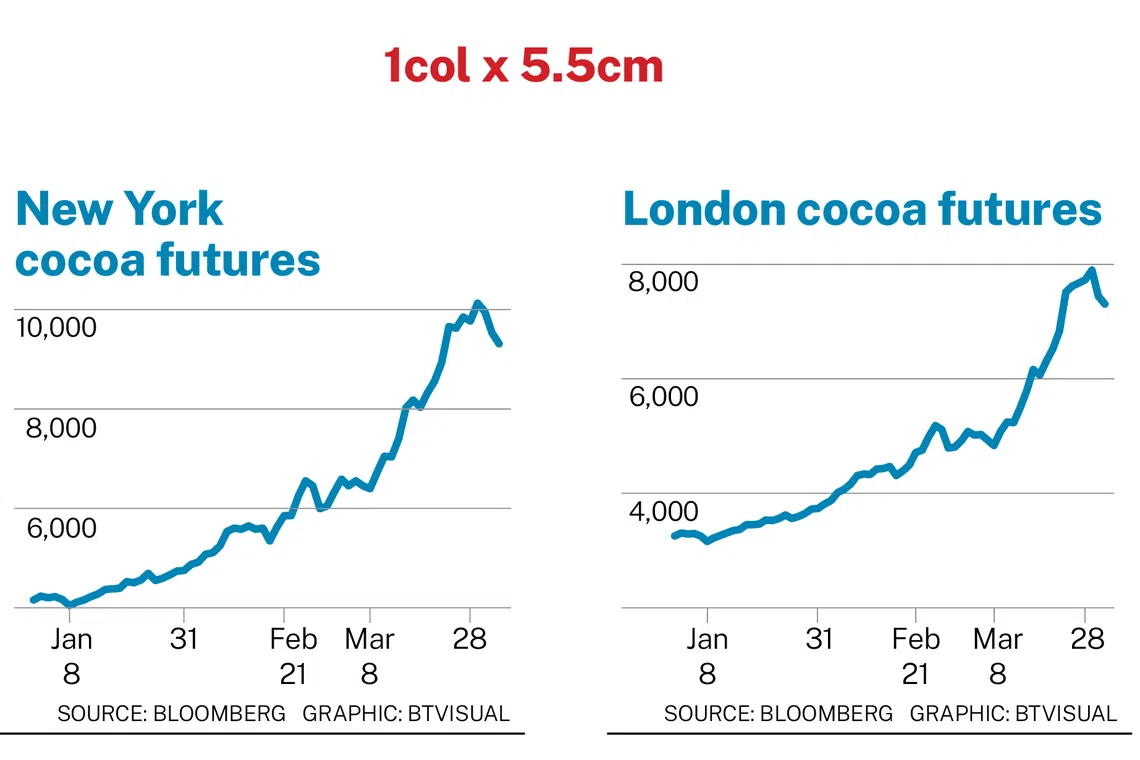
Supply concerns have caused cocoa futures in both the New York and London markets to rise this year, touching new record high levels.
Year to date, London cocoa futures are up 125.6 per cent as at Singapore market close on Apr 4, while cocoa futures in New York have risen 129.4 per cent. Over the past year, futures on the two exchanges have surged 275 per cent and 243.1 per cent, respectively.
According to a February report from the International Cocoa Organization (ICCO), high cocoa prices remain a “significant concern” due to a supply shortfall from Ivory Coast and Ghana – two of the largest cocoa bean-growing countries which together account for about two-thirds of global cocoa production.
Arrivals at the ports of the two countries are down 28 per cent and 35 per cent, respectively, compared to the previous season, ICCO said.
ICCO projected global cocoa supply in 2024 to decline 10.9 per cent year on year to 4.449 million tonnes. A supply deficit of 374,000 tonnes is expected this year, it added.
Short-term spikes in agri commodity prices are par for the course, as commodities are cyclical in nature and dependent on a number of factors such as demand, supply, and macroeconomic conditions. End consumers are often buffered from such spikes in prices.
However, chocolate consumers may not be shielded from the price increases this time, market observers warned, as the fallout from the supply crunch is likely to send shocks across the entire cocoa industry.
Aletheia Capital analyst Nirgunan Tiruchelvam said that chocolate makers could opt for a number of methods to manage the record cocoa prices, including selling a lesser volume of chocolates for the same price or cutting the amount of cocoa content in a chocolate product.
“There is no doubt that there will be a gradual increase in the prices of chocolates or it could be a dramatic increase,” he explained, adding that chocolate makers will either have to cut back on operating expenditure or raise the prices of their products to deal with the higher cocoa prices.
However, Tiruchelvam warned that in instances where an agri commodity sees an “unprecedented spike” in prices, there is a chance that prices could collapse should there be a renewal of production in producing countries – either sooner than expected or without warning.
Darren Stetzel, vice-president of soft commodities for Asia at financial services group StoneX, said that the high prices and costs will ultimately be passed down to the consumer. “We will see chocolate in supermarkets become more expensive and smaller in size, and cocoa substitutes, such as palm oil, will see higher demand to make up for a lower cocoa percentage in products,” he noted.
Stetzel warned that prices may not drop till the middle of next year if demand stays strong and the tightness in West African supply persists. “Tight supply and production deficit forecasts caused a period of panic buying,” Stetzel said, adding that production issues and the lack of cocoa beans are also causing shipments to be delayed. About 80 to 100 per cent of shipped volumes currently can be contracted at higher prices, he pointed out.
Chocolate makers brace for more pain
Companies, too, are bracing themselves for a lengthened period of higher costs and tighter supply of cocoa beans.
Singapore – one of the key countries in Asia for cocoa processing – is home to two chocolate companies: Barry Callebaut which has its regional headquarters here, as well as Aalst Chocolate which was acquired by Cargill in 2021.
When contacted by The Business Times, Barry Callebaut declined to provide specific details on how higher cocoa prices have impacted its productions and operations, and whether the company intends to raise prices for its products due to higher raw material prices. A spokesperson said that the company is currently in a “quiet period” in the lead-up to the release of its half-year results on Apr 10.
For the fiscal year ended Aug 31, 2023, Barry Callebaut saw its sales volume decline 1.1 per cent on the back of weaker customer demand and increasing raw material prices. The company said its free cash flow was “heavily impacted” by increases in raw material prices, particularly cocoa. This strongly affected its net working capital.
Aalst Chocolate could not be reached for comment.
For listed companies in Singapore, Olam Group’s food ingredients unit ofi has operations in the cocoa industry. The company did not respond to BT’s queries by press time. Confectionery maker Delfi also declined to comment.
Aletheia’s Tiruchelvam noted that the effect of higher cocoa prices on listed companies globally has been sporadic. There is “no uniformity” on listed companies so far – with some companies doing well and others faring badly.
Tiruchelvam said that Delfi’s margins “will definitely be affected” amid soaring cocoa prices, and Olam – which holds a substantial portion of cocoa that is traded globally – will have to deal with higher inventory levels that could put pressure on its balance sheet.
“It is difficult to pinpoint who, what and where, but a spike in a commodity to the tune of five times is likely to cause tremors across the entire market,” Tiruchelvam added.
Analysts raise forecasts
Analysts with coverage on cocoa are raising their forecasts as supply concerns continue.
Fitch unit BMI said that the industry is currently witnessing a “parabolic price trend”. “Intractable production issues” have also resulted in a marked tightening of the cocoa sector, it noted.
BMI on Mar 15 raised its average cocoa price forecast for 2024 to US$6,000 per tonne from US$3,750 per tonne previously.
Rabobank analysts, meanwhile, said that they reckon cocoa prices will stay higher for longer as systemic barriers to West African resupply are likely to keep the market “extremely tight” next season.
Rabobank’s forecast for cocoa prices in the second quarter stands at US$9,000 per tonne for New York futures and 7,500 pounds per tonne for London futures..






