

Construction companies must dig deeper to improve productivity amid rising temperatures
Besides focusing on worker safety, they can also look at quantifying impact of heat on productivity

AS RISING temperatures impede the progress of construction projects in Singapore, companies here can do more to raise worker productivity and must plan better across different silos to ensure that projects are completed in good time, experts say.
TBH Consultancy Asia director Meiske Sompie noted there are no lack of reports on loss of productivity due to heat stress, especially as temperatures rise.
For example, she said, an International Labour Organisation report in 2019 found that workers lost about half of their work capacity at temperatures of 33 to 34 degrees Celsius.
In October last year, the Ministry of Manpower (MOM) put in place additional measures to protect outdoor workers from heat stress.
The revised measures included additional rest periods for workers based on Wet Bulb Globe Temperature (WBGT) measurements, which takes into account air temperature, humidity, wind speed and solar radiation to indicate how hot the human body feels.
For outdoor labourers such as construction workers, a WBGT reading of 32 deg C and above is classified as high heat stress.
At that temperature, workers involved in heavy physical labour should be given at least 10 minutes to rest under shade every hour. If WBGT rises to 33 deg C, the recommendation is to increase the hourly rest breaks to a minimum of 15 minutes.
However, between March and June this year, MOM found that about a third of 250 workplaces inspected breached heat stress rules. Workplaces that breach these rules may be fined, or given notices of non-compliance and stop-work orders.
In 2023, the Meteorological Service Singapore (MSS) under the National Environment Agency found that there were 37 days of high heat stress when the hourly average WBGT hit 33 deg C or higher.
Under the Centre for Climate Research Singapore’s projections, they estimate that there could be 75, 87, or 113 days of such high heat stress days by 2059 under low, moderate or high emissions scenarios respectively.
Budgeting for safety
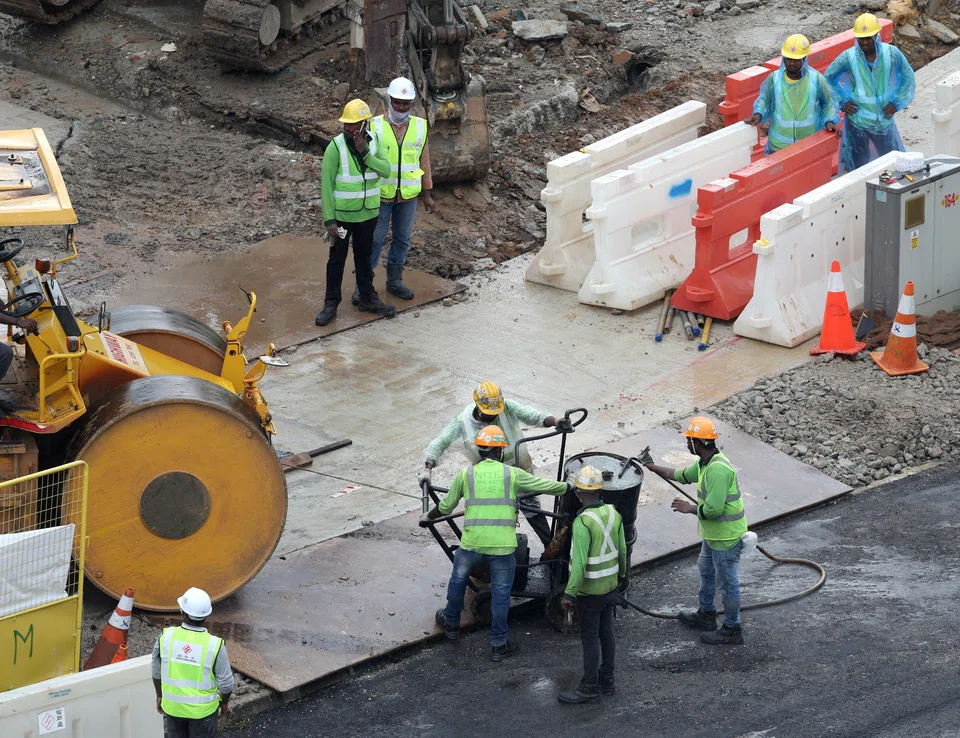
Soilbuild Construction Group chief executive Lim Han Ren said that productivity has been “slightly affected” by rising temperatures, as the company needs to let workers hydrate more frequently and rest under shaded areas.
He noted that common signs of worker heat stress include heat rashes, excessive sweating and irregular breathing, as well as decreased levels of consciousness.
“At times, we may need to rotate the workers’ work scope to minimise their outdoor exposure,” he said. “These have a certain degree of impact on site productivity, leading to slightly longer construction periods.”
Even so, tight construction margins have created little room for additional budgets to provide more training and safety to workers.
According to Sompie, about 1.5 to 3 per cent of construction budgets globally are allocated to safety and welfare. In Singapore, the figure stands at about 1 per cent, she said.
Still, she noted that the government has taken the lead on increasing the budget for safety-related criteria.
From April this year, MOM stated that government agencies will place a minimum weightage of 5 per cent for safety-related criteria in construction tenders with project sums of above S$1 million.
Sompie said: “That can be a good real difference…to make sure that part of the tender evaluation is not only on cost and time, but also to show a good track record about how you adopt and implement safety measures in your workforce.”
She added that additional training and technology could be used to augment worker performance so that they spend less time in the sun.
Collating data to measure performance
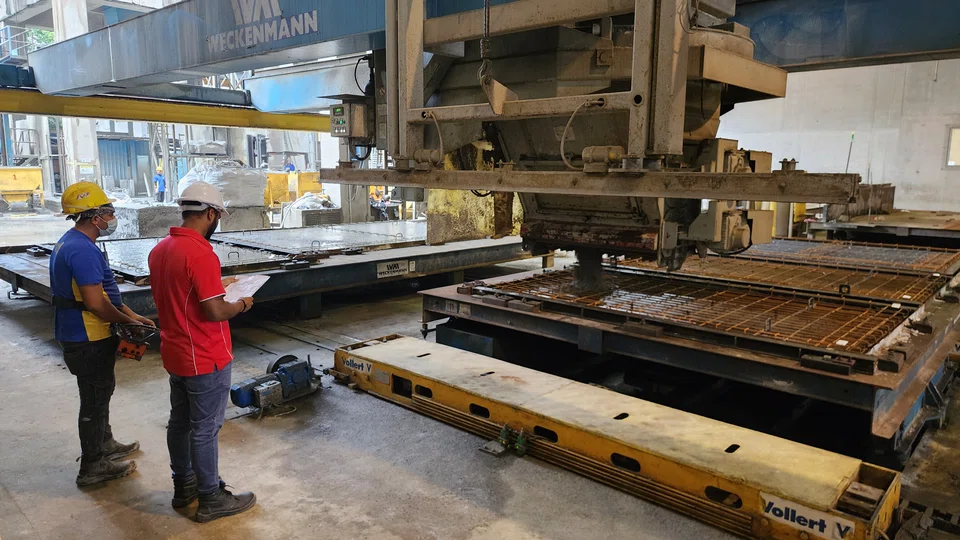
Construction company Tiong Seng Contractors corporate division head Kevin Seet said that it has adopted technology that has made the construction process more efficient.
For the installation of wall systems, he said that the company has replaced the use of a chain block with a dedicated machine instead.
“It was quite manual and more importantly, it was very dangerous (in the past),” he said, adding that this is one way in which the company is sourcing equipment to improve productivity and keep workers safe.
The company also plans for lifts to be installed at its construction sites so that workers do not need to manually carry heavy items, such as sandbags, up using stairs.
While more is spent on worker safety, companies should also do more to quantify the impact that heat has on the productivity of workers, said Kristian Steele, sustainable development consultancy Arup’s Singapore leader for climate and sustainability services.
He said that data points such as worker productivity, temperature and the characteristics of the operating site should be collated so that companies can see how performance is negatively impacted as the weather gets warmer.
“There’s a lot of uncertainty and questions in this subject area now,” he said.
“If there was sufficient data here…the benefit of dealing with this issue is in terms of productivity and in terms of ultimately keeping to your programmes and keeping your revenues flowing.”
TBH’s Sompie said that the real game changer could be when companies collaborate more closely under a new collaborative contracting model piloted for public sector projects.
Under the model, different industry players will collaborate from the moment they tender for contracts. These parties include architects, engineers, contractors and facility managers.
She said that such models are common in Australia, where risk sharing and risk identification are a key focus in the beginning, as opposed to transferring all the risk to the general contractor that tenders for a project.
Streamlining regulatory approvals
Furthermore, Sompie said that the industry faces the challenge of getting the appropriate approvals from different agencies. There could be at least 20 processes that companies need to clear with the Building and Construction Authority (BCA) before they can get full approval for the construction of a building, she added.
Once some construction companies get the initial approvals required to get a project up and running, Sompie said that they may start work to help things progress faster. However, they run the risk of additional changes required to receive further approvals.
“Along the way, there (could be) design changes or feedback…it does create a bit of rework from the company’s point of view,” she said.
She noted that BCA and the Urban Redevelopment Authority are working on an initiative called Corenet X, which should help to streamline the approvals process.
While such changes are happening at higher levels, companies are also working on the ground to manage expectations on productivity and ensure worker safety.
For example, Tiong Seng’s Seet said the company works with clients to flag certain complex architectural designs that take longer to build and cost more as they need to be cast on site instead of being pre-fabricated.
“We have also been very fortunate to meet a lot of clients who are actually willing to hear us out and have been very receptive to these ideas because really, there’s a win-win situation for both parties,” he said.






