Construction companies need to collaborate and plan better as demand climbs
Poaching and project delays could plague the sector as it faces a greater strain on manpower and resources

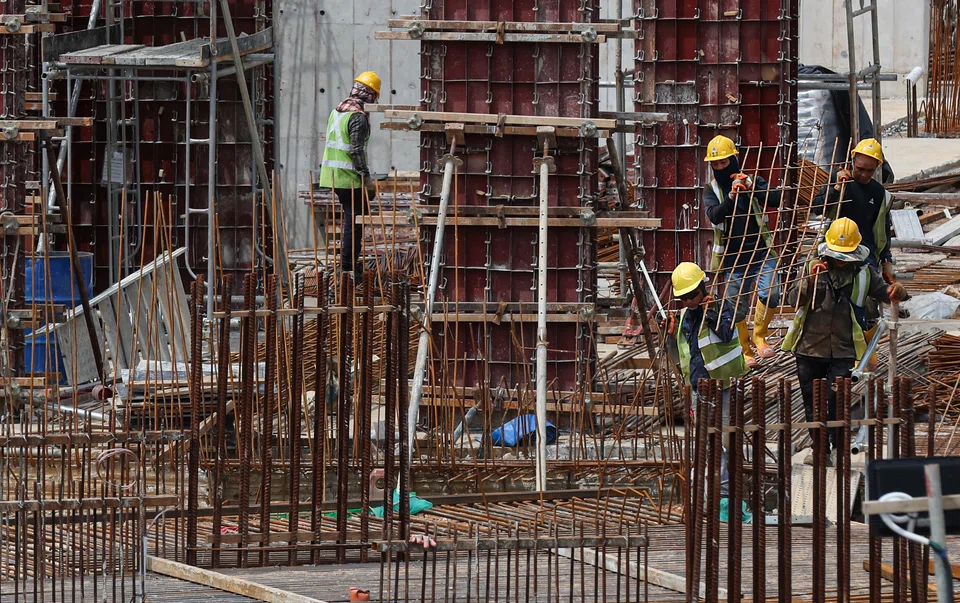
STRONG growth in construction demand is expected to further strain demand for manpower and resources.
Without better planning and collaboration among stakeholders, issues such as poaching could become more significant in 2025 and margins could come under pressure.
On Jan 23, the Building and Construction Authority (BCA) said the total value of construction contracts could come up to S$53 billion in nominal terms, almost 20 per cent higher than the S$44.2 billion posted in 2024.
Singapore Contractors Association president Lee Kay Chai noted that the increased demand would suggest that the sector will need 20 per cent more manpower, too.
“We have been pre-empting our members about the surge (in demand that) is going to happen,” Lee said.
“The solution is you have to plan early and bring in qualified workers from overseas, but if the time comes (and) you can’t bring in these people, then we will have a lot of poaching problems,” he said, adding that projects can suffer if their staff are poached.
He also encouraged companies to bid according to their capabilities and own estimations, rather than chasing lower prices.
The advice comes amid an increase in Chinese players seeking to win local bids with “challenging” prices as their own domestic market suffers, Lee said.
“If we miss a job, forget it. The next one will come, so I’m very glad that the demand is up so we have more opportunities,” he said.
During a panel discussion at the BCA-Real Estate Developers’ Association of Singapore (Redas) Built Environment and Real Estate Prospects Seminar 2025 held on Jan 23, BCA chief executive Kelvin Wong also encouraged companies to differentiate themselves by identifying their unique competencies.
“If your product and services are not differentiated, then we all suffer under price pressures,” he said.
Planning and partnerships
Construction players across the industry will also need to improve the way they plan and work on projects.
At the BCA-Redas seminar, ADDP Architects senior associate partner Markus Cheng said that architects will have to manage their design processes more tightly.
“Architects like to change (designs), we never stop designing... because of that, it causes a lot of downstream problems,” he said.
He added that with the new Corenet X platform, designs need to be uploaded upfront. This will force architects to finalise their designs earlier in the process.
Corenet X is a platform that BCA is implementing to consolidate the process of getting approvals from various authorities.
To give companies more time to familiarise themselves with the platform, BCA announced on Jan 23 that Corenet X will be mandatory for all new projects with a gross floor area of 30,000 square metres or larger from Oct 1, 2025. Previously, BCA had said that all new projects were supposed to be submitted via the platform from Apr 1, 2025.
Meanwhile, TBH Consultancy director Colin Bullock said that the increase in demand for limited resources will require companies to plan ahead and build in buffers for their projects.
For instance, construction of Changi Airport’s Terminal 5 could drive up demand for equipment such as piling rigs. The terminal alone could require about 80 piling rigs for the next two to three years, which would otherwise be used for the construction of housing or commercial properties, he said.
Greater demand can lead to price increases for equipment rental as well, especially for shorter projects. A contractor renting out equipment for six months may have to pay a premium over another contractor renting out equipment for four years, he said.
Bullock’s advice to contractors is to plan ahead and manage their risk.
In a hypothetical site where 100 piles take two days each to install, he is asking contractors to consider if their construction programmes will be adversely impacted if each pile takes two and a half days to install instead.
“The knock-on effect is that that piece of equipment might have actually been proposed for another one of your sites, so they’re now 25 per cent delayed, too...
“It’s people realising that there is merit in being sensible about risk management with regard to the programme of works,” he said.
Construction consultancy Linesight South-east Asia’s regional director Scott Halyday said that while this is a prosperous period for most stakeholders in the industry, everyone should capitalise on that and collaborate more.
He said that there has been more talk around collaborative contracting, which BCA is encouraging construction stakeholders to adopt. It hopes that this form of contracting will get stakeholders, such as developers, contractors and consultants, to come together and better allocate the risks and rewards of different projects, instead of taking a more traditionally adversarial approach.
“You need to be... confident in sharing the risk and the reward, and work in a nature that no one’s left out to dry, so to speak,” Halyday said.
Similarly, BCA’s Wong said that contractors should think about working with good customers to forge long-term partnerships and execute their plans sharply.
During one of his surprise visits to local worksites, he noticed contractors spending a lot of time testing and sealing windows at height, even though these units could have been checked at ground level when they were precast.
“If you trace back some of these inefficiencies, you save (on) a lot of workers’ (time),” he said.
He added that while everyone will face the same labour constraints and market volatility this year, this will be a “great season” for the industry as demand rises.
“If in bad times we can’t change and in good times we can’t change, we can never change, so we should change,” he said.