

7-Eleven operators in Singapore, Thailand chow down on ready-to-eat segment
Strategy has potential to drive growth and can counter tobacco and alcohol sales being affected, say analysts

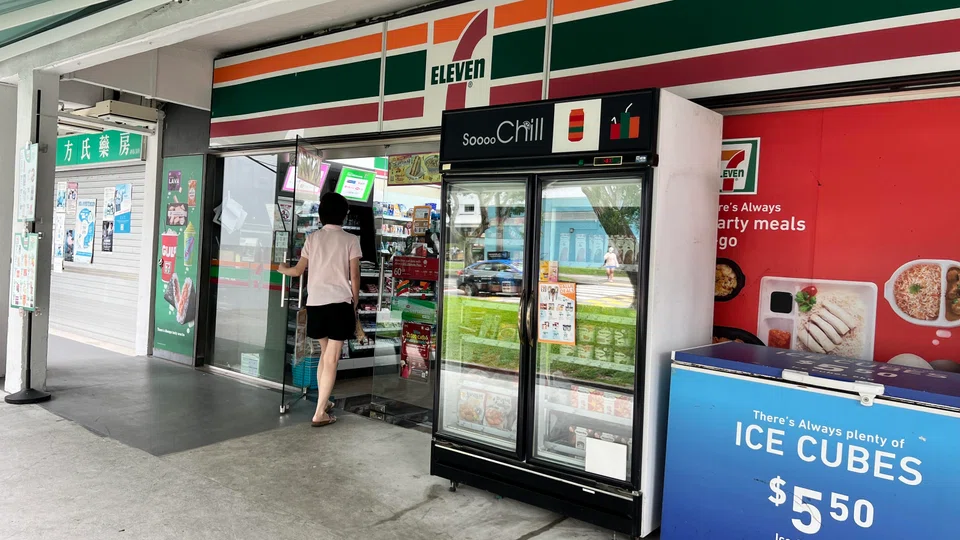
THE 7-Eleven brand of convenience stores is a familiar sight in this part of the world. But the publicly listed operators of the chain in Singapore and Thailand are jostling for the stores to be seen less as a nearby place to pick up cigarettes and beer – and more as “quick-service restaurants”.
The term was floated by Scott Price, the group chief executive of Singapore-listed DFI Retail Group, at an earnings call in August. And it has stuck.
DFI, a multi-format retailer that counts CS Fresh, Giant and Guardian under its brands, also operates 7-Eleven stores in Singapore, Hong Kong, Macau and China’s Guangdong province.
It is looking to elevate its offerings at its 7-Eleven stores with more ready-to-eat options, in an attempt to drive growth in its convenience segment. These refer to packaged food products that have been pre-cooked and are ready for consumption.
It is a strategy that appears to be working for other 7-Eleven franchisees in the region.
In Thailand, 7-Eleven operator CP All – owned by Charoen Pokphand Group (CP Group), one of the largest conglomerates in the kingdom – has also been homing in on ready-to-eat food as it aims to cement its position as market leader there.
Thailand-listed CP All also trades on the Singapore Exchange as a Singapore depository receipt.
Notable differences
According to RHB Singapore senior research analyst Alfie Yeo, DFI’s 7-Eleven outlets are concentrated only in key cities such as Singapore, Hong Kong and Guangzhou in China. In comparison, CP All’s outlets are distributed throughout Thailand, in both key cities and smaller towns.
Meanwhile, DBS analysts Andy Sim, Chee Zheng Feng and Nantika Wiangphoem noted that 7-Eleven’s contribution to each of these two companies is different due to their other businesses and geographical presence.
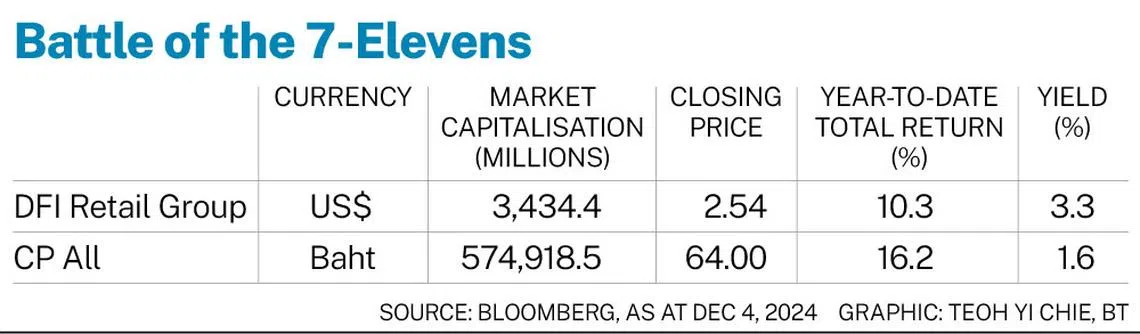
Sim and Chee estimated that 7-Eleven accounted for 24 per cent of DFI’s operating profit in the 2023 financial year, excluding the impact from international financial reporting standards (IFRS) and head-office costs.
For the year ended December 2023, DFI reported an operating profit of US$212.1 million before IFRS effects, 59.2 per cent higher than the US$133.2 million in the year-ago period.
Operating profit for its convenience segment was US$87.7 million, up 73.7 per cent on year from US$50.5 million.
Meanwhile, Krungsri Securities analyst Yuwanee Prommaporn said that 7-Eleven generally contributes about 50 per cent to CP All’s financials.
DBS analyst Nantika estimated that for the nine months ended Sep 30, 2024, 7-Eleven accounted for around 78 per cent of CP All’s net profit.
The company had posted a nine-month net profit of 18.2 billion baht (S$704.9 million), a 39.9 per cent increase from 13 billion baht year on year.
This figure is already close to the full-year net profit of FY2023, which was 18.5 billion baht.
Expanding offerings
Given that both are franchisees in their respective markets, their offerings are “relatively similar”, excluding products catering to local tastes, said analysts.
Both, however, appear to be banking on ready-to-eat products to propel growth.
RHB Singapore’s Yeo said that a shift towards ready-to-eat food could be due to convenience stores’ tobacco sales being affected by alternative tobacco products and timing restrictions on alcohol sales.
Focusing on the ready-to-eat segment also allows the stores to expand its offerings from smaller snacks to full meals and other types of beverages, he added.
DBS’ Nantika noted that CP All’s Thai 7-Eleven operations appear to be positioning itself as a food destination.
“Over time, its (plan) is to push a higher mix of ready-to-eat and ready-to-drink products, which generally yield high margins and remain their key competitive (advantage) over other convenience operators in Thailand,” she said.
She added that the ready-to-eat segment accounts for 28 to 30 per cent of 7-Eleven’s quarterly sales.
RHB Singapore’s Yeo noted: “Convenience stores cater to consumers seeking on-the-go products and services. Therefore, ready-to-eat products are logical offerings, as they capture the impulse-consumption appetite of customers who are on the go, or demand a quick meal.”
For DFI’s 7-Eleven stores, the ready-to-eat element may be more concentrated in select markets under the group’s portfolio.
Jayden Vantarakis, Macquarie Capital’s head of Asean equity research, said that since the 7-Eleven stores in Singapore and Hong Kong are generally small and located in high-traffic spaces, they may not have the space for customers to eat meals on the premises.
“However, Guangdong’s focus is more on ready-to-eat, with space available to consume in the store,” he noted, adding that they offer hot food options as well.
DBS’ Sim and Chee believe that Guangdong is a key focus region due to the market size and sizeable growth, but pointed out that DFI is also making ready-to-eat options more accessible in Hong Kong through its 7-Eleven smartphone app. “We believe this initiative could positively improve the overall sales mix of 7-Eleven to higher margin ready-to-eat (products),” they said.
Other catalysts
In general, consumer lifestyles influence the growth of convenience stores, and markets where customers are less inclined to cook at home are likely to have better growth prospects, noted RHB Singapore’s Yeo.
Analysts covering CP All also believe that the Thai market has a further catalyst in the form of an upcoming stimulus in 2025.
This is as 7-Eleven has the highest market share in Thailand’s retail sales at around 9 per cent, as well as “decent direct contribution” from foreign tourists, said DBS’ Nantika.
Krungsri’s Yuwanee also noted that within the convenience segment, 7-Eleven has low competition, with Lawson and smaller petrol-station shops as its main competitors. Family Mart has already exited the Thai market.
“(CP All’s) ability to raise margins is second to none as competition is limited,” she said. “We see their gross margin increasing by 0.1 to 0.3 percentage point a year.”
TRENDING NOW

High Court rules against Julius Baer’s Singapore trust arm in US$50 million family trust dispute

MSCI proposes standalone status for Indonesia; Jakarta stocks plunge 8%

Once staunchly pro-China, Malaysian Chinese businesses are now distancing themselves from Beijing

No chicken feed: How Malayan Flour Mills built an empire from flour to fowl

