Asian casinos woo Chinese as corruption drive hits Macau
Casino revenues in South Korea and the Philippines seen growing 16% and 33% respectively this year
Shanghai
AT THE oceanfront Ramada Plaza hotel on South Korea's Jeju island, about a hundred Chinese gamblers huddle around felt-topped tables, wagering as much as five million won (S$6,100) at baccarat. Shouts in Mandarin - "Beautiful!" - ring out as bettors with winning hands slam their cards on the green table-tops.
Asian casino operators from South Korea to Australia are pulling in China's gamblers as the country's corruption crackdown scares many away from Macau, the world's biggest gambling hub. They are capitalising on a downturn in the city's gaming industry, which last month suffered its worst drop ever.
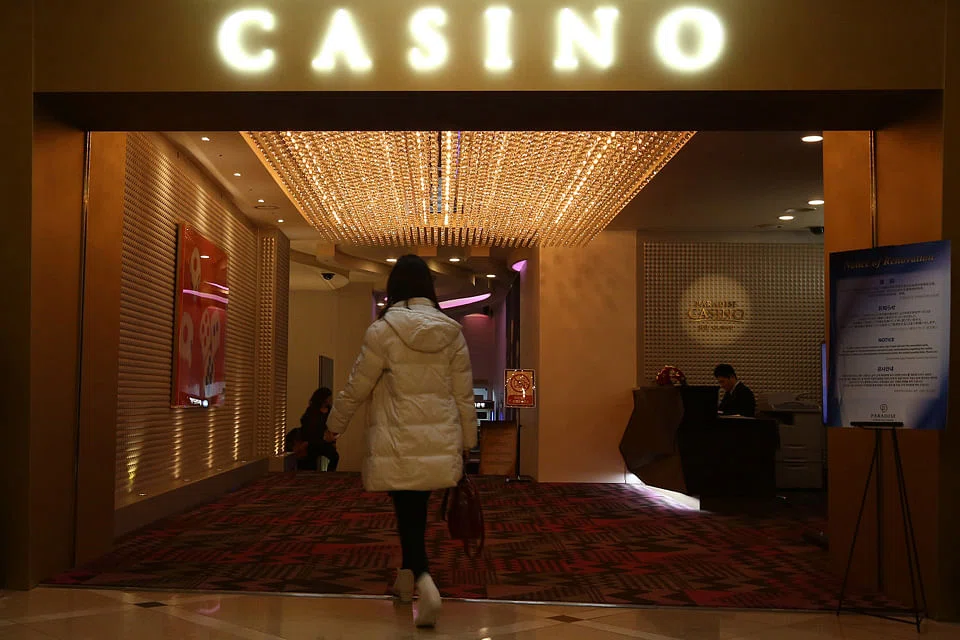
Operators such as Paradise Co in South Korea are hiring Mandarin- speaking staff and offering VIP treatment including free flights, limousines and hotel stays to big spenders.
Echo Entertainment Group Ltd of Sydney and NagaCorp Ltd in Cambodia cater to the junket operators who organise trips for Chinese gamblers with perks such as higher commissions, lower taxes and private jets.
"Premium mass players can be recognised as VIP players and treated better than in Macau," said Lee Hyukbyung, vice-chairman of Paradise, in an interview in Seoul. "And we have other attractions in Korea such as culture, fashion, food."
Macau casino revenue fell last year for the first time and may decline another 8 per cent this year, according to analysts surveyed by Bloomberg. By contrast, South Korea and the Philippines will grow 16 per cent and 33 per cent respectively this year, gaining from the spillover of Chinese gamblers, Deutsche Bank analyst Karen Tang wrote in a note.
Li Gang, director of China's Macau Liaison Office, this month reiterated President Xi Jinping's call for the city to diversify from casinos.
Gambling in Macau, the only place in China where casinos are legal, has declined as Beijing's anti-graft crackdown meant officials didn't dare to visit, and also due to stricter rules and the country's economic slowdown, Mr Li said at a session of the National People's Congress in Beijing.
Macau's process to diversify its economy will take between 20 and 30 years to complete, and the government should strengthen its efforts to achieve this, he added.
"The anti-corruption measures are discouraging some people from travelling to Macau, and as a result we are seeing a slight shift in travel from Macau to other destinations," said Aaron Fischer, a Hong Kong-based analyst at CLSA Ltd. "Vietnam and Philippines will likely benefit as they are the closest. Korea will pick up people in the northern parts of China."
Gamblers who bet at least US$50,000 at Paradise's casinos qualify for freebies usually available only to VIP players, Mr Lee said. In Macau, the minimum needed to get similar perks from junket operators is about US$500,000, according to CLSA data.
Paradise also draws Chinese gamblers to the celebrity-obsessed country by touting its pop culture and offering recommendations of top Korean plastic surgeons, Mr Lee said.
Operators have more risque offerings, too. A gambler who exchanges 300,000 yuan (S$66,600) worth of chips can receive free flights to Jeju, tours with a Mandarin-speaking guide, and the companionship of a "third-tier" Korean actress or model, according to an e-mailed brochure from Shanghai-based tour operator CNS. A CNS travel agent, who would only give her name as Xiao Qi, confirmed the services when contacted by phone.
It's illegal for foreign companies to advertise casino operations in China and Paradise avoids public solicitations, Mr Lee said. Its staff reaches out to high-stakes gamblers recommended by existing customers and makes frequent trips to major Chinese cities including Beijing and Shanghai, he added.
Companies are able to sidestep China's ban on casino marketing by advertising their non-gaming attractions such as a concert or entertainment show held at their venues, said Grant Govertsen, an analyst at Union Gaming Group in Macau.
"Junket operators own restaurants, night clubs; they sponsor golf tournaments and other getaways," he said. "There is plenty of stuff a junket could advertise in a mass-market sort of format."
Still, foreign operators' efforts to attract China's gamblers have caught the notice of local authorities, which announced last month a crackdown on representative offices that "attract and recruit Chinese citizens" to casinos.
Manila's members-only Signature Club in Melco Crown Entertainment's City of Dreams casino has entrance signs in both English and Chinese, while Mandarin-speaking staff direct guests to cashiers, shops and restaurants. The neighbouring Solaire Resort and Casino owned by Bloomberry Resorts Corp has suckling pig and Peking duck on the menu, catering to Chinese palates.
"There are a lot of excuses to go to the Philippines; we always promote the Philippines not on the casino but the whole package," Cristino Naguiat, chairman of Philippine Amusement & Gaming Corp, said last month in Manila. "Even with the crackdown in China, we still had higher volume in terms of gross gaming revenue and in terms of junket and VIPs."
South Korea is preparing to welcome more Chinese gamblers after tourist arrivals from the country rose last year to 6.1 million, with new casinos planned including at Incheon Airport.WP