

Because it is there
The assault on Mount Everest has set off a backlash as tourist zones reclaim their pride and privacy.
ON May 29, 1953 when Edmund Hillary (a reclusive Auckland bee-keeper) and his intrepid Nepalese Sherpa Tenzing Norgay emerged above the clouds to finally ruffle Mount Everest's 29,029-foot killer peak, it was the culmination of decades of romantic endeavour at the lung-bursting limits of human endurance. No mortal had set foot this high before. Sagarmatha - or Chomolungma, as the mountain is reverentially known in the Nepalese and Tibetan vernacular - was exclusively the abode of the gods.
Later, in typically understated fashion - entirely without artifice or in the glare of media flashbulbs - Hillary said in an aside to a climbing companion: "Well, George, we knocked the bastard off."
It was another George - George Leigh Mallory, the storied British climber - who famously said of the lure of Everest: "Because it is there", before vanishing with fellow climber Andrew Irvine after being spotted pressing on 300 metres below the summit. His frozen mummified body was found in 1999. Irvine remains unaccounted for.
Lure of the untamed wild
Since then over 200 people have died on the mountain through hypothermia, falls, oxygen deprivation, pulmonary oedema, inadequate acclimatisation, frostbite, dehydration, and heart failure.
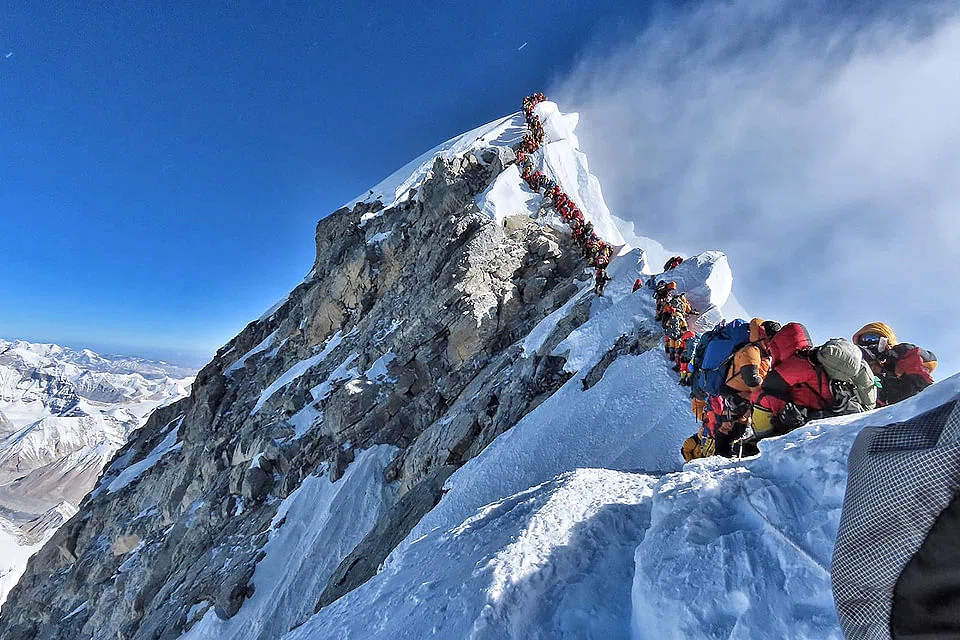
As many as 19 people died in May 1996 as competing expeditions slogged up through the oxygen-starved "death zone" (above 26,000 feet) and 11 more perished in 2019 as overcrowding took its inevitable toll with waiting times dragging on fatally depleting oxygen and human reserves.

Why would anyone be willing to take such a risk? For the professional climber, the answer is simple. It's the lure of the untamed wild. Because it is there. That very wild is now ferociously resisting attempts to tame it as assaults on Everest's flanks have moved up to an industrial scale with 381 permits issued to 44 climbing teams in 2019.
The Nepal government does not cap expeditions (leaving traffic flow to be managed by climbing teams and tour companies) and appears hopelessly addicted to its US$300 million annual earnings.
A lack of government oversight has combined with the increasing commercialisation of professional expeditions that claim to place anyone atop Everest for the tidy sum of US$60,000 or more.
The onslaught of casual hikers and unfit thrill-seekers has put not only their own lives at risk but also imperilled their guides and created a blot on the landscape for those who came to experience something removed and unique.
Over 4,800 people have climbed the mountain, a staggering number given the risks involved and the amount of time it took for the first human being to make that successful ascent. Almost 300 have died.
Apart from Everest's high kill rate, another half dozen are likely to succumb to altitude sickness each year and die on the trek to the base camp before any climbing commences.
And while Nepal struggles to cope with the growing number of climbers and the mounting rubbish on what is a sacred site (all fallouts of its own making), developments in Tibet indicate a further surge in climbers attempting the north face as China's new mountaineering centre gears up with space for a museum and memorabilia, recreation, training, equipment and mountain-rescue operations.
Over-harvesting of tourism is a growing problem all over the world and, as with all such enterprises, it is afflicted by diminishing returns as travellers seek out places less polluted by crowds, noise and selfie stunts.
There is a purity that true travellers (as opposed to cattle-herded tourists) desire that is harder and harder to find as the world's last fastnesses are prised open by GPS, roads and megapixels.
Diminishing returns affect travellers, who derive less pleasure from their passion; the local culture, where craftsmanship is replaced by kitschy tourist gewgaws; and the local inhabitants, who eventually tire of the "invasion" and push back to reclaim their lives.
Wanderer on a deadline
Most of all, the ruthless undressing of the world has eliminated the sense of discovery that inspired original wanderers who immersed themselves in local cultures and committed their knowledge to books. Today's wanderer is on a tight deadline with just a few minutes to shoot a selfie before racing on to the next point. The accretion of centuries barely rubs off on his New Balance soles.
Quaint dolls-house cities like Bruges are clamping down on tourist numbers to fight the charmless monoculture of "chocolate and beer" shops catering for short-term visitors. The mayor, rightly, wants the place to regain its pride as a Unesco Heritage City. Macau wrestles with its flood of casino day-trippers. Amsterdam is playing with tourist taxes to limit the influx, while Barcelona (a city of 1.6 million that annually hosts a staggering 32 million tourists) considers a ceiling on new accommodation.
All over the world there is a brewing clash between New Age purists and hard-boiled business over the definition of "profit". Is the pulse-calming tranquillity of a green view worth more (or less) than a coal plant that sullies our lungs but sets homes aglow? It is a question travellers need to ponder before ticking off the next item on that bucket list.
If Everest has taught us anything it is to slow down and smell the roses. There are limits to tourism on steroids. Unless, of course, as with deforestation and plastic rubbish, we are willing to despoil our one planet for a quick buck, fleeting convenience, and a photo op.
Share with us your feedback on BT's products and services






