

China bloggers touting make-up tips spur Estee Lauder's sales
Millennials account for 35-40% of sales in China; Estee Lauder says Chinese women now using more make-up
Hong Kong
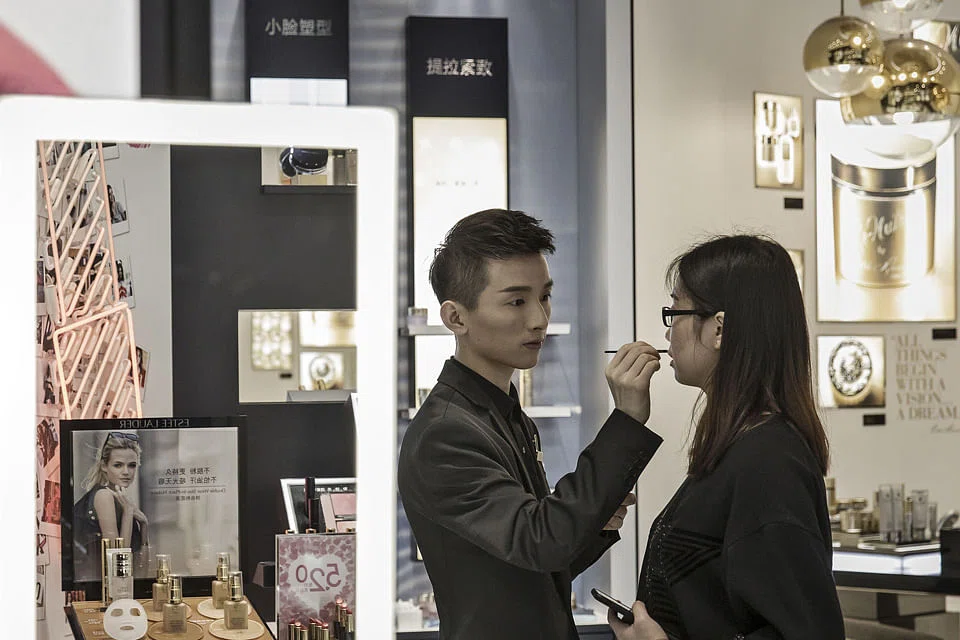
CHINESE millennials are becoming the world's biggest beauty queens, thanks to the power of the Internet.
Make-up and grooming tips proffered by popular lifestyle bloggers are inspiring women in their late teens to early 30s to splurge 585 yuan (S$121) on a Tom Ford lipstick and 1,350 yuan on an eight-gram compact of La Mer's illuminating foundation powder online.
This demand has driven a 20 per cent jump in Estee Lauder Company's sales in China in the quarter through March, making it the New York-based group's fastest-growing cosmetics market.
Fabrice Weber, Estee Lauder's Asia-Pacific president said in Hong Kong: "In the past, Chinese women didn't put on foundation, mascara, and eye shadow. Today, it's perfectly OK. Millennials are completely uninhibited to think 'I need to look stunning'."
He credits that to the power of social media. Millennials, or people aged between 18 and 30 contribute about 35 per cent to 40 per cent of Estee Lauder's sales in China, he said. This is a larger proportion of sales than millennials account for on average globally.
And remarkably, millennials are prominent buyers of the company's most expensive brands.
Sales growth in China and in the travel retail segment boosted by visits overseas by Chinese middle-class consumers, will help Estee Lauder as it catches up to industry leader L'Oreal in the country. Estee Lauder had a 3.7 per cent market share in China's cosmetics market as of last year; L'Oreal had a 30 per cent share, said market researcher Euromonitor International.
Retail cosmetics sales for all companies will total US$7.4 billion in China in 2021, up from US$4.3 billion last year, Euromonitor forecast.
Fuelling growth are social media websites, such as Weibo, Youku, iQiyi and Tudou, to which women are increasingly turning for tutorials on applying of make-up.
In Shanghai, a blogger who goes by the name Annie-uu shares dozens of images of herself, cosmetics, fashion accessories and holiday snaps every few days on Weibo with her 650,000 followers.
Among her recent touts are SK-II Facial Treatment Essence, which she used to prevent sunburn during a trip to Colorado's Grand Canyon; she also promoted a Dior lipstick inspired by actress Jennifer Lawrence and Estee Lauder's Jo Malone perfume, which she told followers on May 20 "is the smell of summer, and it makes you think of London".
Catherine Lim, a retail analyst with Bloomberg Intelligence in Singapore, said: "International cosmetics brands are rushing to China now, fighting fiercely for the market, especially the young customers."
Compared with their more sophisticated peers in Japan and the US, millennials in China have lower brand loyalty and are more easily influenced by beauty bloggers to try out new products, she said.
Estee Lauder's growth in the world's biggest consumer market follows an expansion overseas and its purchase of independent, social media-driven beauty brands such as Too Faced, for about US$1.45 billion last year.
In China, Estee Lauder supplies more than a dozen make-up brands, including Bobbi Brown and La Mer. The company expects its cosmetics sales in China to overtake Japan this fiscal year, spurred by demand for Tom Ford lipsticks and Jo Malone fragrances.
Mr Weber said: "Chinese women have evolved very rapidly from being 'skincare-centric'. Now they are evolving into big users of fragrance and make-up. It's moving China in the lead of Japan."
The company, founded by Estee and Joseph Lauder in New York City in 1946, now sells some of its products on Alibaba Group Holding Ltd's Tmall online shopping platform.
That has fuelled a 70 per cent surge in its third-quarter online revenue. Purchases in China conducted over the Internet account for less than 10 per cent of revenue, but that proportion will probably double within four years, Mr Weber said.
When the Paris-trained Mr Weber assumed his current role in 2007, only two of Estee Lauder's 30 brands were in the Chinese market. "Now we have 16. There's huge opportunity." BLOOMBERG






