

Cordlife storage lapses warrant compensation, but class action may be difficult: lawyers

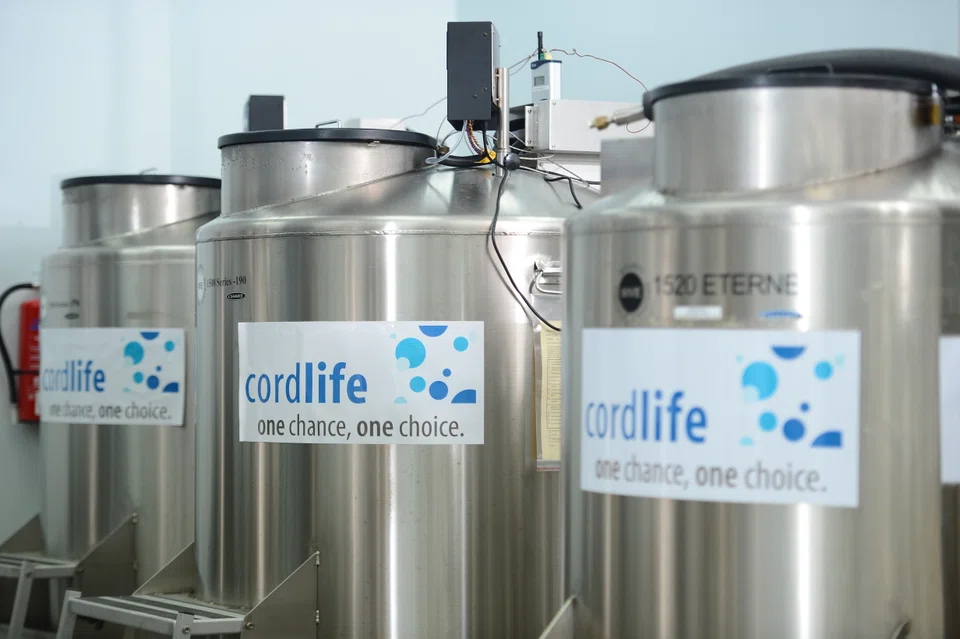
CORDLIFE customers who have been affected by the cord-blood bank’s storage issues may have some grounds for compensation, lawyers said, but mounting a class action-type lawsuit in Singapore might be a difficult feat.
This comes as the Ministry of Health (MOH) on Thursday (Nov 30) said seven of Cordlife’s 22 cord-blood storage tanks were recorded with temperatures above acceptable limits. The infringements had been found over several different periods since November 2020.
The mainboard-listed group – one of four licensed cord-blood banks in Singapore – has been barred for six months from collecting, testing, processing and storing new cord-blood or tissue samples, as well as from running new test types for patients.
Cord blood units belonging to at least 2,150 clients have been damaged.
In an e-mail seen by The Business Times informing customers of the issue, the company pointed to its service agreement with customers.
A clause indicates: “If, in the opinion of your healthcare provider, it is subsequently determined that the cord-blood cannot be successfully used for an approved cord-blood transplant, we will make every effort to find a suitable replacement cord-blood for your child.”
In response to queries from BT, a Cordlife spokesperson clarified that the “healthcare provider” refers to the transplant physician from whom the customer’s child will be seeking treatment if required.
“We will work with the public cord-blood banks worldwide to find a suitable match for their child if the need arises. This is part of the service agreement we have with all our clients,” said the spokesperson.
While the clause appears to place an obligation on the company to find a suitable replacement if the need arises, NLC Law Asia’s associate director Rezvana Fairouse said this does not negate the duty of care on Cordlife to store cord-blood properly.
“Customers can commence court action if it is found that Cordlife has breached any present and relevant contractual provisions in the contract relating to the storing of the cord-blood, or if it was found that Cordlife had been negligent in the storing of the cord-blood resulting in damage notwithstanding such a clause,” she said.
Robson Lee, partner at Kennedys Legal Solutions, said Cordlife’s apology letter and MOH’s suspension are also signs the company “has breached its duty of care to customers”.
He added that the search for a suitable replacement could also be complex and expensive, with customers possibly having to bear the costs.
Yam Wern-Jhien, director at Setia Law, noted that Cordlife could be insulated from legal suits if the contract contains an exclusion or limitation of liability clause.
A service agreement seen by BT does not, however, appear to include such a liability clause.
Representative action rare in Singapore
The large number of affected customers raises the questions of whether a class action suit could be mounted against Cordlife.
Legal experts who spoke to BT said Singapore is not, generally, a litigious society, and does not have a class action mechanism such as that in the United States.
Rather than a US-style class action mechanism, Yam noted that Singapore’s legal system allows for representative action.
Under the class action suit, a few claimants can bring to court an action on behalf of an entire class of claimants – save for specific claimants who have opted out of the action.
A representative action likewise allows some claimants to bring an action for a larger group of claimants – but all claimants have to consent to being represented in the action.
Although allowed, such suits are rare in Singapore.
“It can be logistically complex to organise and coordinate a representative action, although some lawyers have devised alternative mechanisms, such as incorporating a special purpose vehicle with a clear internal decision-making and funding structure,” Yam said.
Representative actions can also be expensive. Unlike in the US, Singapore offers limited options for litigation funding.
“The US permits contingency fees – allowing lawyers to take a percentage of their client’s monetary award as their fee – which acts as a financial incentive for lawyers to invest in and drive class action suits,” said Yam.
Representative actions are also rarely successful.
Ng Lip Chih, director of Foo & Quek Law, noted a previous case in which more than 200 ex-members of Sijori Resort Club sued Treasure Resort. The representative action was discontinued by the High Court as the contracts for each claimant and its benefits differed.
“It is currently uncertain if all of the affected customers of Cordlife had the exact same contract terms. If there are differing contracts, they will need to prove their own contract terms,” said Ng.
He added that the losses suffered by each claimant would have to be identical; otherwise, they may have to return to court to “prove individually the damages each of them suffered as a result of the defendant’s breaches”.
Meanwhile, Johannes Hadi, partner at Eugene Thuraisingam, noted that the problem “appears to have been quite contained”.
He noted Cordlife’s announcement that the single affected tank that was tested contained around 2.7 per cent of all cord-blood units stored in Singapore.
The Cordlife spokesperson told BT it stores 69,310 cord-blood units in Singapore. Of the seven affected tanks, about 2,200 units were confirmed to have been damaged. Investigations are ongoing for another 17,300 units.
While the company is likely to be insured against such claims, Kennedys’ Lee said such an action will “affect the confidence of the industry’s customers in the company’s management and operations, including public investors of its shares”.
Meanwhile, MOH said Singapore’s three other licensed cord-blood banks – Cryoviva (Singapore) Laboratory Services, StemCord and the Singapore cord-blood Bank – were audited and no temperature excursions of concern were found.
StemCord chief executive Valerie Wong said the company stores cord-blood in multiple cryo units as a security measure.
Storing cord-blood in multiple units gives the flexibility to use only what is needed, as well as enables StemCord to split up the cryo units and store them at two separate locations, she added.
Cordlife’s shares closed 32 per cent lower on the first full trading day after the MOH announcement. They have since climbed S$0.025, or 8.1 per cent, to end Monday at S$0.335.
TRENDING NOW

Ex-Nvidia CEO Jensen Huang carried a secret for more than a year. It led to his downfall

South-east Asia has lost Nvidia’s best salesman

Demand, tech capabilities position Apac and AI as Skyscanner’s next growth frontiers: CEO Bryan Batista

Jensen Huang discusses comeback as Nvidia CEO with allies: report

