

F&B demand in Singapore's CBD picks up after dine-in group size upped to five
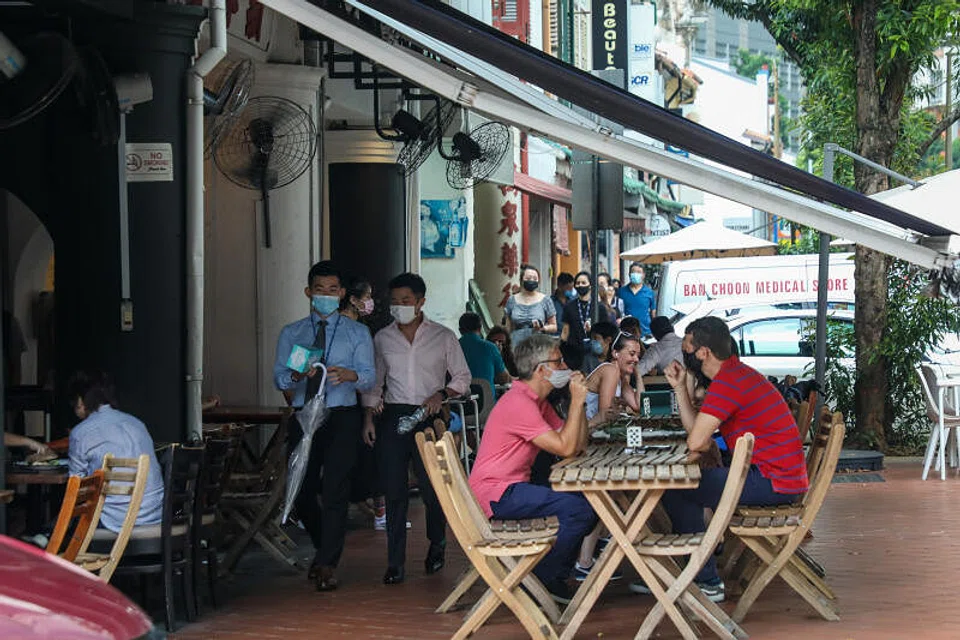
Quiet afternoons and sleepy evenings at restaurants in Singapore's Central Business District (CBD) may finally be drawing to a close, as restaurants there are beginning to see a much-anticipated revival on the back of recently relaxed dining restrictions.
F&B establishments say corporate crowds have begun to trickle back in, even as some patrons continue to work from home or choose to hold off until they are allowed to entertain a larger group of guests.
Several Chinese restaurants that The Business Times spoke to this week have seen groups of four or five customers return, after the government gave the green light for the dine-in group size to go up to five from July 12.
Ponte Group, which operates rooftop restaurant LeVeL33 at Marina Bay Financial Centre (MBFC), saw reservations for its venues go up by 25 per cent since Monday.
With slightly more leeway, companies have found various workarounds to continue hosting business lunches.
"Instead of hosting different clients in one lunch, companies split into several lunches over different days and host one client each day," said Darren Yew, general manager at Peach Garden Group of Restaurants.
Chinese restaurants said that they rely on communal dining of larger groups, which may explain the rise in bookings.
"Many of our dishes which customers like, such as whole live fish, peking duck or suckling pig, are more suitable for bigger groups to share," said Mr Yew.
Similarly, reservation platform Chope reported a 55 per cent jump in bookings and a corresponding 47 per cent increase in the number of people reserved for on Monday, compared to the previous day when the dine-in limit was capped at two.
But operators feel there's still a long way to go before restaurants see crowds anywhere near pre-Covid levels again, as work-from-home remains the default and many other restrictions are in force.
"With strict government measures in place, no inter-mingling nor multiple tables is allowed, so corporate bookings are still a little soft compared to before," said Andy Wong, vice-president of food and beverage (Asia) at Millennium Hotels and Resorts.
He added that private rooms would hold as many as 30 diners at a time, before the pandemic.
Chinese restaurants, which typically host in groups of between eight and 12 people per table, find it difficult to appeal to customers when faced with the current restraints.
Mr Wong noted that at Hua Ting Restaurant at Orchard Hotel, there has been an increase in diners since the capacity limit went up to five, but the response is still slightly slower than when the limit was eight people earlier this year.
Restaurants also noted that the distribution of their customers has shifted. Corporate customers used to make up the majority of its business in the past, but private diners now make up a significant or even a larger portion of its customer base.
Peach Garden has 10 to 20 groups of corporate customers on a weekday lunch these days, compared to 20 to 30 groups before the pandemic, said Mr Yew.
Similarly, at Ponte Group's restaurants, demand from corporate customers, particularly office tenants at MBFC towers where they are located, continues to be weak as offices remain largely empty, said Martin Bem, the group's founder and managing director.
A considerable number of high-spending expatriates are leaving Singapore to return home, he added, which further narrows their clientele base.
Other factors, such as the ban on background music due to Covid-19 restrictions, were also some of the reasons that owners attributed the business lull to.
Lim Lay Bee, manager of the Beng Thin Hoon Kee Restaurant, said it was hard to bring back its corporate orders, especially as the lack of music, which is typically characteristic of Chinese restaurants, is not allowed.
"When you don't entertain, you won't come to a chinese restaurant for lunch. Especially now that we can't have music, it's very quiet," she said.
While customer traffic is still not at ideal levels, Carolyn Tan, senior vice-president of TungLok Group said: "To expect business to return to pre-Covid levels at this time is not realistic, when we have barely emerged from (the) phases of heightened alerts."
Still, businesses are optimistic on recovery in the coming months. With the endemic nature of the virus, restaurants are ramping up efforts to better fit the new office crowd, strengthening their delivery and takeaway services or looking at alternatives such as virtual cooking lessons.
Some restaurants, such as Chao Shan Cuisine on Phillip Street are also gearing up for the upcoming Mid-Autumn Festival, having already received advance bookings for the festive occasion.
While restaurants in the CBD area may be feeling the impact now, by offering quality food and service along with attractive promotions, many customers are still willing to head to the CBD area with family and friends, said Mr Yew.
Tunglok's Ms Tan said: "Diners will travel for good food and experience. Singapore is a small city with excellent transport infrastructure, so it doesn't take much to travel."
READ MORE:
TRENDING NOW
What role can Japan play in Asean’s future?

IOI Properties and CapitaLand Investment closer to acquiring One Raffles Place in joint bid

AI bubble may burst soon amid financing concentration, rising rates: Ray Dalio

OCBC sheds S$8 billion in value as shares close nearly 6% down; analysts cautious on banks

