

Barramundi Group cuts H1 loss to S$5.2 million, sees bigger fish to fry in Brunei

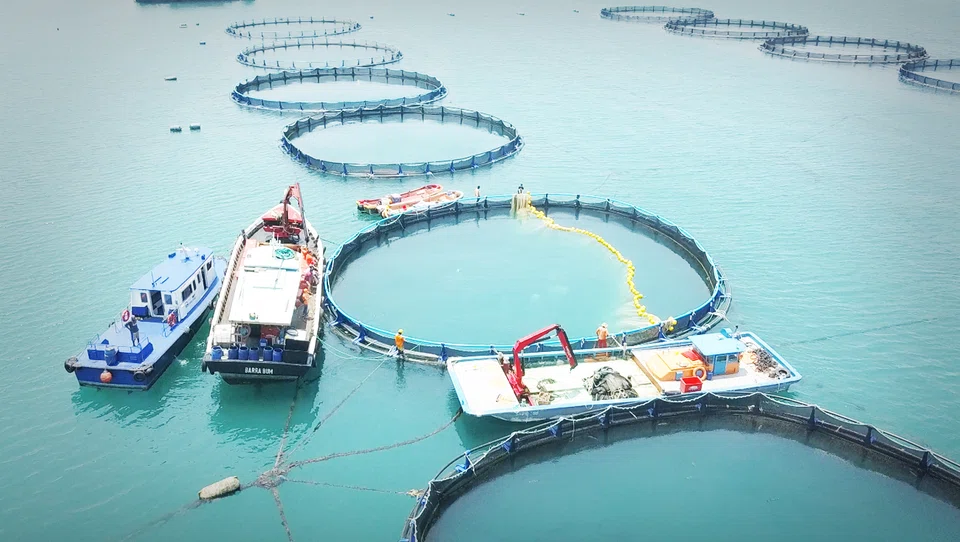
BARRAMUNDI Group, the only operator of fish farms in Singapore’s southern waters, on Wednesday (Aug 30) narrowed its net loss for the first half year ended Jun 30 to S$5.2 million, from a loss of S$12.1 million in the corresponding year-ago period.
This was attributed to “proactive cost management strategies and operational adjustments executed” in this period, the group said. This includes streamlining headcount and processes in Singapore and Brunei, reducing administrative expenses, as well as trimming executive salaries.
Loss per share came in at S$0.12959, based on a total shareholding of 40.4 million.
Revenue slipped 1.6 per cent to S$16.6 million from S$16.9 million. This came as the company’s sales volumes fell to 714 tonnes whole fish equivalent (WFE) in this half year, from 930 tonnes WFE in H1 FY2022.
WFE is an industry standard measurement that refers to the weight of the fish after bleeding.
The fall in revenue was offset by increased retail prices and higher contribution from Fassler Gourmet, the group’s products processing subsidiary.
The company had earlier in June harvested all its Asian sea bass, known as barramundi, in Singapore, and stopped stocking its three ocean-based farm sites with juvenile fish due to outbreaks caused by the scale drop disease virus. It had attempted a vaccine field trial, but ceased operations after inconclusive results. The pathogen, which occurs naturally in Singapore and parts of South-east Asia, can kill more than half a pen of barramundi, which is often touted as the salmon of the tropics.
This resulted in sales limitations in the Singapore market, said the group. Its Singapore revenue came in at S$2.1 million, down 41.8 per cent from S$3.6 million.
The group has since harvested the remaining biomass to optimise its operational efficiency, and will repurpose infrastructure in Brunei. It also noted that the cessation of sea farm operations in Singapore had helped to relieve cash flow pressures.
In an earnings call on Wednesday, chief executive James Kwan said that Brunei represents a “tremendous opportunity for the group”, as it has “significantly lower” energy, labour and land costs compared to Singapore and Australia, where Barramundi has businesses. “Energy costs (in Brunei), for example, can be up to seven to 10 times lower than (in) other countries like Singapore,” he noted, adding that Brunei is now the “centre of gravity” for the group’s production.
Its Brunei operations currently have more than 8,000 hectares of sea and land leases, an operational recirculating aquaculture system (RAS) nursery, and a diagnostic lab for fish and autogenous vaccines under its Uvaxx brand.
RAS refers to a type of closed-containment aquaculture system for fish culture in controlled indoor environments, which enables farmers to achieve higher productivity, among other benefits, according to the Singapore Food Agency.
The group is planning to raise capital to further develop a land-based RAS project that will support growth in Brunei. Details on the amount required will be shared soon, said Kwan.
He aims for this project to have an annual production capacity of 3,000 tonnes at peak production, but did not state when this would be achieved. “Even though this is (capital expenditure-intensive), it gives us predictability in terms of the biomass that can be produced annually,” he said.
Comparing the group’s Brunei and Singapore operations, Kwan said that the land and sea leases in Brunei are much larger than the three farm sites it has in Singapore.
Production from its upcoming land-based RAS project will also outstrip its past production in Singapore, which was 950 tonnes in 2019.
Its Singapore site will now focus on producing superior barramundi fry and fingerling in Singapore from the company’s genetics and breeding programme.
A spokesperson for the company in July noted that operations in Singapore will also be centred on aqua-tech capabilities such as vaccine and therapeutics development, veterinary and animal health, and broodstock (fish used for breeding purposes) research and development.
While Barramundi no longer has sea farm operations here after harvesting its fish in June, the production in Brunei, once fully ramped up, will likely be “well beyond” the domestic consumption, with a large portion expected to end up in Singapore and other markets.
The company also noted that it had placed its Australia business under voluntary administration. Two subsidiaries, MPA Fish Farms and MPA Marketing, were acquired by Australia-based salmon farm operator Tassal Group on Jul 31, but its results were not separated in its H1 figures.
Barramundi trades on the Euronext Growth Oslo, a bourse in Norway. It last traded at four Norwegian kroner on Aug 7.
TRENDING NOW
Indonesia begins cutting natural gas exports to Singapore from Oct 24: reports

Singapore’s central gas buyer affirms Indonesia’s role as ‘important partner’ amid export review warning

KKR founders among investors buying 42% of Peter Lim’s Valencia; club valued at US$1.4 billion

NEA issues notices to 10 Singapore-based companies, including Wilmar and APP, over haze

