

For Britain's chicken farmers, Brexit and Covid brew a perfect storm
Pressures are building on businesses as they emerge from pandemic to confront trade barriers with Europe
 Add BT as a preferred source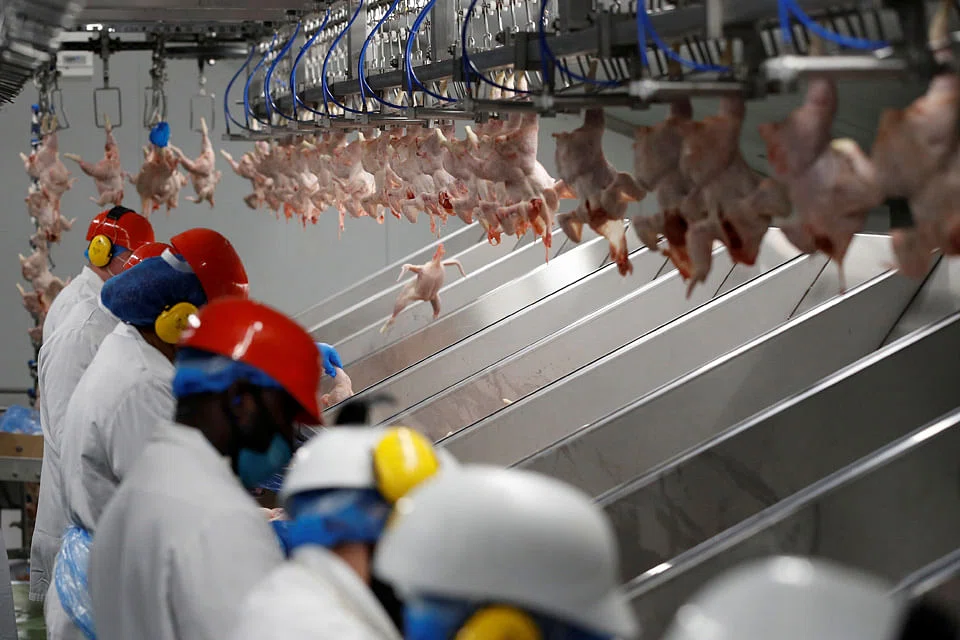
Driffield, England
WHEN Nigel Upson checks the plucked chicken carcasses dangling from a rotating line at his poultry plant in England, he sees cash haemorrhaging out of his business from a collision of events that has distressed every part of the farm-to-fork supply chain.
Like food manufacturers across Britain, Upson was hit this year by an exodus of eastern European workers who, deterred by Brexit paperwork, left en masse when Covid restrictions lifted, compounding his already soaring cost of feed and fuel.
Such is the scale of the hit, he cut output by 10 per cent and hiked wages by 11 per cent, a rise that was immediately matched or bettered by neighbouring employers in the northeast of England. Increases in the cost of food will surely follow.
"We're being hit from all sides," Upson told Reuters in front of four vast, spotless sheds that house 33,000 chickens apiece. "It is, to use the phrase, a perfect storm. Something will have to give."
The deepening problems at Upson's Soanes Poultry plant in east Yorkshire are a microcosm of the pressures building on businesses across the world's fifth-largest economy as they emerge from Covid to confront the post-Brexit trade barriers erected with Europe.
In the broader food sector, operators have increased wages by as much as 30 per cent in some cases just to retain staff, likely forcing an end to an economic model that led supermarkets such as Tesco to offer some of the lowest prices in Europe.
Following the departure of European workers who often did the jobs that British workers didn't want, retailers may have to import more.
While all major economies have been hit by supply chain problems and a labour shortage after the pandemic, Britain's tough new immigration rules have made it harder to recover, businesses say.
For the rural businesses situated near the flat, open fields of Yorkshire, Upson says the situation is dire. Although he says he needs 138 workers for his plant, he recently had to operate with under 100. Staff turnover is high. Richard Griffiths, head of the British Poultry Council, says that with Europeans making up about 60 per cent of the sector, the industry has lost more than 15 per cent of its staff.
When numbers are particularly tight Upson gets his sales, marketing and finance staff to don the long white coats and hairnets that are needed on the processing line. "Three weeks ago the offices were empty, everyone was in the factory," he said, of a business that supplies high-end birds for butchers, farm shops and restaurants. For the run-up to Christmas, he may look to students.
On difficult days Soanes can only deliver the absolute basics - chickens piled into boxes. They do not have time to truss the birds for retail or put them into separate, Soanes-labelled packaging that commands a higher selling price.
The sudden rise in wages and the drop in output also come on top of spikes in the cost of animal feed, energy and fuel, carbon dioxide, cardboard and plastic packaging. "We've just had to say to our customers, sorry, the price is going up," Upson said. "We're losing money, big style." The poorest consumers would be hardest hit, he added.
Business owners have urged the government to temporarily ease visa rules while they do the staff training and automation of processes needed to help close Britain's 20-year, 20 per cent productivity gap with the United States, Germany and France. But far from changing course, Prime Minister Boris Johnson says businesses need to cut their addiction to cheap foreign labour now, invest in technology and offer well-paid jobs to some of the 1.5 million unemployed people in Britain.
According to Upson, there is a shortage of workers in rural communities and with some 1.1 million job vacancies in the country, people can be choosy about which they pick. "Working in a chicken factory isn't everybody's idea of a career," he noted.
While 5,500 foreign poultry workers will be allowed to work in Britain before Christmas, and the UK will offer emergency visas to 800 foreign butchers to avoid a mass pig cull sparked by a shortage in abattoirs, the industry says it needs more.
As for automation, the production of whole birds is already highly mechanised, and while it could be used more for boneless meat and convenience cuts, the cost is prohibitive for a small operator.
Soanes has an annual turnover of £25 million (S$46.4 million). In the last three years its owners have spent £5 million on expansion. Now output must fit the size of the workforce.
While Upson acknowledges Johnson's desire to move to a "high-wage, high-skills" economy, he said not all jobs fit that bill. "What skill do you need to put chicken in a box?" he asked. "We can put wages up, but prices will go up."
He is starting to despair. "Normally you can just be pragmatic and say, it will sort itself out. But I'm not sure where this one ends." REUTERS
Decoding Asia newsletter: your guide to navigating Asia in a new global order. Sign up here to get Decoding Asia newsletter. Delivered to your inbox. Free.
Share with us your feedback on BT's products and services
TRENDING NOW

Shanda co-founder sells Tanglin Hill bungalow for S$76 million
Yeo’s, Tiger Beer and now Gardenia – flight of food manufacturing from Singapore might be just as planned

Nearly half of Apac’s wealthy expect market crash or correction, plan to rotate to cash: study
Jumbo Seafood to close flagship East Coast Seafood Centre outlet on Sep 30

