

Happier customers give petrol stations, car distributors better scores
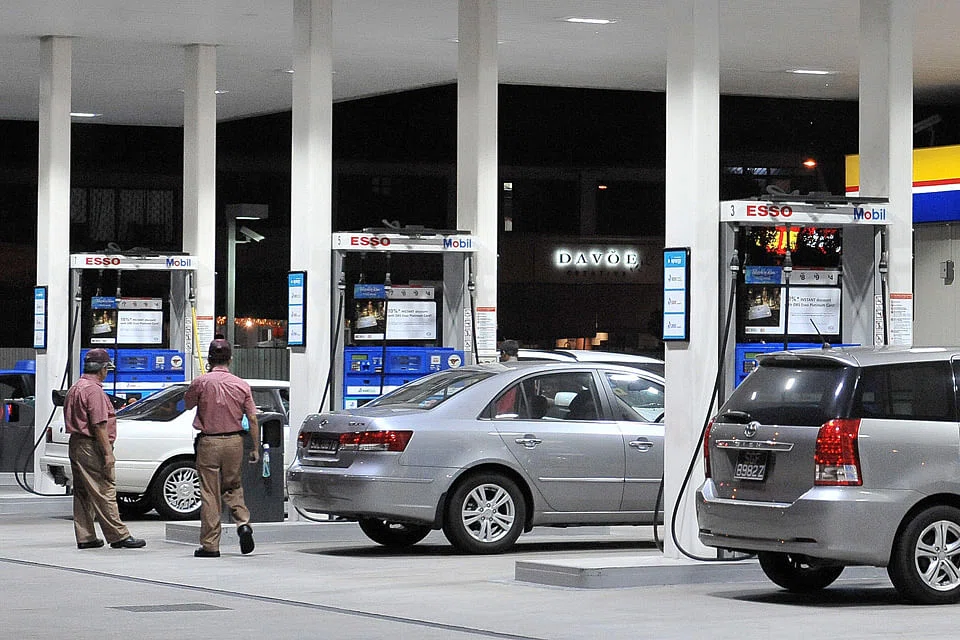
SINGAPORE'S car owners appear to be happier now than they were a year ago - if not with traffic conditions on the roads, then at least with the businesses that keep their wheels going.
Petrol stations and distributors of motor vehicles were the only retailers to see a significant improvement in their latest Customer Satisfaction Index of Singapore (CSISG) scores.
While the retail sector's overall score inched up 0.5 per cent to 70 out of a possible 100, the motor vehicles sub-sector gained 3.1 per cent to score 72.8 and petrol service stations gained 2.1 per cent to score 70.7 points.
The period over which the survey was conducted - from January to March this year - coincided with a double-digit year-on-year growth in motor vehicle sales. These jumped 33.2 per cent in January, 25.4 per cent in February and 40 per cent year-on-year in March, the Department of Statistics said.
But for petrol service stations, sales during that period fell. Retail sales at these stations fell 27.5 per cent in January, 20.8 per cent in February and 21.4 per cent in March, partly due to lower pump prices.
ExxonMobil's Esso, the only one of the four brands scored (the other three were Shell, Caltex and SPC) that posted a significant improvement, saw its score jump 4.8 per cent from bottom-ranked 68.3 last year to 71.5 this year, just shy of top-ranked SPC's 71.7.
It would seem then that sales volumes do not correlate with how satisfied customers are.
While it is tricky to ascertain from data alone what drove the better performance of these two retail sub-sectors, the report from the Institute of Service Excellence at SMU (ISES) - which compiles the index and scores for a range of sectors over the course of each year - shows that customer satisfaction has to do with more than competitive petrol prices, for instance.
"Petrol service stations have arguably transformed what is essentially a banal chore of refuelling your vehicle into quite a shopping experience. Besides groceries and essentials, many have bank ATMs and self-service machines so visits to the petrol station are potentially multi-touch interactions that build upon the core reason for the visit," says ISES academic director Marcus Lee.
For petrol service kiosks, such touchpoints would include the layout of the convenience stores at the station, the variety offered at these stores, how courteous the staff are and the payment process. On at least one count - variety - customers rated petrol service stations as doing significantly better this year, compared to last.
Dr Lee believes the competitive nature of retailing today, particularly when it comes to a commodity such as petrol, means that companies are pushed to find new ways to build relationships with customers that draw them to return.
"There is an added focus by retailers and many other service providers to move into non-core areas in an effort to enhance their service proposition. Customer experience is key to building an ongoing relationship and move away from the transactional relationship one would traditionally associate with retailing," he says.
Motor vehicle distributors, meanwhile, cannot afford to rest on their improved scores. As certificate of entitlement (COE) premiums are expected to slide further, lowering the costs of purchasing a car, there has been anticipation among vehicle retailers of a significant pick-up in sales volumes.
"And here's the potential for customer satisfaction to take a negative hit. If dealerships see a spike in customers, do they have the capacity to serve them at a level that meets their expectations?" asks Dr Lee.
While a potential car buyer can now access much information prior to his visit to the showroom, it remains challenging for dealerships to scale up their workforce to cater to cyclical spikes in sales - particularly on the technical back-end of the sales process.
"Well-trained and experienced staff, both at the front and back ends of the service process, are essential in delivering high-quality service. Companies will have to find alternative solutions to plug shortfalls, and if not, invariably, customer satisfaction will suffer," Dr Lee says.
Then, there is also the possibility that car prices do not fall as much as anticipated. Perceived value, as measured by the CSISG study, is closely linked to the purchase price.
"If the anticipated lower COE price does not materialise as expected, this might be negatively reflected in (motor vehicle retailers') CSISG performance," says Dr Lee.
TRENDING NOW
US dollar falters after Iran’s offer to reopen Hormuz sends oil lower

He built the Vingroup empire. Now South-east Asia’s richest man is handing some key roles to his sons

Floods compound Philippine growth woes from public-works scandal

Tokyo reverses baby bust with AI matchmaking and generous subsidies

