

How China became a caviar powerhouse
Zhejiang-based Kaluga Queen, the world's largest producer of the delicacy, has a 30% global market share and been growing at an average of 20% annually
Beijing
AT CHINESE caviar firm Kaluga Queen, the world's biggest producer of the delicacy claims to have perfected the art of caviar processing.
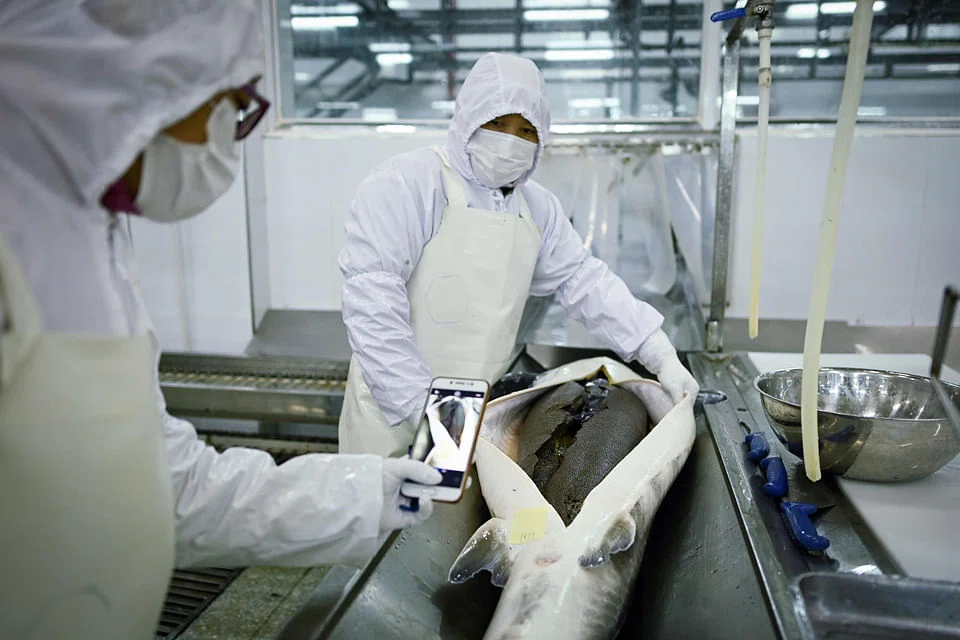
"Everything is meticulously controlled, from the temperature of the water and the room, to the cleaning and salting of the eggs," said Han Lei, the company's head of international sales.
All visitors to its facility in the Chinese province of Zhejiang are subjected to extreme hygiene checks before they can enter. They have to go through an air shower, wash their hands for an extended period of time in disinfected water, and put on sterilised clothes.
At full capacity, Kaluga's state-of-the-art processing plant, set up in 2008, will be able to produce 300 tonnes of caviar a year, more than three times its current production levels.
The company already has a 30 per cent global market share and exports to 23 countries. It has been growing at an average of 20 per cent annually with a yearly turnover of about 250 million yuan (S$48.4 million).
In just 10 years, Chinese caviar producers led by Kaluga Queen have managed to export their products around the world and place them on the menus of many Michelin star-rated restaurants.
"It has been a challenge. At first, restaurants turned us down as soon as they heard the word China" said Mr Han.
Kaluga Queen uses salt from Germany, feed from Peru and imports the tins from France. "We directly went to what was best in the market", said Mr Han.
China has a reputation for repeated food scandals and dodging compliance with hygiene standards, rather than being known for producing one of the world's most expensive and exclusive foods.
The country does not have a long history of caviar culture and the sturgeon, which produces the expensive black and grey eggs, disappeared from China's rivers long ago.
"In the beginning, Chinese caviar tasted like mud. It's a very shy fish that needs clean water and cold temperatures. China invested heavily to create good conditions. Today, you can really taste the difference," said Giorgio Brandinelli, founder of GFA Gourmet, which supplies food to luxury hotels in China.
China's caviar producers have leveraged the country's vast lakes in provinces like Zhejiang and Yunnan.
The journey of the sturgeons for Kaluga Queen begins in Qiandao Lake, situated about 300km south-east of Shanghai. The lake has been earmarked as a natural reserve by the government.
It is here that Kaluga Queen set up its sturgeon farm in 2003, by importing millions of fertilised eggs from Russia. The cages sit in crystal-clear water a short boat ride away from the shore among small islands of pine trees and tea plantations.
"Our main resource is water. This is what determines the quality of the eggs", said Mr Han.
The cages are constantly kept clean by a filtering system developed by the company. They are also moved to a new position in the lake every three years.
The first international breakthrough for Kaluga Queen was in 2011 when German airline Lufthansa, after two rounds of testing, decided to serve Chinese caviar to their first-class customers.
Since then, Chinese caviar has earned a reputation for being some of the best in the world on a par with those produced by Iran or Russia. China has also gone on to become the main caviar supplier to the US and the European Union.
"Chinese exports in the global market have been partially aided by trade sanctions imposed on Iran and Russia - historical producers of caviar - which restricted their ability to supply the global market," said Alessandro Miraldi, an associate partner at Shanghai-based consulting firm Battaglia Advisory Services.
Meanwhile, the domestic market remains underdeveloped with Chinese consumers still unaware their country produces some of the best caviar in the world.
"Penetrating China is our next target", said Mr Han, adding that the company currently spends some 10 million yuan in marketing to potential Chinese consumers every year.
TRENDING NOW

Inside Jensen Huang’s last hours as Nvidia CEO

Higher rates, weaker spending: Is the Philippines entering stagflation?
‘I’ll be buying more’: Singapore investors pour into Nvidia shares on Jensen Huang’s exit

Demand, tech capabilities position Apac and AI as Skyscanner’s next growth frontiers: CEO Bryan Batista

