Mounting challenges for bike retailers amid surge in demand
Stocks are running short amid global shipping and supply chain disruptions; cycling accessories also selling fast
Claudia Tan HS
Singapore
THE fast-growing popularity of cycling at the height of the Covid-19 pandemic has led to a boost in sales for bike shops here. But supplies are running short amid global shipping and supply chain disruptions - a phenomenon the industry was not prepared for.
Industry players The Business Times (BT) spoke to said that bike sales surged as much as 50 per cent between May to July compared with the same period last year.
Based on data from OCBC on card spending, the number of transactions at bicycle stores rose 68.5 per cent to 8,740 in the first quarter of 2020 from the year ago period. Spending on cycling app Zwift, which allows riding with other cyclists in a virtual environment, also doubled during the circuit breaker period.
Kenneth Tan, owner of Cycleworx, which distributes Italian bicycle brand Pinarello, said that the "rush to buy bicycles" was something none of the bike shop owners had anticipated. As such, many last-minute orders were not fulfilled in time to meet the sudden surge.
When retailers were closed during the circuit breaker period, people turned to buying bikes online.
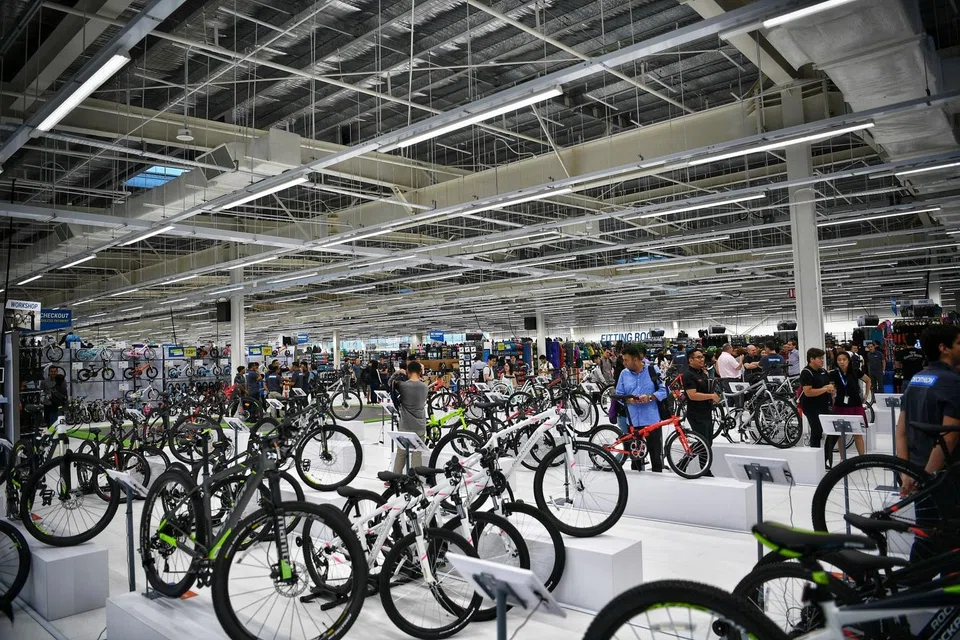
The total number of bikes sold by Decathlon (Singapore) online grew by 118 per cent in May compared with the year ago period. Sales remained robust even as restrictions were lifted and shops reopened. The number of bicycles sold by Decathlon grew 64 per cent and 47 per cent in June and July respectively. Basic cycling accessories such as helmets were also snapped up quickly.
"Our helmets and apparel are totally sold out and stocks, which were forecasted to last till the end of the year, have all been sold out in July," said a Decathlon spokesperson.
Helmets sold at Decathlon, which are manufactured in China, are expected to arrive by early October.
Meanwhile, bike manufacturers in Western markets with production facilities in Asia are bearing the brunt of the impact.
Cycleworx's Mr Tan said there was a "trickle-down effect" from China's early supply chain disruptions due to factory shutdowns when the virus first surfaced there.
Cycleworx experienced up to a three-month delay for some bike accessories and bicycles, said Mr Tan.
Likewise, Treknology3, which distributes Trek bicycles from the United States, is currently facing delays of around two to three months for bicycles.
Each bicycle is made up of various parts such as gears and tyres, which manufacturers source from different vendors. With vendors short on supplies, it led to an overall delay in the manufacturing and eventual shipment of bicycles, said Azhar Abdullah, Treknology3's distribution and marketing manager.
Even the world's largest bike maker, Giant, was not spared production woes, exacerbated by the pandemic and geopolitical trade barriers, reports show.
The uptick in cycling interest comes as people seek activities to stay fit without breaching social distancing rules.
Against this backdrop, entry-level bikes accounted for most of the growth, said Treknology3's Mr Azhar.
This includes people who know how to cycle but had never thought of owning a bike prior to the pandemic. There was also business from seasoned cyclists who send their bikes for upgrading or servicing, he said.
Separately, the increase in food delivery riders is also likely to have contributed to the demand, said Mr Azhar.
To be sure, the bike shortage situation in Singapore is not quite as dire as that globally. This is in part due to the fact that the city-state's infrastructure is not as bike-friendly compared with some cities in the West. For instance, there are not as many facilities at workplaces for people to lock up their bikes safely. Other limiting factors include the weather and a lack of cycling paths for people to commute long distances.
Checks by BT showed that certain bike models are still readily available online at retailers like Decathlon, Hello Bicycle and Rodalink. Decathlon said stocks began to recover when China lifted its lockdown in March and shipments gradually started to arrive in Singapore in the last week of April. But the impact is uneven across brands. Brompton bikes, for instance, are out of stock at most retailers here.
Demand for Brompton, known for its foldable bikes, increased by twofold since the virus outbreak, said Bob Lee, owner of bike shop 808 Cycles, which is currently out of Bromptons.
There is "very limited availability" for Brompton bikes now and stocks are only estimated to arrive in the first half of next year. But industry players are expecting demand to taper off by mid-2021 given that most people are cycling as a form of leisure rather than commuting.
"I don't think demand will be sustained because we are in a unique situation," said Mr Azhar.
Currently, most people are leveraging on the flexibility of working from home to go for rides in the mornings or evenings. Only a small percentage are buying bikes to use as a mode of transport.
"People usually pick it (cycling) up for health and wellness and as a recreational activity," said Mr Azhar.