

Panadol maker Haleon launches innovation hub in Singapore, to invest S$100 million annually in Apac R&D
The consumer healthcare giant will work with local researchers and startups on Asia-focused solutions

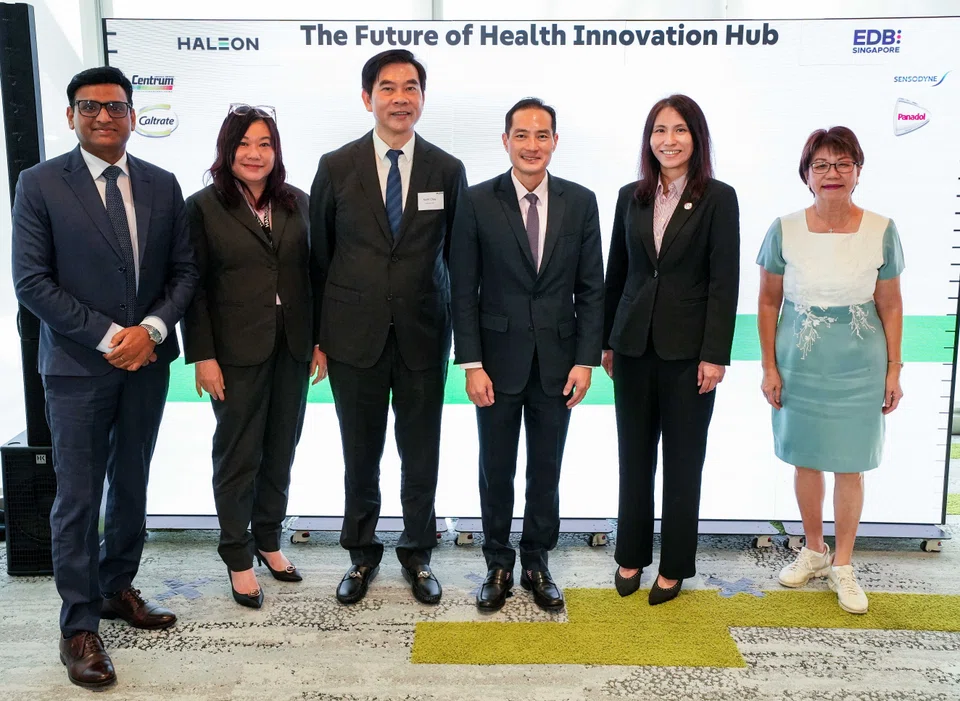
[SINGAPORE] Haleon launched a healthcare innovation hub in Singapore on Wednesday (Nov 25), which will tap the city-state’s research capabilities and startup ecosystem to develop products tailored to the needs of Asian consumers.
The new Future of Health Innovation Hub, supported by Singapore’s Economic Development Board (EDB), will see Haleon invest more than S$100 million in research and innovation across the Asia-Pacific annually.
The British firm, best known for consumer healthcare brands Panadol, Advil and Sensodyne, was spun off from the consumer health division of pharmaceutical giant GSK in 2022. Haleon is listed in London and New York.
The hub will focus its research and development efforts particularly in Haleon’s oral health brands such as Sensodyne, and wellness brands including Centrum and Caltrate.
Its research and innovation efforts will utilise consumer insights, scientific expertise, digital capabilities and artificial intelligence-enabled technologies to develop science-backed products for Apac consumers.
Haleon will also pursue innovation through partnerships with academic institutions and government agencies, including specialised research institutes at the National University of Singapore, Nanyang Technological University and A*Star.

The company also said it will work with local startup partners such as microbiome company Amili and cognitive health technology provider Gray Matter Solutions.
These partnerships are intended to drive clinical studies and academic research relevant to Asian populations, to develop innovations focused on healthy ageing, health inclusivity and condition awareness.
Ho Weng Si, executive vice-president at EDB, said Haleon’s decision to launch the innovation hub in Singapore reflects the strength of the city-state’s innovation ecosystem, while enabling the company to develop its consumer health solutions for the wider region.


Singapore also serves as the company’s headquarters for Apac, where Haleon operates across 18 markets.
Dr Keith Choy, Asia-Pacific president at Haleon, noted that the company’s efforts in Apac will contribute significantly to its global ambition to reach one billion new consumers by 2030.
He said that the region’s varying levels of economic development and diverse demographic profiles present different opportunities for the consumer healthcare industry – from ageing populations to younger, more health-conscious consumers.
In the Philippines, for instance, Haleon has introduced single-unit packaging for its Centrum nutritional supplements to make them more affordable to lower-income consumers.
“Asia’s diversity is its biggest opportunity,” he said, adding that Apac is the most populous region served by Haleon.
Speaking at the launch, Singapore’s Senior Minister of State for Health Tan Kiat How noted that Haleon’s innovation hub also aligns with the city-state’s efforts to enhance the health of its residents amid increasingly longer lifespans.
Tan, who is also senior minister of state for digital development and information, said Singapore is increasingly moving its healthcare priorities upstream, from treating illnesses to preventing them.
“(The innovation hub) can explore ways to make preventive health more personal, accessible and actionable,” he said.
Tan noted that Singapore has a strong research and healthcare ecosystem with a track record of bringing researchers and the public and private sectors together to drive innovation.
“It is about combining different strengths to turn promising ideas into practical solutions – developed with Asia’s needs in mind, and with the potential to benefit people not just in Singapore, not just in South-east Asia, but beyond.”
He added: “Ultimately, the measure of success is not how many new technologies we develop, but how many people can live healthier, more independent lives because of them.”
Decoding Asia newsletter: your guide to navigating Asia in a new global order. Sign up here to get Decoding Asia newsletter. Delivered to your inbox. Free.
Copyright SPH Media. All rights reserved.
TRENDING NOW

Jensen Huang is gone. Nvidia’s controls still need explaining

Prive liquidators meet with creditors a year after restaurant group’s shutdown

Grab eyes financial services arm as next growth engine, targets US$500 million in segment Ebitda by 2028

Hong Leong completes 3-year overhaul of flagship building, business operations

