



Philippine garment makers find they can’t quit the US just yet
Long-standing relationships built over decades with American clients have helped to soften the blow

[MANILA] When US President Donald Trump set a 19 per cent tariff on exports from the Philippines last July, its key body representing foreign buyers of apparel, including Walmart and Neiman Marcus Group, pledged to shift gear and focus on other destinations such as the Middle East and Europe.
Six months on, it’s becoming evident how difficult that transition will be to make.
For the Foreign Buyers Association of the Philippines, the US remains a critical market, accounting for between 80 to 85 per cent of its business, despite a push to move up the value chain and branch into new geographies. Garment sales this year to overseas buyers are predicted to be around US$1 billion, largely in line with 2025, because other nations cannot rival US demand.
“We are exploring other markets that could pay better,” association head Robert Young said. “They are interested, however, the volume, they cannot match the US. In the export business, you have to have volume.”
Long-standing relationships built over decades with US clients have helped to soften the blow, however. Young said several large US buyers have agreed to either fully shoulder the 19 per cent levy or at least share the load 50:50 but those agreements are not necessarily permanent.
With higher input costs such as power, logistics and labour making clothes made in the Philippines about 15 per cent more costly than in places such as Vietnam, India and China, Young said his group is working with manufacturers to move away from mass produced, lower-end garments.
The Philippines has “about the third most-expensive labour costs in Asean. In power costs, we are one of the highest”, Young said. “Also, our productivity is becoming lower and lower due to other countries being mechanised. We don’t have the machines due to a lack of capital. Those things can be solved by the government, but there’s a little bit of neglect.”
Most large-scale textile mills in the nation closed years ago due to high operational costs and Young said there is not enough political will from the Philippine President Ferdinand Marcos Jr’s government to reinvest in the sector. Garment factories have been going out of business too, at the end of last year, Charter Link Clark, a supplier for Lululemon Athletica operating in the Clark Freeport Zone north of Manila, closed its doors, laying off some 500 workers.
Sourcing denim from China and South Korea, and cotton from India, Pakistan and Turkey, the Foreign Buyers Association is encouraging factories to lean into clothes with greater detailing and higher-end finishes, like hand embroidery and beading, to boost margins and reach new buyers.
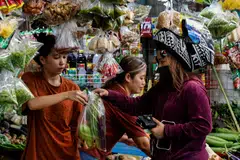



“We used to be very strong, selling jogging pants, sportswear in Canada and the US,” Young said. “Not anymore. We can only sell those things with higher, more elaborate trends.”
To that end, an export arm of the government last month converted a sprawling former trade centre complex into the Likhang Filipino Exhibition Halls – six curated galleries, with each dedicated to product categories such as fashion and textiles, furniture and lighting, home decor and traditional arts.
Meant as a permanent showroom and marketplace to showcase Filipino products and host international buyers, the space opened on Jan 20 but had few visitors on a recent weekday.
“This is good, at least this is something,” Young said in a hall laid out with lounge room furniture and lights. “But it’s not enough. No matter how many showcases you build, it’s infrastructure and the ease of doing business that you have to attend to.” BLOOMBERG
Decoding Asia newsletter: your guide to navigating Asia in a new global order. Sign up here to get Decoding Asia newsletter. Delivered to your inbox. Free.
Share with us your feedback on BT's products and services
TRENDING NOW

Indonesia begins cutting natural gas exports to Singapore from Oct 24: reports

Singapore’s central gas buyer affirms Indonesia’s role as ‘important partner’ amid export review warning

KKR founders among investors buying 42% of Peter Lim’s Valencia; club valued at US$1.4 billion

NEA issues notices to 10 Singapore-based companies, including Wilmar and APP, over haze

