Ready-to-eat meals a growing business for restaurant group Tung Lok
CEO Andrew Tjioe expects the return of tourists to boost financial performance too

Sharon See
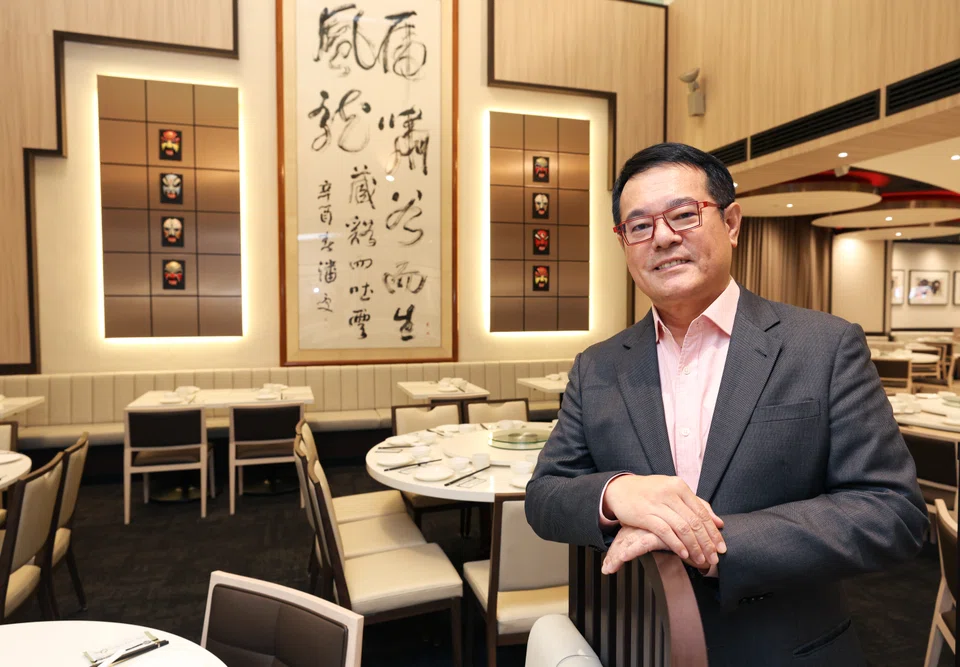
ANDREW Tjioe’s refrigerator is usually full of frozen ready-to-eat dishes, ranging from braised pork to dumplings. Produced at the central kitchen of Tung Lok Group – the restaurant operator he founded – these dishes have become mainstays of his dining table.
“I use them in our family regularly, if not on a daily basis,” says Tjioe, who is also chief executive of the Catalist-listed restaurant group.
Herbal chicken, braised pork shank and guo tie (potstickers) are his family’s favourites, he says. “So, I have to ensure that the products are of good quality, healthy, and you can have it on a daily basis.”
Tung Lok’s foray into the frozen food business started before the Covid-19 pandemic. It turned out to be a fortuitous move, giving the company a stream of revenue even when the dining scene was heavily curbed in 2020 and 2021.
Sales of frozen food shot up 400 per cent in the first year of the pandemic, Tjioe says, since people could not dine out. The company used the downtime at its restaurants to increase the variety of ready-to-eat dishes offered, which now stands at 64 items.
“My chefs were very free,” Tjioe says with a laugh. “Rather than waiting, they might as well do R&D (research and development).”
Besides Chinese cuisine, the group also branched into other cuisines: plant-based, Western and even halal.
Any food that takes time to braise or stew is a good candidate for preparation in the central kitchen, which supplies its network of restaurants, Tjioe says.
“How can you make goulash in the kitchen on the same day, and expect that this will be good? No way,” he points out. “The taste is better if it is done yesterday.”
A blast freezer allows food to retain its freshness in taste. There is “no better way” of maintaining consistency in taste and quality than using a central kitchen, he says, adding that this model is also “idiot-proof” for staff: “As long as they’re very clear in their mind, don’t measure wrongly, nothing can go wrong.”
The bulk of Tung Lok’s ready-to-eat sales are made via e-commerce platforms and retail corners at its restaurants. But Tjioe hopes to supply businesses in the future: “If you want to open a restaurant, you can just select 20 or 30 items from our 64 items and you’re in business. (It’s) very easy, you’re no longer chef-dependent.”
All hands on deck
As for Tung Lok’s own restaurants, bulk cooking in the central kitchen has helped boost productivity. This means restaurant staff can concentrate on tasks that the kitchen cannot perform, such as serving customers.
“That’s how you maintain the same amount of sales, revenue, but with much less manpower,” Tjioe says.
Like others in the food and beverage (F&B) industry, Tung Lok is facing a labour crunch even as manpower costs have grown. Last year, he says, wages rose 15 per cent year on year.
“That’s why we switched to robots, and we deploy, at the moment, 20 food delivery robots at different restaurants,” he remarks.
The group has about 500 employees now – a level Tjioe described as “leaner and meaner” – down from 800 just before the pandemic hit.
“I’ve never laid off anybody (before), and I laid off 200,” he notes, recalling the difficult decision he made before the “circuit breaker” or partial lockdown in April 2020. “I just thought that if we don’t do it, we’ll be in trouble.”
After some foreign workers headed back to their home countries, total headcount fell further to 400.
What Tjioe did not expect was that the company would be approached by the authorities to supply meal boxes to migrant worker dormitories. While Tung Lok was “not big in catering”, it took on the business since Covid curbs meant that many staff would otherwise have had to stay home.
“Every outlet can only have two (staff) inside and two outside… so what am I going to do with the rest? Go to the central kitchen to do packing,” he says.
For four months, everyone in the company was mobilised – including the executive chef, general manager and Tjioe himself – to produce 15,000 bento meals a day, almost round the clock.
“If the CEO can become a packer, nobody cannot,” he recalls. “It was an experience.”
Bouncing back
Government support for businesses during the pandemic was critical, says Tjioe. Without it, there would have been “more bloodshed”. Tung Lok avoided losses in 2020 as a result, although it was “kind of squeezed” by the on-and-off-again dine-in restrictions in 2021.
But by last year, with the lifting of restrictions, business bounced back to pre-pandemic levels.
Revenue nearly doubled to S$39.1 million for the half-year ended Sep 30, 2022, from S$20.3 million in the year-ago period.
This helped the company rake in a net profit of S$1 million, compared with a loss of S$3.4 million previously.
Over the past year, the company also took the opportunity to reorganise its offerings. It closed eight outlets, most of which had leases that were up for renewal: “We just didn’t renew, especially when the landlord was unreasonable by asking for more rent during the pandemic.”
Tung Lok also downsized some restaurants that were “too big”, and used the excess space for a separate brand.
One example is Douraku Sushi, which occupies part of the 10,000-square-foot space that used to belong entirely to Tung Lok Seafood at d’Arena along Upper Jurong Road. The space turned out to be excessive for just one restaurant during the pandemic, he adds.
As a restaurant business, it is important to be constantly clued in to what is going on in the market, says Tjioe.
The typical “spender” these days is aged 25 to 40, health-conscious, and cares about sustainable food sources. That is the direction taken by Tung Lok’s new dining concept Qin Restaurant and Bar.
“We care about the environment, especially after going through those very terrible periods of the haze,” he says. The company decided then to drop any use of palm oil, as the haze is mainly caused by fires set to clear land for such plantations.
Tjioe is also hopeful that improvements in farming technology in Singapore will make it viable for the company to turn to more local food sources, even if they may be pricier.
As for the outlook this year, he says: “F&B will always have a place in our society for as long as Singapore’s economy continues to grow, especially when funds are still coming in, and investments are still coming in.”
He considers it fortunate that Tung Lok was “not so much affected” by the low tourist arrivals in recent years, as its main customers are locals and businesses. Still, China’s reopening is expected to have a “positive impact” on Tung Lok’s financial performance, driven by the influx of conferences and corporate events, as well as tourist spending.
Tjioe also noted that Singapore has been attracting the super rich thanks to its swift handling of Covid-19. This flow of “hot money” into the city-state has brought along clientele who spend upwards of S$20,000 per meal at Tung Lok’s fine-dining establishments.
While such high-end expenditure was not uncommon pre-pandemic, it is surprising that Singapore is “enjoying this” at a time of global economic uncertainty, he adds.