Staff-served buffet lines not faring well: caterers
Published Thu, May 6, 2021 · 09:50 PM

    Singapore

    STAFF-SERVED buffet lines will continue to be a fixture even as Singapore moves to Phase 2, but this arrangement is cold comfort for most in the catering business.

    Buffets lines, suspended last year because of the pandemic, were allowed to resume on April 12 - but since then, caterers have noticed that demand, including from corporate customers, has been lacklustre.

    Those that have managed to survive continue to rely on offering bentos, tingkat meals (served in tiffin carriers) or bulk sales to hotels and dorms, for example.

    So although dining establishments will be allowed to accept groups of up to five persons from Saturday - down from the current eight - buffets have been allowed to continue, subject to existing rules.

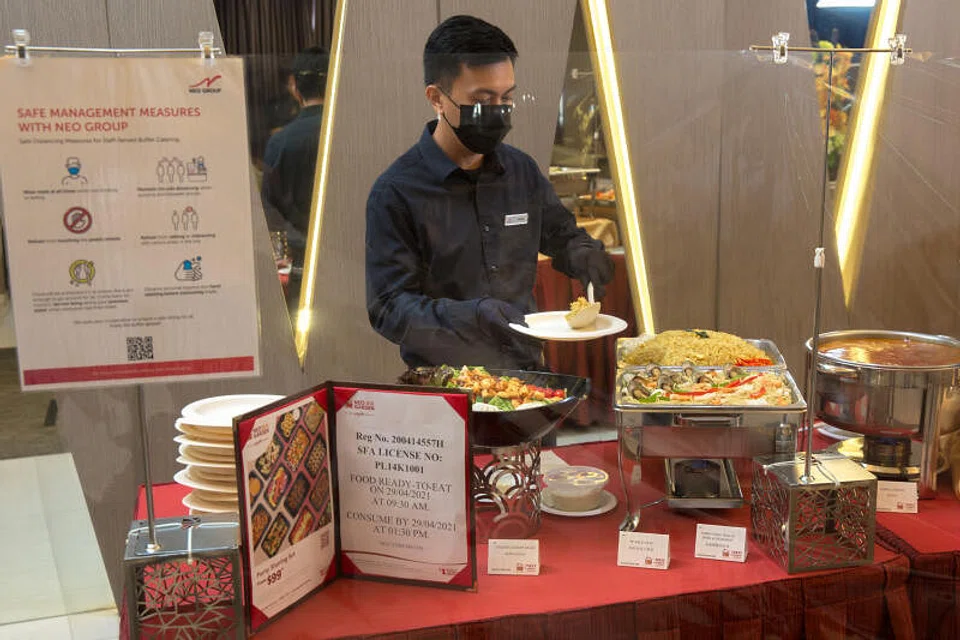
    These are that staff are to serve the food in individual portions only, and each food line can have a maximum of 50 persons.

    Vincent Phang, president of the Association of Catering Professionals Singapore (ACAPS), which represents about 80 caterers, said: "Caterers were looking forward to the resumption (of buffet lines), but the result has not been good. I called a few members and they have not gotten any bookings."

    Mr Phang, who is also chief executive of Tung Lok Group's events and catering division, noted that food delivery services - with fewer restrictions such as minimum orders - are more convenient.

    Corporations are still wary of hosting events, especially considering the surge in community cases recently, he said. With the latest curbs, more companies will encourage employees to work from home, and this decreased interaction in office settings will hit buffet catering, he added.

    Caterers The Business Times spoke to said they were getting enquiries about buffet catering, but not even half the number they used to get pre-Covid.

    Sally Liew, executive director of Neo Group, which operates 17 brands under its catering arm, including Neo Garden and Deli Hub, said demand for buffets is now "not that significant", especially when households - a traditional market segment for caterers - are still subject to a cap in number of visitors per day.

    Since food lines were allowed back last month, catered buffets have only made up about 10 per cent of orders - a far cry from approximately 80 per cent before the pandemic, she added.

    Terence Han, assistant director of Stamford Catering Services, agreed, noting that bentos and other packed-meal options continue to make up the lion's share of orders.

    Many companies are still working in a split-team format, and with the maximum office capacity being lowered again, the situation with buffet lines will only worsen, he said. "There's no rush to have buffets, no huge demand."

    Chief executive of Amici Events & Catering Willie Tan said his firm would serve buffets at an average of 20 events a day during pre-Covid times; today, it serves at two.

    On the heels of the advisory from Enterprise Singapore to F&B establishments to limit dining groups to five persons from May 8, Amici said it will track developments and may suspend buffet catering if necessary.

    As it is, several companies have already called to postpone their events, Mr Tan said.

    Business costs have also risen. In order to operate buffets at corporate and work-related events, caterers need to follow safe-distancing guidelines. Measures include keeping a 1-m distance between customers, using new plates for every serving, installing sneeze guards over the food and providing packed cutlery and hand sanitiser - all of which add to costs.

    The most significant change, however, is the need for manpower to service the buffet lines, since guests are not allowed to serve themselves. Some caterers have had to reallocate their resources; others have chosen to recruit.

    Even before hiring servers became standard practice, Neo Group had provided them as an option for its clients. To service its buffet lines now, it deploys two servers at S$60 per server for four hours - the same price it was offering before, said Ms Liew.

    The online restaurant Grain said it will charge S$50 per server for three hours when it resumes buffet lines, with no mark-up from its previous cost, said its chief operating officer Ena Lee.

    Stamford Catering is currently absorbing the additional manpower costs since the volume of orders is still manageable.

    Chris Loh, co-founder and co-owner of Rasel Catering and co-owner of Purple Sage Group, said she has had to raise wages by about 15 per cent to keep her workers.

    Amici is also hiring, but it is not only seeking servers; it is looking for those with a wider range of operational skills.

    In the past, butlers could be hired from Amici to cater to clients' every need, be it food top-up, queue management or VIP care. Staff service now looks slightly different, Mr Tan noted, with servers being only required to be stationed behind buffet lines during the event.

    Another cost factor to consider is food costs, which have risen alongside freight costs in the pandemic, though the increase varies at 2-20 per cent. With smaller event sizes, caterers are also unable to capitalise on economies of scale.

    Staff-served lines may not be to everyone's tastes. Clients have commented that they no longer have the freedom to choose what and how much food to take, said Rasel's Ms Loh. The serving of food can also be quite stressful for both the server and consumer if the majority of the participants queue up at the buffet at the same time, added Amici's Mr Tan.

    Online catering portal FoodLine.sg has found that users of its website tend to browse from tingkat, mini buffet, bento and a la carte menus; buffet orders now stand at less than 1 per cent of pre-Covid levels.

    The Department of Statistics says that between February and December last year, food caterers' sales fell by between 31.5 and 78.2 per cent, compared to corresponding months in 2019. For March 2021, the most recent data for which retail sales for the sector is available, a 25 per cent fall in year-on-year sales was recorded.