

Temasek-backed biotech Oxford Nanopore wants to make genetics tech accessible to startups
The London-listed company is working with Singapore to catalogue 10,000 genes, which can help to pinpoint how genetic factors influence responses to medication

WHEN the Covid-19 pandemic broke out, countries scrambled for a way to quickly detect the disease.
This brought public attention to the field of genomics – a branch of molecular biology concerned with the structure and function of the genome, which is the genetic information of an organism, and can be used to identify the presence of the virus.
Among companies in this field is London-listed Oxford Nanopore Technologies, which was spotlighted for providing Covid-19 test kits to the UK’s National Health Service. An offshoot of Oxford University, its sequencing technology was used by researchers to characterise the genome of the Sars-CoV-2 virus to identify and track variants.
Post-Covid, the company is leveraging the portability of its products to further precision medicine, which aims to understand how genomic and other factors contribute to the health of individuals – basically tailoring treatment to people who have a similar make-up.
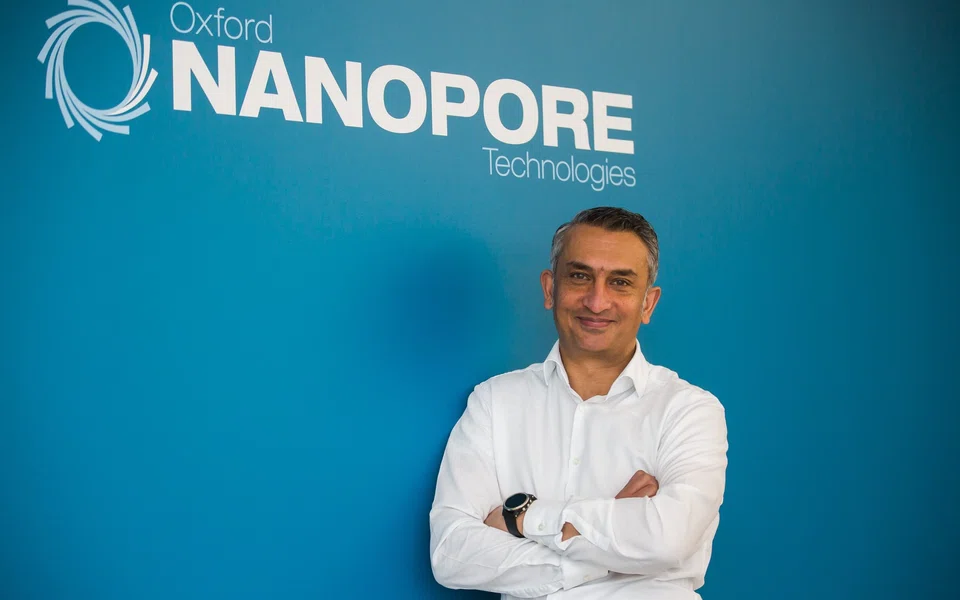
Gordon Sanghera, chief executive of Oxford Nanopore, said: “We’re interested in the source code of all these living systems… It’s a real time, interactive understanding of our biology.”
Oxford Nanopore in August announced that it would be working on a project with Singapore’s National Precision Medicine programme, led by Precision Health Research, Singapore (Precise). It aims to develop a comprehensive catalogue representing three major ethnic groups in Singapore – Chinese, Malay and Indian.
The company will be sequencing 10,000 multi-ancestry genomes representing Singapore’s population under the Precise-SG100K research programme led by the Ministry of Health. The project, announced in 2022, will involve the complete set of genes for 100,000 Singaporeans in total.
Kathleen Barnes, Oxford Nanopore’s senior vice-president of population health and precision medicine, said characterising genomes of different ancestry groups is important as it would enable people to understand what mutations may exist within these genomes, as well as the risks within these genomes.
Said Barnes: “Eighty-five per cent of what (DNA) has been sequenced in the world today are of European-ancestry populations. We’re trying to catch up in other groups.”
She added that South-east Asia is potentially the most under-represented and diverse population when it comes to DNA sequencing.
“So to create that equity in healthcare and develop precision medicine tools that are going to change the lives of patients in this part of the world, we have to have that reference genome – that library, if you will – of variation,” she said.
“There’s much that hasn’t been identified in this part of the world.”
To reach out to the Asia-Pacific region, Oxford Nanopore established its regional headquarters in Singapore in 2018, said CEO Sanghera. It also uses Singapore as a distribution centre for its regional customers.
It has 150 active customers and collaborators here, including the National University of Singapore and Tan Tock Seng Hospital.
The group is also backed by Singapore state investors Temasek and GIC. Temasek joined a May 2021 fundraising round and was reported to have put in £125 million (S$214.9 million) jointly with Wellington Management, M&G Investments and Nikon. GIC invested in Oxford Nanopore in 2018.
Tech on the go
DNA sequencing is not new, but several companies, including dominant players such as US-headquartered Illumina and China-based BGI Group, make use of older technologies that require centralised facilities, noted Sanghera, who co-founded Oxford Nanopore in 2005.
In his view, these technologies also do not paint the full picture of the genome, as it leaves out some parts – he compared it to a black-and-white picture, whereas Oxford Nanopore’s results would be “high definition and in colour”.
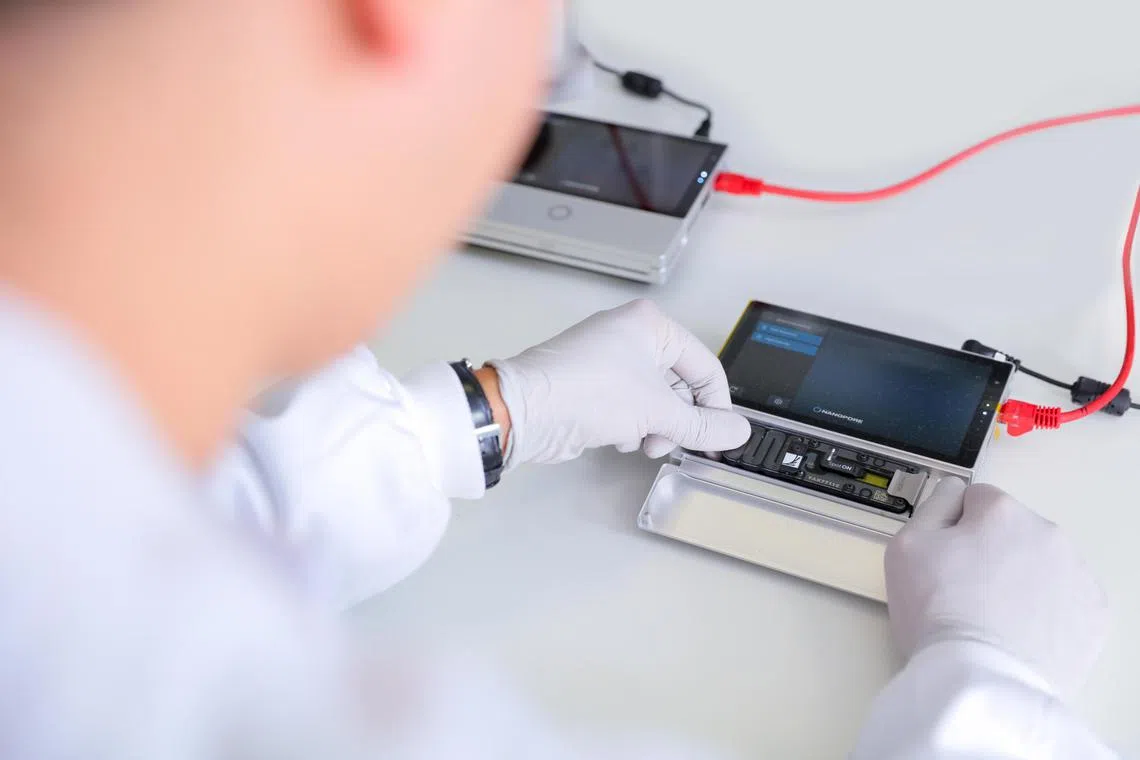
Oxford Nanopore builds on these technologies to create a more affordable DNA sequencer that is portable. With this, Sanghera aims to “change the dynamics” of the DNA sequencing equipment and consumables market, estimated to be worth around US$6.2 billion in 2024.
“Instead of having researchers send their samples to those large, multi-million dollar infrastructures… they can start to sequence at their lab sites,” he said. He estimates that Oxford Nanopore is currently at a 4 to 5 per cent rate of penetration and growth globally.
The largely different proposition compared to the incumbent players led to the company’s prominence during the pandemic. When it went public in October 2021, Oxford Nanopore was valued at nearly £5 billion.
The company generated a revenue of £84.1 million for the six months ended Jun 30, down 2.2 per cent on-year from £86 million, Oxford Nanopore announced on Tuesday (Sep 3).
Underlying revenue, which excludes revenue from Covid sequencing as well as The Emirati Genome Program in Abu Dhabi, was up 9.2 per cent to £82.6 million from £75.6 million.
However, adjusted loss before interest, taxes, depreciation, and amortisation (Lbitda) widened to £61.6 million from £39.4 million, due to increased operational expenses. Lbitda did improve versus £65.6 million in H2 2023.
Sanghera told The Business Times before the results that the group is on-track for its goal of Ebitda (earnings before interest, taxes, depreciation, and amortisation) breakeven by the end of 2027.
Growing the ecosystem
With higher accessibility comes opportunities for companies with fewer resources to tap into the growing genomics industry. Sanghera said startups and small and medium enterprises can make use of Oxford Nanopore’s technology to enter the genomic research space.
Barnes compared the company’s technology to the smartphone, which acts as a base for other developers to build their software. “We have built the technology, and working with startup partners, there’s the opportunity to build applications,” she said.
These partner companies can help to create a clinical application out of Oxford Nanopore’s technology, designing a diagnostic test that would be usable in a healthcare setting, she added. For example, it can be used to predict cardiovascular disease in those aged under 20.
She noted that the 10,000 genomes that are part of the company’s project with Singapore’s National Precision Medicine programme will create an opportunity in the area of pharmacogenetics, which looks at how genetic factors affect how people react to medication.

“We know a certain genetic mutation will predict how you respond to medication. This should be the easiest thing to monitor preemptively, but because of cost policies and access to the technology, it isn’t widely adopted,” she said.
“So with this new knowledge that will be gained with the 10,000 genomes, not only is there an opportunity to scale, there’s also an opportunity to identify novel variants associated with how you respond to a drug, that we don’t even know about,” she said.
Sanghera highlighted that the initiatives in precision medicine rolled out by Singapore are likely to foster innovation in several fields, which can then be exported to the rest of Asia-Pacific.
“You can take these science breakthroughs and turn them into real-world applications, whether that is diagnostics, healthcare, food industry contamination or biopharma manufacturing,” he said.
TRENDING NOW

Nvidia CEO Jensen Huang’s confession engulfs chip giant in spying controversy

China recruited exec at Singapore data centre firm to spy on Nvidia CEO Jensen Huang: US intelligence

Higher rates, weaker spending: Is the Philippines entering stagflation?

Could Japan trigger the next global financial crisis?

