



ThaiBev expected to still dominate domestic market as Thailand eases liquor production laws
High barriers to entry for small producers and entrepreneurs abound, including time needed to build up networks, maintain quality control

THAILAND’S Lower House recently passed a Bill to promote liquor production by small distilleries and breweries, in a move designed to loosen the grip of the kingdom’s dominant liquor players.
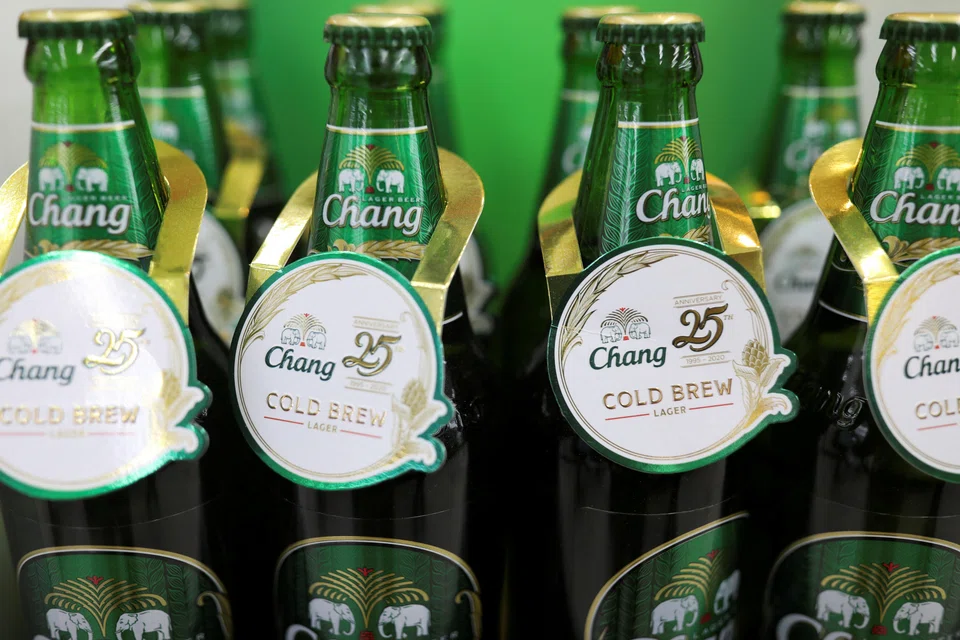
But market watchers believe that the domestic market share of Thai Beverage ( ThaiBev ) is unlikely to be heavily shaken. The maker of Chang Beer has built up an entrenched distribution network in Thailand over several years, and this would be difficult for new entrants to replicate.
New players will also have to navigate the country’s strict advertising rules for alcohol.
Dominant market leaders
The Community Liquor Bill, which received approval from lawmakers in Thailand’s House of Representatives, opens the way for individual entrepreneurs, cooperatives and farmers’ groups to secure licences to produce and trade liquor.
Some media reports suggested that new players may affect the incumbent ones, particularly Singapore-listed ThaiBev and Boon Rawd Brewery, which are dominant in the kingdom’s beer and spirits market.
However, analysts who spoke to The Business Times pointed to the many barriers that the new players would have to overcome.
Alfie Yeo, senior research analyst at RHB Singapore, said that as a market leader, ThaiBev enjoys the kind of scale that only other major beer players can rival: “We believe it wouldn’t be easy for smaller players to take market share away from the incumbents, since it will involve brand building and distribution network, which takes time.”
Meghana Kande, research analyst at CGS International Securities Singapore, agreed, saying: “Near-term barriers to entry for alcohol producers are still high, given the time and capital required to build production capacity and distribution networks, and maintain quality standards.”
She estimated that ThaiBev has around 90 per cent of the domestic market share for spirits by volume; in the beer arena, it has cornered 42 per cent of the market.
For the fiscal year 2024, the top line for both segments grew. Revenue from spirits rose 0.8 per cent to 120.7 billion baht (S$4.8 billion); that from beer climbed 2.4 per cent to 126.3 billion baht.
Spirits and beer contribute to 35.5 per cent and 37.1 per cent, respectively, of ThaiBev’s overall FY2024 top line.
Other factors
Analysts also credited other factors, including ThaiBev’s own efforts, which could make it difficult for new entrants to scale up in the industry.
DBS Group Research analysts Andy Sim and Chee Zheng Feng noted ThaiBev’s regular refreshing of its line-up of spirits and beers, and the attention it has given to its non-alcoholic beverages and its businesses outside Thailand.
And then there are the kingdom’s strict alcohol advertising laws, which, for example, bar displays of the actual beverage, packaging and container; advertisements also cannot promote such alcoholic drinks in a positive light, such as by claiming health benefits.
That said, Sim and Chee believe new players could stimulate the overall market in terms of consumption, and grow the industry in terms of value, if not volume.
Paul Chew, head of research at Phillip Securities, said beyond these smaller players, the larger threat looming for ThaiBev is beverage maker Carabao Group, which has its sights on cornering a fifth of the market in three to five years.
In November 2023, the conglomerate entered the beer market through its Carabao and Tawandang beer brands. The group said then that it was aiming to become one of the top three players in Thailand’s beer market.
TRENDING NOW

Britain’s mansion tax shows the difficulty of targeting wealth

Once staunchly pro-China, Malaysian Chinese businesses are now distancing themselves from Beijing

The only common thing in S-E Asia is that we all eat rice: Cisco’s Asean president

Singapore data centre operator DayOne opts for US IPO at likely US$20 billion valuation

