

UK restaurant scheme big success, finds study
Incentive sees government contribute 50% of cost of cafe, restaurant or pub meal, up to £10 per person
 Add BT as a preferred source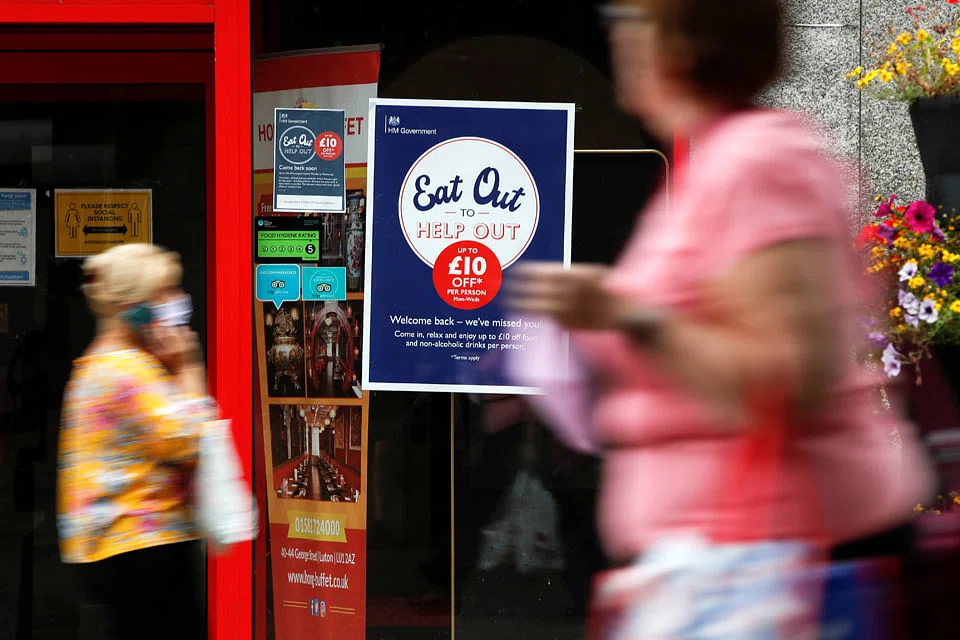
DeeperDive is a beta AI feature. Refer to full articles for the facts.
London
A BRITISH government scheme to encourage people to visit restaurants, by paying a slice of the bill, has boosted a sector devastated by the coronavirus, according to a study published on Monday.
The incentive - "Eat Out to Help Out" - is valid Monday to Wednesday through August, and sees the government contribute 50 per cent of the cost of a cafe, restaurant or pub meal, up to £10 (S$17.80) per person.
Analysis from the Centre for Economics and Business Research (CEBR) shows that despite the pandemic it has helped to increase diner numbers by more than a quarter year-on-year.
In the first two weeks of August, the number of people who ate out on the scheme's active days leapt 26.9 per cent, said the CEBR.
It noted the month-long scheme, crafted by finance minister Rishi Sunak, would give Britain "a much-needed boost towards normality".
Navigate Asia in
a new global order
Get the insights delivered to your inbox.
Nina Skero, an economist at CEBR, said it was "impossible to deny" that the initiative had been a success.
She noted it encouraged people to use restaurants while also helping people "get back into the habit of socialising", which could provide a broader economic benefit.
However, despite the scheme providing a rare piece of good news for Britain's reeling economy, analysts have noted it could be impacting customer levels on days when it is not in operation.
In contrast to the healthy restaurant figures for Monday to Wednesday, diner numbers fell 21.3 per cent on Thursday to Sunday, the CEBR said, citing figures from OpenTable, an online restaurant reservation service.
For the entire week, there was an overall drop of 7.1 per cent year-on-year - an improvement on the almost 30 per cent fall for the period prior to the scheme's introduction.
The government has set aside £500 million to fund the "Eat Out to Help Out" policy, which is aimed at aiding the struggling hospitality sector. It is one of various stimulus measures announced by Mr Sunak to try to kickstart the British economy, which has been devastated by the pandemic.
Official figures published in August revealed that the UK economy shrank by one fifth in the second quarter of 2020, more than any European neighbour, as the country's virus lockdown decimated businesses and plunged the country into its deepest recession on record.
Britain also has the worst economic record of the G-7 richest countries in the world over the same period.
More than 22,000 restaurant jobs have been cut since the start of the year, twice as many as for 2019 as a whole, according to a recent study from the Centre for Retail Research.
It also showed that 1,467 restaurants have closed, an increase of 59.1 per cent compared to 2019.
Among the UK high street chains impacted include Pizza Express, which has announced more than 1,000 possible job losses, and Carluccio's which has already collapsed. AFP
Decoding Asia newsletter: your guide to navigating Asia in a new global order. Sign up here to get Decoding Asia newsletter. Delivered to your inbox. Free.
Share with us your feedback on BT's products and services
TRENDING NOW

Shelving S$5 billion office redevelopment plan proved ‘wise’ as geopolitical risks mount: OCBC chairman

OCBC is said to emerge as lead bidder for HSBC Indonesia assets

Middle East-linked energy supply shocks put Asean Power Grid back in focus

Eurokars Group introduces rental car franchises Enterprise Rent-A-Car, National Car Rental, and Alamo to Singapore

