Corporate governance for the value era
There is significant room for improvement in disclosures relevant to shareholder value creation
THE Singapore Governance and Transparency Index (SGTI) 2026 has taken place amid significant changes in the Republic’s capital market ecosystem.
MAS’ announcement of the equities market review provided the impetus for much activity, from regulatory consultations and reviews to new listing rules and programmes aimed at revitalising the capital market. One focus of the discussion has been the importance of corporate governance in sustaining such a revitalisation.
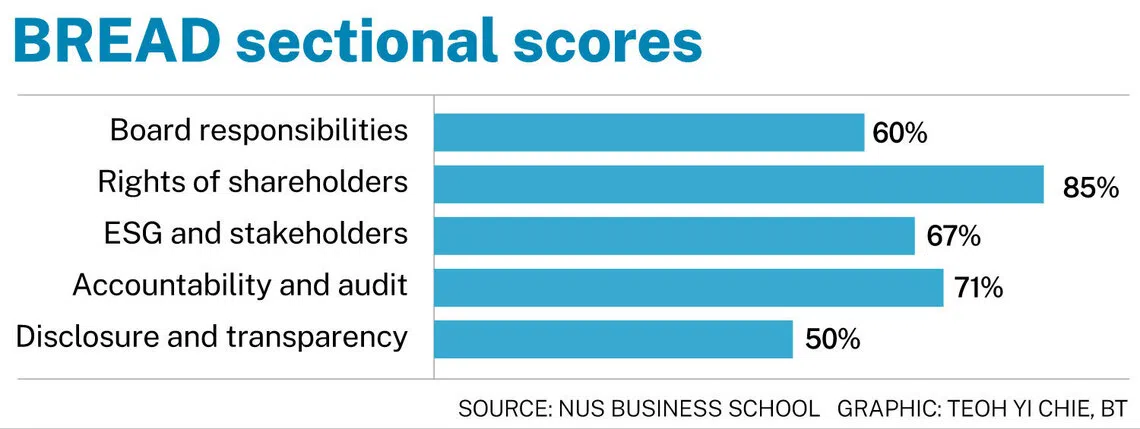
Against this backdrop, SGTI 2026 has a mean score of 69.5 points out of a maximum achievable score of 143 points. The base score covers five dimensions: board responsibilities (35 points), rights of shareholders (10 points), ESG and stakeholders (20 points), accountability and audit (10 points), and disclosure and transparency (25 points).
The final score is derived from the base score and an adjustment for bonuses and penalties (see also box insert “How scoring for the Index is done”).
Strongest performance is seen in disclosures relating to shareholder rights (mean normalised score of 85 per cent), followed by accountability and audit, and ESG and stakeholders (mean normalised scores of 71 per cent and 67 per cent respectively).
Rewards, returns and relations
The results of SGTI show that there is significant room for improvement in disclosures relevant to shareholder value creation. This can be seen in three areas featured in SGX RegCo’s recent consultation: remuneration, dividend policy and investor relations.
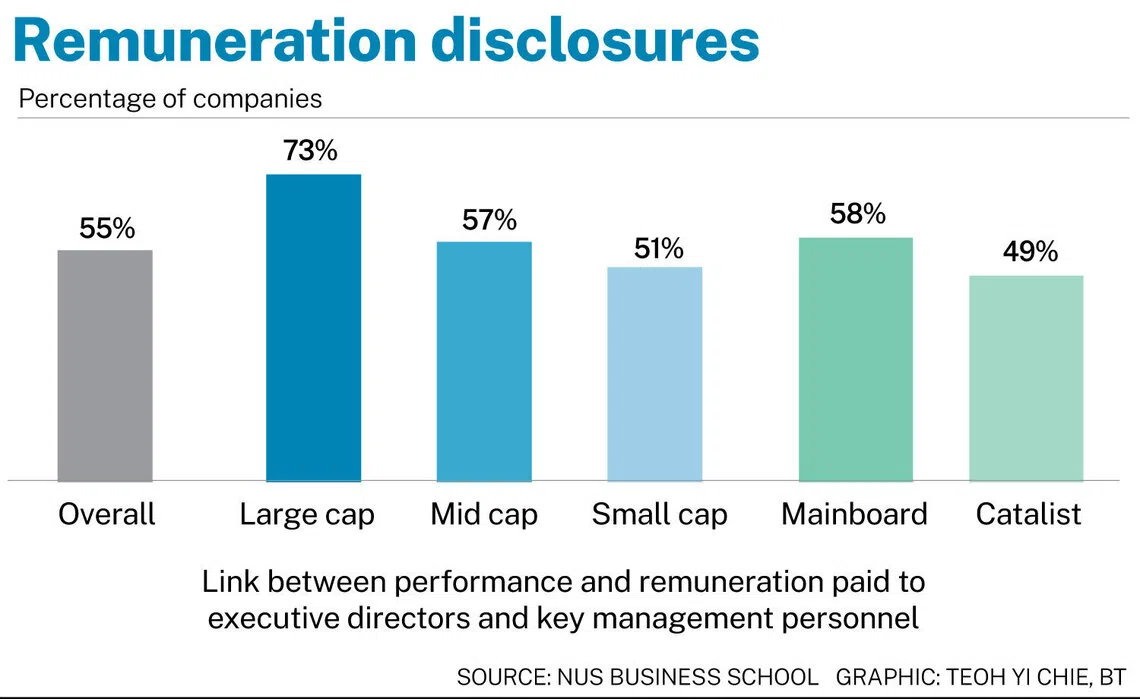
Due to Listing Rule 1207(10D), companies are disclosing the exact remuneration of directors and CEOs. However, just over half of the companies go further to disclose information on the link between the performance of executive directors (EDs) and key management personnel, and their remuneration.
As expected, there is a significant size effect. Seventy-three per cent of large-cap companies (defined as a market cap of more than S$1 billion) disclose information about the link between the performance and remuneration of their EDs and C-suite executives.
This is notably higher than the 57 per cent for mid-cap companies (market cap of S$300 million to S$1 billion) and 51 per cent of small-cap companies (market cap less than S$300 million). A narrower gap exists between mainboard and Catalist companies, with disclosure rates of 58 per cent and 49 per cent respectively.


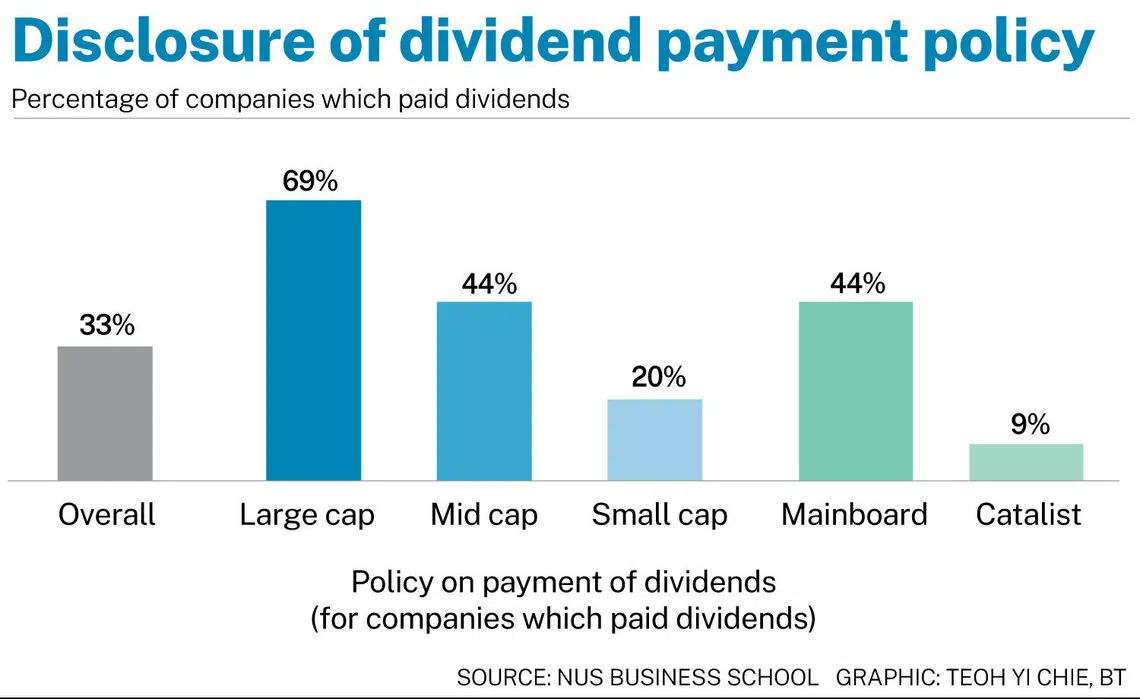
Disclosure of dividend payment policies is also low. Overall, only one-third of companies which paid dividends also disclosed their dividend payment policies. There is also a much larger difference between the two boards. Among the mainboard companies which paid dividends, 44 per cent disclosed their dividend payment policies, while for Catalist companies, this drops to 9 per cent.
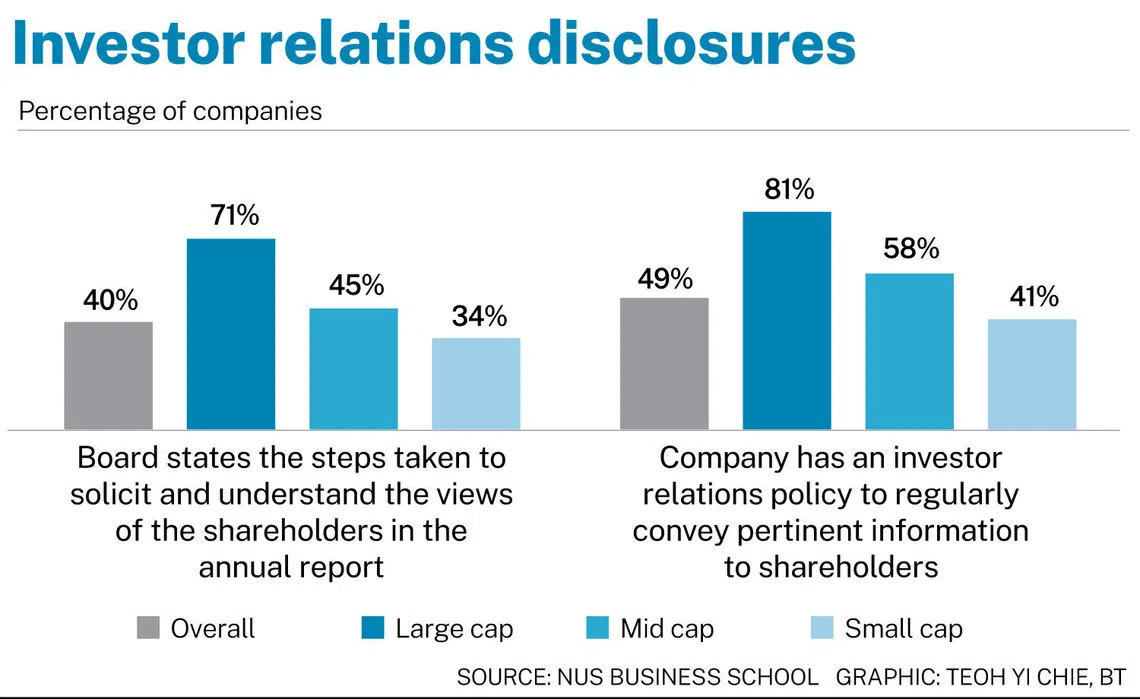
A similar picture emerges with investor relations disclosures. Only 40 per cent of the companies have boards disclosing in the annual report the steps taken to solicit and understand shareholders’ views, for example through analyst briefings, investor roadshows or Investors’ Day briefings.
Around half of the companies disclose having an investor relations policy to regularly convey pertinent information to shareholders. Again, both these indicators show a size and listing board effect.
An ecosystem in transition
The work of the Equities Market Review Group is complemented by the ongoing review of the Code of Corporate Governance, exploring how the Code can be updated to strengthen governance and disclosures such that they remain material for stakeholders, while maintaining proportionate compliance requirements for companies.
SGX has had several consultations in support of the Review Group’s recommendations, including on shifting to a more disclosure-based regime and on requiring enhanced disclosures on remuneration, dividend, and investor relations policies.
More recently, an industry-led initiative has emerged in the shape of the Institute of Singapore Chartered Accountants’ (ISCA) Strengthening Financial Reporting Taskforce, which aims to identify how companies can be more effective in communicating their performance, risks, and long-term value.
With these initiatives still in progress or having recently concluded, we have decided to defer the incorporation of value-related indicators into the SGTI assessment. We had earlier announced our plans to introduce such measures for the 2026 assessment. However, the various reviews will establish new disclosure requirements and refined governance priorities.
By timing our revisions after the review outcomes, we can ensure that our framework reflects the enhanced governance and reporting regime now emerging.
How scoring for the Index is done
The Singapore Governance and Transparency Index (SGTI) evaluates companies on their corporate governance practices and disclosures, as well as the timeliness, accessibility and transparency of their financial results.
Beginning in 2017, Real estate investment trusts (Reits) and business trusts have been assessed as well. The SGTI is a joint initiative of CPA Australia, NUS Business School’s Centre for Governance and Sustainability (CGS), and the Singapore Institute of Directors, supported by The Business Times.
The SGTI score has two components: the base score and the adjustment for bonuses and penalties. The base score for companies contains five pillars: board responsibilities (35 points), rights of shareholders (10 points), ESG and stakeholders (20 points), accountability and audit (10 points), and disclosure and transparency (25 points).
The aggregate of bonuses and penalties is incorporated to the base score to arrive at the company’s SGTI total score.
The SGTI also evaluates Reits and business trusts on similar criteria, but with added coverage on the unique nature of their operations. The base score for Reits and business trusts includes: questions in the base score for the SGTI (75 points) and additional questions in the base score for Reits and business trusts (25 points) that focus on structure, leverage, interested person transactions, competency of the Reit manager or trustee-manager, and emoluments.
A total of 458 Singapore-listed companies and 41 Reits and business trusts which released their annual reports and sustainability reports by May 31 were included for the SGTI 2026. The sources of information for SGTI assessment include annual reports, sustainability reports, websites, and announcements on the SGX website.
Announcements made on the SGX website as well as in media coverage, which occurred between Jan 1, 2024 and Apr 30, 2026, have been used to update the scores.
Further information on the scoring methodology, including the full instrument, and past results may be obtained from CGS’s website at http://bschool.nus.edu.sg/cgs. Queries about the SGTI may be sent to cgs@nus.edu.sg. In order to maintain independence and fairness of the SGTI, reports or advice cannot be provided to individual companies.
Linking governance to value
In the meantime, at CGS we have been reflecting on how to incorporate value into the SGTI framework. CGS is collaborating with ISCA on a study to identify what drives value, and how these drivers map to the current reporting system. We are starting with financial determinants, as these provide the most direct and measurable link between what companies disclose and the value they create for shareholders.
However, companies need not wait for the various initiatives to conclude. While allowance must be made for differences in sector and size, the results of SGTI show that considerable room for improvement remains.
The SGX consultation on enhanced disclosures for value creation and investor engagement gives a clear indication of the direction ahead. Companies can position themselves for coming requirements by providing meaningful, decision-useful information on their governance practices and value creation.
There has been encouraging progress since the launch of the review of the equities market, with increased trading activity and investor interest. To help sustain this momentum, companies need to keep their house in order through robust governance and transparent disclosures.
Lawrence Loh, Nguyen Hanh Trang, Nguyen Thi Thuy and Annette Singh are respectively director, senior research analyst, senior research associate and research lead of the Centre for Governance and Sustainability at NUS Business School
Decoding Asia newsletter: your guide to navigating Asia in a new global order. Sign up here to get Decoding Asia newsletter. Delivered to your inbox. Free.
Share with us your feedback on BT's products and services