Cromwell E-Reit to pivot to logistics for growth
It will start rebalancing its portfolio by acquiring warehouses in post-Brexit UK, and also in Central European markets
Singapore
CROMWELL European Reit (C-Reit) plans to rebalance its portfolio towards logistics properties, starting with acquiring warehouses in post-Brexit United Kingdom (UK), and also in less-traditional markets in Central Europe.
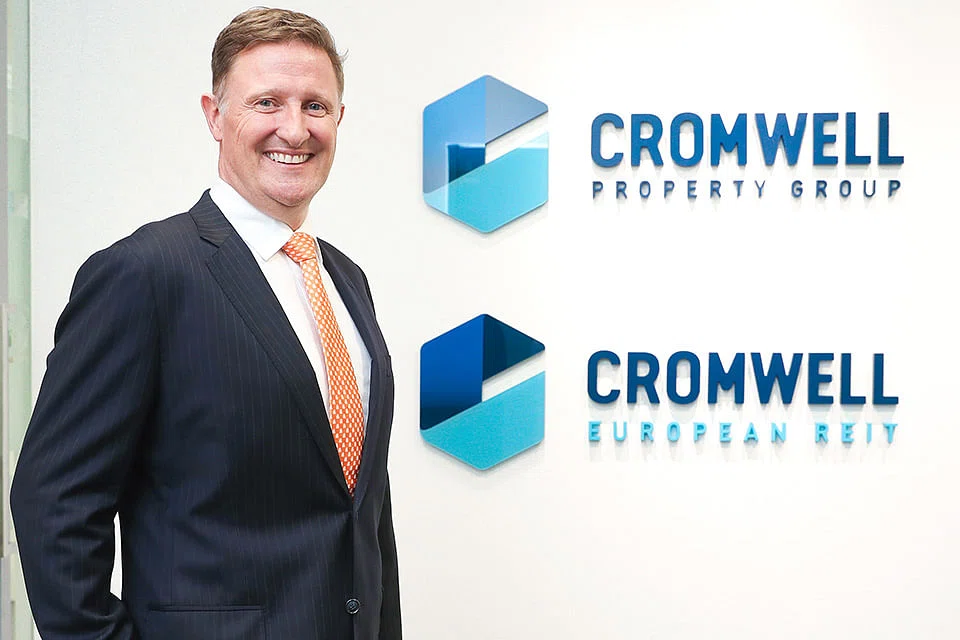
In an interviewon Tuesday, CEO of the manager Simon Garing also clarified that the ongoing tussle between ARA Asset Management and its sponsor Cromwell Property group has no impact on its plans to diversify into new geographies and nascent asset classes such as data centres.
The Reit has reported a net property income (NPI) of 30.8 million euros (S$49.6 million) for the first quarter ended March 31, 2021, down 0.4 per cent, partly due to rent reduction in some Italian properties, and the disposal of 12 higher-yielding and higher-risk assets in the Netherlands, France and Denmark. Gross revenue was nearly unchanged from the year before at 48.5 million euros.
Income available for distribution fell by 6.5 per cent to 21.7 million euros; pre-consolidation distribution per unit was also down 9.1 per cent to 0.827 euro cent, due to the timing of the investment of its private placement proceeds to offset the additional weighted average units on issue in March 2021.
The manager noted that the top and bottom line were almost at pre-Covid levels, as the eurozone economy was not yet affected by the pandemic in the first quarter of last year.
The portfolio is currently 57 per cent office and 38 per cent logistics. The Reit manager is eyeing a 50-50 split. In Q1, its office portfolio saw a rent reversion of -1 per cent across a small sample size of renewals, while occupancy dipped 0.6 percentage point to 94.5 per cent.
Its logistics portfolio clocked a 1.5 per cent rent reversion, dampened by the departure of a large anchor tenant which relocated to Belgium from Denmark. Half its space was leased out again at a 15 per cent discount. Past quarters have shown average rent increases of 2-4 per cent per annum for logistics, due to limited supply and high demand, Mr Garing said.
"As long as we can hold that zero to one per cent (rent reversion for the office portfolio) and deliver the 2-3 per cent (rent reversion for logistics), investors overall would benefit. This is why we're pivoting towards logistics. We don't see this as a one-year phenomenon. We see the the move to online shopping in Europe as a long-term structural change. We see more demand from the likes of UPS, DHL, and local third-party logistics providers, as well as larger retailers looking to put warehouses closer to the population."
Explaining how this barbell strategy works, he added: "The office provides long leases to government and multinational tenants, which provides the anchor to the income, and the logistics, which tends to be shorter leases, is where the market growth is happening."
He expects this to increase the market capitalisation of the Reit down the road. Singapore-listed logistics Reits here are trading at 1.3 to 1.5 times book, versus the average office Reits' multiple of 0.9 times. C-Reit was trading at 0.94 times book as at May 10.
The Reit has just completed its five-to-one unit consolidation to improve its trading liquidity, and believes that inclusion to the FTSE EPRA Nareit Global Real Estate Index will not be too faraway a goal.
Geographically, the Reit also recently bought 11 modern logistics assets in the Czech Republic and Slovakia. It also has six office assets Poland. Mr Garing said these assets allow the Reit to enjoy higher property yields while riding the growing office and logistics fundamentals there.
With its continued investment in Central and Eastern Europe, it expects its current 85 per cent exposure to Western Europe to shrink gradually to 75 per cent. The Reit does not yet have any UK exposure, partly because it has been awaiting a firm Brexit outcome. It is eyeing assets in the Midlands, a central distribution hub of the UK.
It added that prolonged lockdown extensions to combat a third resurgent wave of Covid-19 infections in various European markets have also resulted in a recent increase in rent re-profiling requests for the first time since October 2020. A fifth of its tenants has approached them for some relief, but most have simply moved from paying rent three months in advance to monthly.
C-Reit last July also signed a heads of terms agreement with its sponsor Cromwell Property and Stratus Data Centres to preliminarily co-invest directly into 50-per-cent stakes in two data centre projects in London and Frankfurt. In response to this, ARA had expressed shock, citing Cromwell's lack of expertise in the asset class. Cromwell later pulled out when the deal structure changed. ARA had also taken issue before with Cromwell's interests in Polish retail property.
Last year, ARA mounted a proportional takeover offer for the Brisbane-based fund manager to buy 29 per cent of the register it did not already control. It also managed to get two of its nominees Gary Weiss and Joe Gersh appointed into the boardroom. Cromwell lost its chairman and two other directors, who were replaced by Rob Blain, executive chairman of CBRE Asia Pacific, and and Ooi Eng Peng, chairman of ESR-Reit.
To this, Mr Garing simply said: "What's pleasing is that the majority of those directors (on Cromwell's board) are independent and experienced business people." ARA has a 28.45 per cent stake in Cromwell Property Group, and no direct stake in C-Reit or its manager.
Units of Cromwell E-Reit closed flat at 2.40 euros or S$3.83.