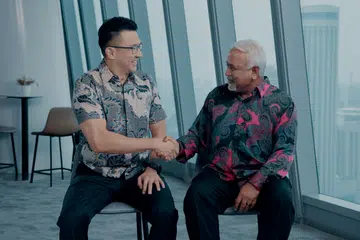
Anext Bank’s new CEO leverages CTO stint to grow SME lending by financing AI hardware
Qiu Kai takes unusual route to corner office at Ant International unit


[SINGAPORE] It has been about one and a half years since Qiu Kai took over as chief executive of digital wholesale lender Anext Bank, stepping up from his previous role as chief technology officer (CTO).
The route from CTO to CEO is uncommon, he acknowledged, but one that has proven valuable at a technology-driven, digital wholesale bank.
“Now in the role of CEO, it widens my lens. I’ve got a lot more information and understanding from other areas of the business that allows me to better leverage my technical knowledge to come up with more sustainable and different kinds of strategies,” he told The Business Times.
Anext, launched in 2022, is a Singapore-incorporated digital wholesale bank that primarily serves micro, small and medium-sized enterprises (MSMEs). Its parent company, Ant International, is the overseas arm of Ant Group, the fintech giant linked to Alibaba Group.
One of Anext’s strategies that Qiu is focusing on is graphics processing unit (GPU) financing, through which companies obtain loans by offering up their AI hardware as collateral. Anext’s role is thus to finance the hardware needed for artificial intelligence models. Banks such as Japan’s Mitsubishi UFJ Financial Group have undertaken GPU financing for a number of players in this space.
The bank is “doing quite well” in AI infrastructure financing, said Qiu, after spending 2025 studying the sector and identifying sustainable growth opportunities.
“I think we are one of the first movers in the market, and we’ve also established quite well-connected networks with players in the region.”
GPU financing, alongside secured lending, will form the foundation for Anext’s plans to scale its unsecured lending business. Qiu noted that a strong loan portfolio is essential for a digital wholesale bank, and these products will help it to expand lending in its MSME segment.
Meanwhile, the bank is seeking to grow its unsecured lending business through CreditNow, Anext’s embedded unsecured lending product.
The product taps on alternative data, extending unsecured credit to SMEs that may otherwise struggle to get financing. For eligible SMEs, application time has been reduced from about 30 minutes to about a minute with no manual document uploads required.
Anext also partners other ecosystems to offer unsecured lending, such as parent company Ant International’s Antom, which acquired Singapore point-of-sale (POS) solutions company Epos. With Antom, live POS data is used to assess business performance and get a credit offering.
CreditNow is available to over 100,000 merchants across more than 15 POS providers; more platforms will be added this year.
A key factor in scaling CreditNow will be in identifying and understanding the alternative data points that MSMEs can provide, said Qiu. This can range from POS data to e-commerce or delivery platform data, depending on the partner ecosystem.
“Our credit and data scientists teams come in to understand the whole ecosystem, and come up with a model so that we are able to give a credit decision instantly,” he said.
AI is also being leveraged to better understand customers via alternative data to build credit models. Aside from credit, AI is also being used for internal operations, from know-your-customer processes to anti-money laundering.
These efforts have improved operational efficiency and can lower the cost of serving these MSME customers, said Qiu. Being part of a bigger group in Ant International is also a benefit, given that Anext can tap its parent’s investments into AI.
Sticking to Singapore
Unlike its full digital bank competitors, Anext remains Singapore-focused, and has no plans to pursue bank licences elsewhere, said Qiu.
Singapore remains central to Anext’s growth strategy, although the bank is also targeting businesses expanding into the city-state from markets such as Hong Kong and China, noted Qiu. The bank is leveraging its remote onboarding capabilities to attract these entrepreneurs to bank with it.
Qiu also sees opportunities to deepen collaboration within the Ant International ecosystem, both to enhance services and acquire inbound customers from subsidiaries such as payments company WorldFirst or digital lender Bettr.
“So that’s why I think we don’t have to do anything else – just closely tie up and work with Ant International to have better synergy,” he said.
Anext aims to position itself as the primary operating bank for Singapore MSMEs by maintaining simple and affordable pricing, said Qiu. The bank is also embedding its deposit accounts onto payment service providers such as WorldFirst, which lets customers open a fixed deposit account to receive payments in Singapore dollars while earning interest.
“In 2025, the deposit base grew about 27 per cent to cross S$1.2 billion,” said Qiu, adding that there are plans to continue expanding the offering through partnerships.
In his first year at the helm, Anext reported a fall in net interest income to S$38.2 million in 2025, from S$41 million in 2024. Its losses grew to S$49.8 million from S$37.2 million.
But interest income grew to S$68.3 million in 2025, from S$61.4 million in 2024. Fee income fell to S$2 million from S$3.3 million, while net trading income grew to S$2.3 million from S$683,000.
Qiu said the bank is “on the right track” to breaking even by 2027, which the Monetary Authority of Singapore has spelt out as a requirement.
One of his biggest priorities is ensuring that Anext continues to serve its customers better. Qiu often reaches out through his own personal network to get feedback on the bank’s products.
“We need to have that DNA to stay very close to our customer…We have to stay close to the ground to understand the pain and come up with new products to better help them,” he said.
Looking ahead, Anext will focus on building its foundation to scale up its CreditNow product through partners, both internal and external. A major area of focus will be identifying new alternative data sources to improve credit assessment.
“In today’s era, the critical part is how well and how widely you look for those data points, and that’s something that requires a lot of innovation and partnerships,” he added.