

Data centre giants in Singapore play down double whammy of US chip curbs, reported Nvidia shipment freeze
Analysts warn of project delays and more cautious investment, even among global hyperscalers

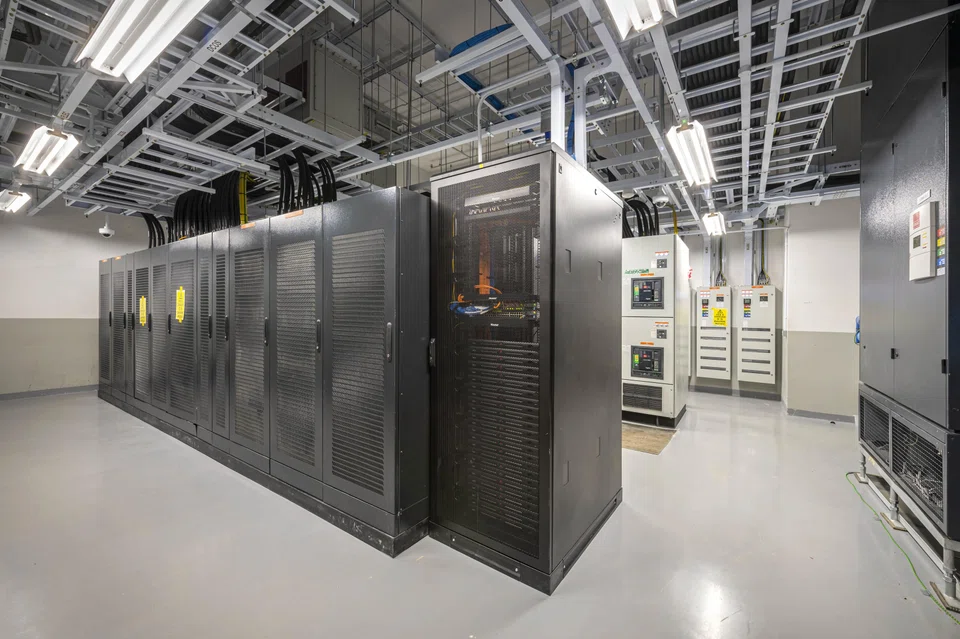
[SINGAPORE] US data centre giants Equinix and Digital Realty are playing down the fallout from Nvidia’s reported suspension of artificial intelligence server shipments to South-east Asia, even as analysts warn of project delays, higher compliance costs and more cautious lending.
While analysts expect the reported Nvidia chip ban affecting Singapore, Malaysia, Thailand and Indonesia to be temporary, it adds to the uncertainty facing a region already grappling with tighter US semiconductor controls announced on Nov 16, aimed at curbing China’s access to advanced chips.
Deputy Prime Minister Gan Kim Yong said on Friday (Nov 27) that Singapore has not confirmed the shipment halt, first reported by the Financial Times.
“Our confidence in South-east Asia is unchanged,” an Equinix spokesperson told The Business Times, pointing to broad-based demand from enterprises, cloud and network providers, and financial services firms.
Its customers continue to plan for long-term growth, and the company continues to invest across Singapore, Malaysia, Indonesia, Thailand and the Philippines, the spokesperson said.
Equinix noted that as a colocation provider, it does not directly provide access to computing power, including advanced graphics processing units.
Digital Realty, meanwhile, expects limited impact on its existing business, given that its South-east Asian operations primarily serve cloud and enterprise customers through colocation services.
It is reviewing the latest US export controls to assess their implications, including licensing and reporting requirements.
Other data centre players operating here – including Keppel, ST Telemedia Global Data Centres, Singtel and AirTrunk – declined to comment. Nvidia has yet to respond to queries.
Shipment freeze could delay projects
Analysts expect Nvidia’s reported shipment suspension to be temporary, although it could disrupt project timelines and financing as uncertainties remain.
Paul Chew, head of research at Phillip Securities Research, views the suspension as “precautions against all the new (US) regulations”.
Meanwhile, Andrew Kitson, head of technology industry research at BMI, a unit of Fitch Solutions, expects Nvidia to “move quickly to secure workarounds to minimise disruptions to these markets” where possible.
With chief executive Jensen Huang back at the helm, there is a possibility that export controls “may not be implemented in full and that some exemptions may be made”, he said, citing Huang’s influence with the Trump administration and Nvidia’s push for greater access to China.
Alicia Garcia Herrero, Asia-Pacific chief economist at Natixis Corporate & Investment Banking, said the suspension risks delaying AI server deliveries and stalling projects tied to Chinese customers, with financing already put on hold for some deals.
“Most vulnerable are China-linked operators, neoclouds serving Chinese AI firms, and markets with high Chinese exposure such as Malaysia (Johor) and Thailand,” she said. “Singapore is relatively less exposed due to its more diversified customer base.”
This comes as the latest US export controls extend restrictions beyond physical chip shipments to Chinese companies’ remote access to advanced computing power, with implications for data centres across the region.
In an earlier report, Natixis estimated that nearly a third of operational data centre capacity across the four affected South-east Asian markets is linked to Chinese ownership or tenants, with the proportion exceeding 45 per cent in both Malaysia and Thailand.
Joanna Cheah, Asean research analyst, Jefferies, said that Singapore’s relatively stringent approach to regulatory compliance also leaves its data centre sector “better positioned” to navigate the new US restrictions.
The impact could be more pronounced in regional markets where a larger share of new data centre capacity is being built to cater to Chinese AI-related demand, she added.
Investment outlook grows murkier
Even if Nvidia’s reported chip ban gets resolved, analysts still expect South-east Asia’s data centre investment expansion to take a hit from tighter US export controls.
“Combined, they are likely to slow and make more selective the region’s AI data centre investment boom by raising compliance costs, licensing uncertainty and risks for China-facing projects,” said Garcia Herrero.
She noted that capital will likely gravitate towards facilities with secure access to chips and diversified customer bases, particularly those serving US and other Western companies.
Similarly, Phillip Securities’ Chew said that regional demand will taper as financing becomes more cautious and Chinese demand weakens, even as it becomes increasingly concentrated among US hyperscalers.
However, BMI’s Kitson expects global hyperscalers’ appetite for expansion and investment to cool over the next 12 to 18 months as companies assess how the new semiconductor trade rules are implemented and enforced.
While South-east Asia’s digital transformation will sustain demand for data centre services, he cautioned that local demand may not immediately compensate for a shortfall in Chinese demand.
Uncertainties persist, even as countries such as Singapore have said they are studying the details and engaging with the US authorities on the measures.
Kitson also pointed to Donald Trump’s earlier threat to impose tariffs on US-based hyperscalers developing AI data centres outside the US.
“How this might be enforced – even if the tech companies did not push back and allow this to happen – is far from clear,” he added.
Additional reporting by Young Zhan Heng
TRENDING NOW

JPMorgan, BlackRock among those making bid to manage CPF savings

GIC in talks to lease bulk of 88,000 sq ft CapitaSky space to be vacated by Allianz

BN-PN’s Melaka election landslide puts spotlight on jobs, investments and political divides
Why Singapore, Johor and Riau Islands should build a cross-border ecosystem for AI

