Data centre operators seek government support as demand for green energy surges
But the local supply of green power purchase agreements will likely be limited, with Singapore still reliant on fossil fuels to power its grid

TOTAL power demand from data centres in Singapore is expected to rise as more companies digitalise and transition to using cloud infrastructure. In view of this, market watchers say data centre operators will need to work with the government as they pivot towards renewable energy sources.
Observers say that one of the reasons driving operators towards more green power purchase agreements (PPAs) could be the rising demand for power from data centre tenants who are handling artificial intelligence (AI) workloads.
However, the local supply of such PPAs will likely be limited as Singapore remains heavily reliant on fossil fuels to power its grid.
Professor Lee Poh Seng, executive director of the Energy Studies Institute at the National University of Singapore (NUS), said demand appeared to rise last year, as data centre operators expected more tenants to take on power-hungry AI workloads.
Furthermore, he noted that operators are also trying to reduce their carbon footprint and burnish their sustainability credentials.
Corporate PPAs for renewable energy in the Asia-Pacific were forecast to increase 35 per cent year on year to 31.4 gigawatts in 2023, said a report by energy data analytics company Wood Mackenzie.
Given Singapore’s land constraints, however, the potential of renewable sources of energy will always be limited, said Prof Lee. For instance, he does not expect more than 10 per cent of total local electricity generation to originate from solar installations.
However, data centres are estimated to account for about 12 per cent of total power demand in Singapore by 2030.
“I think locally generated (green) PPAs will definitely be in short supply, but in high demand,” he said.
Data centre operator Equinix on Apr 29 said that it signed its first local renewable energy PPA with Sembcorp Industries for the SolarNova 7 programme of the Economic Development Board and Housing and Development Board (HDB).
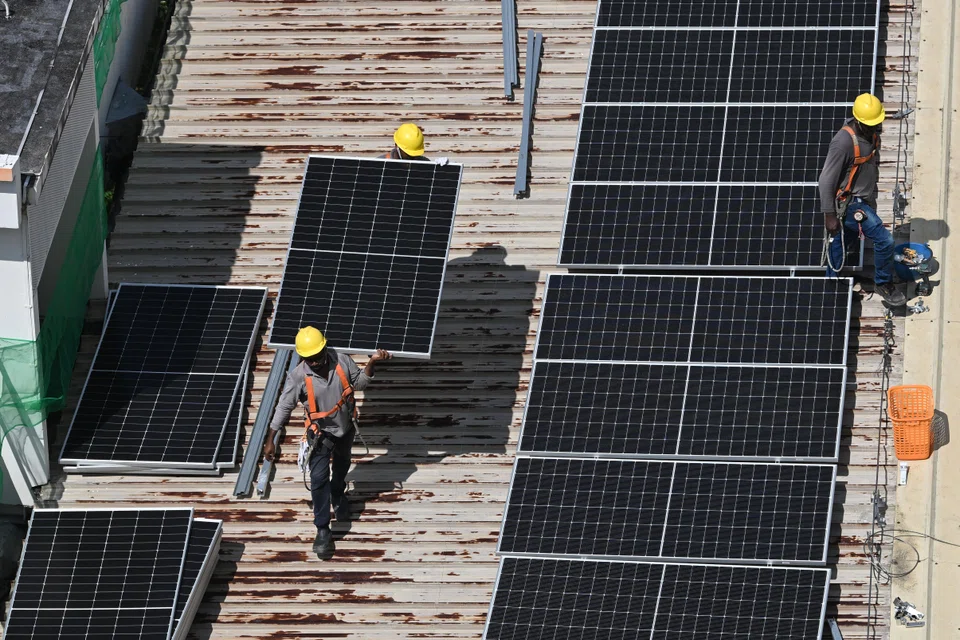
Under the SolarNova 7 programme, solar panels will be installed across 1,290 HDB blocks and 99 government sites that will contribute about 75 megawatt-peak to the grid.
Equinix executive vice-president of global operations Raouf Abdel said that the PPA secures the company the rights to the renewable credit that comes with the new renewable energy generated from the project. The energy generated will go towards powering these buildings’ common spaces, as well as the broader grid.
“Our goal, where that’s viable… (is to) go and try and secure PPAs for that market because we want that net new (renewable generation) within the markets we operate,” he said, adding that the company aims to achieve 100 per cent renewable energy coverage by 2030, from 96 per cent in 2023.
The company declined to reveal the amount it paid to underwrite the development of the solar project for confidentiality reasons.
In 2020, Meta – formerly known as Facebook – and Google signed similar virtual PPAs with Sunseap Group and Sembcorp, respectively, for their operations in Singapore. Meta also signed a virtual PPA with Sunseap in 2021 to purchase credits from the nation’s largest offshore floating solar farm in the Strait of Johor.
David Broadstock, senior research lead and energy transition research lead with the Sustainable and Green Finance Institute, said that given local constraints, the nation will need to look at how public and private partnerships and blended finance might help to facilitate infrastructure that permits clean energy that is produced overseas to be consumed domestically.
He said that the conversation has shifted from merely building more energy infrastructure to capture renewables in countries across the region, to moving the electricity to where demand is highest.
“Building the power-creation equipment is different from moving power out, and moving the power requires a very different process,” he said, adding that such a challenge would be beyond the scope of any single company.
“If you wanted to build a cable from Malaysia to Singapore, even if it was just across the strait, you’re talking (about) a lot of permissions and requirements and security questions to be addressed.”
He added that carbon offsets will be an important part of the energy transition for companies in the very near term. However, a longer-term solution for permitting greater flows of clean electricity will need to be found as well, to reduce the nation’s reliance on natural gas.
Equinix South Asia managing director Leong Yee May said that she hopes for greater clarity from the government on its energy import plans soon, and added that talks about increasing local renewable capacity are ongoing.
Energy sources
Still, there are other ways that the company could potentially reduce its reliance on the grid and eventually use greener sources of energy.
Within Equinix’s US portfolio, some of its data centres are built with on-site fuel cells that can generate power from natural gas and bio feed, which augments the power supplied from the grid.
Leong said that data centre operators are not allowed to run such fuel cells on site in Singapore, although the company is also in talks with the authorities to explore different possibilities.
Such a solution would take a load off the local grid, which has a limited capacity to power the growing data centre industry. Furthermore, it could give the operator the option to import clean hydrogen or other power sources when they become commercially viable.
She noted that the operator’s fourth facility, which was opened in the Tai Seng area in March 2020, still does not have sufficient power capacity for the level at which it has permission to operate. Because it sits on a site that was previously a warehouse, new substations and power lines have to be built and laid to the facility.
Abdel said: “As the demand increases in the market and the (power) generation doesn’t keep up, even if you have the connection, that may not be enough... That’s the kind of constraint we’re seeing behind the actual distribution itself.”