

Data centre pilot to set higher efficiency standards, give operators longer leases

Yong Jun Yuan
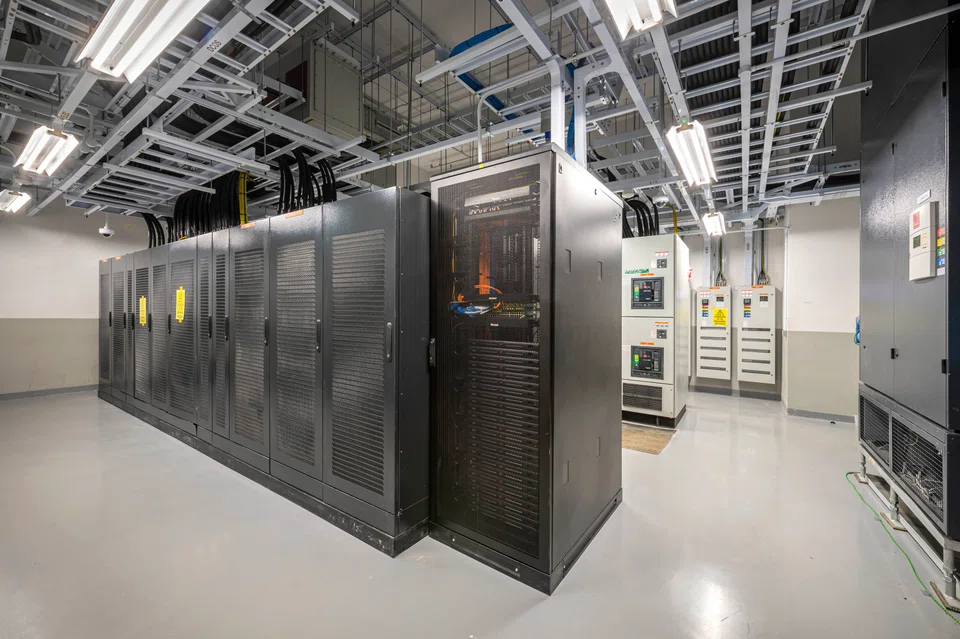
THE Economic Development Board (EDB) and Infocomm Media Development Authority (IMDA) have announced that they have launched a pilot data centre call-for-application exercise, with criteria aimed at ensuring the “calibrated and sustainable growth” of data centres in Singapore.
The Business Times (BT) understands that data centre operators will be able to submit proposals for up to 60MW of data centre capacity under the exercise. The pilot exercise had originally planned to split a total of 60MW of data centre capacity among 3 operators.
Successful applicants in the exercise will also be awarded 30-year leases — longer than the 20-year ones previously proposed.
Leong Yee May, the managing director of Equinix South Asia, a data centre operator, welcomed the increased capacity, given that larger data centres can benefit from economies of scale if they use advanced cooling techniques. The longer leases also give certainty that the data centre will still be operational in the long run.
“Because investments for data centres are intensive from a capital-expenditure perspective … it’s really a return on investment for us, and it gives us that security and longevity,” she said.
IMDA and EDB declined to reveal the number of data centres that would be approved, although they would consider all proposals on their merits.
The data centre proposals will be evaluated on key requirements such as their usage of energy-efficient IT equipment, and their plans to bring their data centre power usage effectiveness (PUE) to 1.3 or better at 100 per cent IT load. The proposals should also plan for data centres to attain the BCA-IMDA Green Mark for New Data Centre (Platinum) standard.
PUE is a ratio that describes a data centre’s energy efficiency, with a lower figure representing higher efficiency.
BT understands that the requirements were set based on the targets observed in China and other European countries, as well as on industry feedback and existing innovations to improve the energy efficiency of data centres.
The lowering of the PUE target from the 2019 version of BCA-IMDA’s Green Mark for Data Centres (Platinum) standard of 1.35 to 1.3 would reduce annual energy consumption at a 10MW data centre by about 4 Gigawatt-hours. This is equivalent to the annual energy consumption of about 900 4-room flats.
Notably, Equinix’s data centres have an annualised average global PUE of 1.48, down from 1.62 back in 2015.
Leong said that Equinix is considering tapping technology to improve energy efficiency, such as through the use of liquid cooling and its bespoke surface-cooling technology, which reduces its water and power consumption.
ST Telemedia Global Data Centres’ head of corporate development Lionel Yeo said that the PUE of 1.3 is ambitious — but necessary.
“This can be achieved through a combination of technology innovation, acceptance of contemporary overseas practices for data hall temperatures, and close alignment with the IT equipment energy-usage patterns,” he said.
The company’s newest facility, STT Loyang, has achieved a PUE of 1.3 with solutions such as high-efficiency chillers and a 2,000 cubic metre rooftop solar panel installed on-site.
Data centre proposals will also be assessed on how they decarbonise and offset the data centre’s carbon-emissions footprint through the use of innovative technologies such as hydrogen or solar energy.
Ashton Soh, who heads the data centre committee in SGTech, said in May that the industry body has plans for a micro-grid in Tuas that will power about 600MW of data centres with renewable energy. SGTech, a trade association for Singapore’s tech industry representing more than 1,000 member companies, is in talks with government agencies.
Applicants in the call-for-applications exercise will also be assessed on how their plans strengthen the nation’s regional and international digital connectivity, as well as its position as a data centre and technology hub.
They will need to show how their proposals usher in other business activities that will bring broader economic value and outcomes through areas like research and development and product development.
A moratorium on data centres was put in place in 2019, after the government began its consultation with industry players, to enable sustainable growth for the industry. As of 2021, there were more than 70 data centres with a combined capacity of about 1,000 megawatts (MWs) in operation.
Companies looking to build new data centres or expand their existing ones will have up till Nov 21 this year to submit their proposals. The result of the exercise will be announced “early next year”.
BT understands that older data centres still in operation can tap EDB’s incentives and grants to improve the efficiency of their facilities. Two such schemes are the Resource Efficiency Grant for Emissions and Investment Allowance for Emissions Reduction.
TRENDING NOW

If Europe goes to war, the fallout will be felt in East Asia

Keppel posts 20% rise in Q3 net profit; New Keppel earnings up 15%

CICT Q3 NPI rises 13.8% to S$334.9 million on contributions from Paragon and other acquisitions
Stocks to watch: Keppel, CICT, MLT, Golden-Agri, Wilmar, CDLHT, FEHT, UltraGreen.ai

