

Data centre Reits could head for IPO on SGX as conditions turn favourable
Rising enthusiasm for AI, availability of cheaper financing due to lower interest rates among reasons cited by analysts

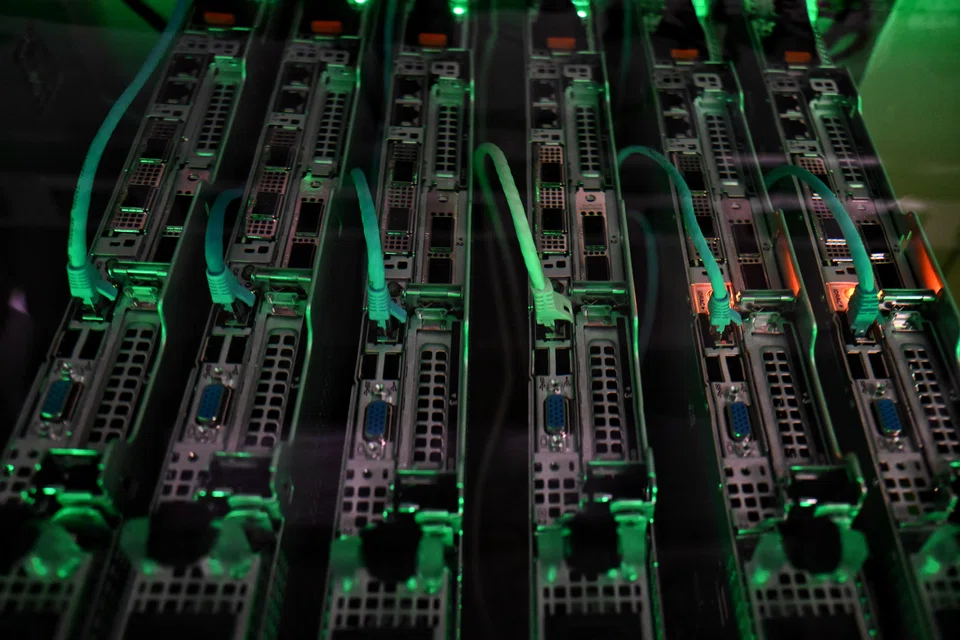
THE data centre race is heating up, driven by rising interest in artificial intelligence (AI). And Singapore’s equity market could be a beneficiary, as operators look to the city-state as an enticing potential location to securitise their data centre assets.
Analysts that spoke to The Business Times said data centre operators might choose to list a real estate investment trust (Reit) as interest rates begin to fall.
While the incoming Trump administration in the United States could introduce some uncertainty regarding interest rate cuts, Phillip Securities Research senior research analyst Darren Chan still expects there to be three cuts made in 2025.
Chan said that falling interest rates could lead to cheaper financing and increased appetite for equities as bond yields become less attractive.
One data centre player that could be reviewing its options is Japan’s Nippon Telegraph and Telephone Corp (NTT), which in September was reported to be considering the listing of a global data centre Reit in Singapore.
In a recent interview with BT, NTT Data group president and chief executive officer Yutaka Sasaki said that the capital required for data centre investments is high.
As the company grows its data centre footprint, its finance costs have risen as interest rates stay high relative to Japan.
Sasaki said that while the company has been able to generate good operating income, net income has not kept pace.
“We need to improve the cash-flow processes; so one of the ways (to do so) is Reits, and we (have) started to study the option,” he said.
He added that the company is also considering investing in the region with other partners.
For instance, Sasaki regards NTT Data’s partnership with Tokyo Electric Power Company as a good one for securing both electricity and land for data centre assets. The company will also look for similar partners in the region on a case-by-case basis.
Vijay Natarajan, a research analyst at RHB Bank Singapore, noted that the timing of such a deal in late 2025 could be ideal as additional rate cuts would have resulted in higher equity valuations and improved investor appetite for Reits.
“We believe that the decision to list a data centre Reit now is more to tap the market enthusiasm for AI-led demand, which has led to premium valuations for good quality data centre assets and consequently, a lower cost of equity,” he added.
Strong demand
Data centre assets have been appealing to investors in recent years for their positive rental reversions as supply remains tight.
Phillip Securities’ Chan said: “Data centres in most geographies reported positive rent reversions in the last year or so, with exceptionally strong rental reversions for co-location assets in Singapore due to the limited supply.”
RHB’s Natarajan also pointed out that growth in the segment has been driven by significant hyperscale data centre investments from major tech players such as Microsoft, Google and Amazon in South-east Asia.
At Singtel’s earnings briefing on Nov 13, its Digital InfraCo unit’s CEO Bill Chang said that companies are paying customer reservation fees for data centres such as DC Tuas in Singapore, which will come online in January 2026.
Helped by rental price hikes and energy cost passthroughs to clients, the company’s data centre revenue segment grew 17.6 per cent to S$169 million.
Keppel DC Reit also posted an 8.9 per cent increase in revenue to S$76.9 million in its third-quarter earnings, on “strong reversions and escalations” across its portfolio.
Private or public markets?
Still, the analysts noted that data centre operators have other options when considering how they can monetise their assets.
RHB’s Natarajan said that private equity players and sovereign wealth funds have been buying stakes in data centre assets and portfolios.
He cited the example of the acquisition of data centre operator AirTrunk by Blackstone and the Canada Pension Plan Investment Board in September this year. The deal closed at an implied enterprise value of A$24 billion (S$20.8 billion) – above market expectations.
“Typically, private equity will be a good option for a data centre player that is in the rapid growth and expansion phase, as (it) would be able to provide capital at a competitive cost in order to benefit from the future growth potential of such investments,” he said.
Furthermore, Natarajan noted that Singapore-listed Reits have less capacity for development, compared with privately owned data centre players.
For instance, such Reits are subject to a maximum development limit of 25 per cent of deposited property on existing assets, subject to unitholders’ approvals.
Reits are also subject to stricter gearing requirements as compared with private entities, which can limit debt headroom for large-scale developments.
“On the other hand, a mature portfolio with stabilised assets may be better suited for a Reit listing, as Reit investors typically seek stable dividend yields alongside net asset value growth,” he said.
Phillip Securities’ Chan said that private equity can also be quicker and more flexible than Reit initial public offerings (IPOs), and come with fewer regulatory and reporting burdens.
“However, private equity can be more costly than Reit IPOs as they usually seek higher returns on equity,” he said.
TRENDING NOW

Once staunchly pro-China, Malaysian Chinese businesses are now distancing themselves from Beijing

Britain’s mansion tax shows the difficulty of targeting wealth

Three hats, one goal: How Ng Kian Swan runs sustainability at NUHS

COE review: The gap between luxury and mass-market cars isn’t the only one worth bridging

