

Data centres a possibility for Stoneweg European Reit under new sponsor
SWI Group “fully supports” the Reit’s strategy to rebalance its portfolio to focus more on industrial properties and high-quality offices

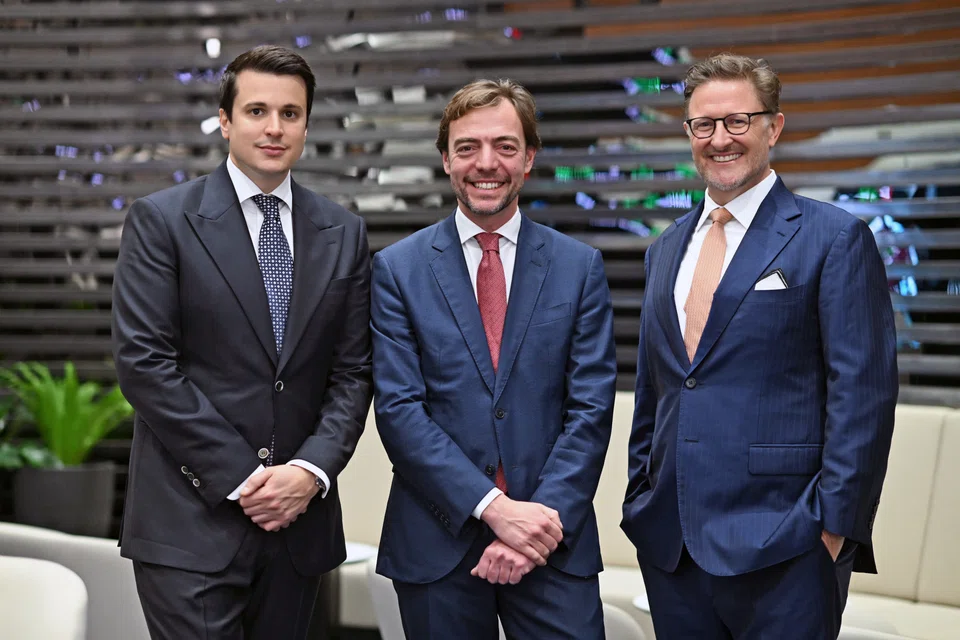
[SINGAPORE] Stoneweg European real estate investment trust (Sert) , which has traditionally had assets in European office and logistics, could explore opportunities in the data centre sector, in line with the expertise of its new sponsor.
Formerly known as Cromwell European Reit, the pure-play European Reit welcomed its new sponsor, SWI Group last December.
Based in Geneva, Switzerland, SWI Group is a partnership between real estate investment group Stoneweg and alternative investment group Icona Capital. The latter conducts private equity transactions and has real estate transactions, including in European data centres.
The new sponsor is a substantial unitholder of Sert and owns 28 per cent of its shares.
In an interview with The Business Times, Jaume Sabater, the group chief executive officer of the sponsor said that SWI Group “fully supports” Sert’s strategy to rebalance its portfolio to focus more on industrial properties and high-quality offices.
At the same time, Sabater said the sponsor wishes to support Sert by exposing it to opportunities in new asset classes and geographies that SWI Group is familiar with.
“Clearly, SWI Group has an expertise in data centres, and that’s something that we want to actively work on to see how it could fit (into Sert’s portfolio),” he said.
Elaborating, Simon Garing, the CEO of Sert’s manager, said that while other Singapore-listed Reits, or S-Reits, typically purchase mature data centre assets, Sert’s strategy is to invest in data centre development.
To this end, Sert’s sponsor has a “substantial pipeline” of development opportunities in data centres and provides a good opportunity for Sert to co-invest alongside its sponsor, he said.
Just last year, for instance, Icona Capital acquired a 250,000 square metre (sq m) site in Madrid, Spain, to develop into data centres.
Among the geographies that Sabater thinks Sert can consider entering is Switzerland – where SWI Group is headquartered – and Spain, which has attracted institutional and international capital into the real estate market over the last few years.
The mainboard-listed Reit currently has more than 100 properties across 10 European countries. They are the United Kingdom, Denmark, Finland, France, Germany, Italy, the Netherlands, Poland, the Czech Republic and Slovakia.
Logistics comprises 55 per cent of its portfolio, with around 45 per cent in office. Sert has two data centre tenants in the current portfolio, one in Denmark and the other in Poland.
Europe market outlook
While the Reit market in Europe “has not been great” due to high interest rates, Sabater said he is confident in the sector’s outlook.
Interest rates have gone down and real estate transactions have picked up over the last two quarters, suggesting that real estate valuations have bottomed out.
“We’re starting to see quarterly improvement in valuations and we expect that trend to continue,” he added.
Rents are also improving across the asset classes under Sert’s portfolio, namely industrial and logistics, which bodes well for the Reit, he said.
Sponsor’s first Asian investment
Sert is SWI Group’s first investment in Asia and Singapore.
Sabater said that the team chose Singapore as its first investment destination in Asia due to its strength as a financial hub. The Reit manager’s presence in Singapore also allows the sponsor to bring its investment opportunities in Europe and the US to the Asian market, he said.
In its latest financial results, Sert’s distribution per unit for the second half ended Dec 31, 2024, fell 10.7 per cent to 0.07056 euro, from 0.07903 euro in the corresponding year-ago period.
H2 revenue declined to 106.6 million euros, down 1.4 per cent from 108.1 million euros in the year-ago period.
Net property income for the period was down 0.2 per cent at 65.6 million euros, from 65.7 million euros in H2 2023.
Garing believes that there will be greater investor interest in Sert this year.
With vacancy rates for logistics assets in Europe currently hovering at around 4 per cent, logistics players looking to increase their warehouse space will face a supply crunch. This will drive the sector’s rent up, said Garing.
Moreover, investors that are underweight in Europe logistics now want to increase their holdings in the region. Given that Sert is the largest S-Reit with pure European exposure, Garing said that the Reit is a “natural” choice for investors looking to shift their exposure from US and China.
To that end, investors are glad that Sert has a European sponsor with a real estate development pipeline, he said.
“We’re making no commitments today, but what we’re excited about is their very deep pockets, their wealth of expertise, knowledge and resources… If we’re doing developments on our own book, it’s really helpful to have additional support,” he added.
TRENDING NOW

NEA identifies 7 firms responsible for haze fires, notices issued urging action: Grace Fu

DBS remains analysts’ pick ahead of Q3 earnings after Singapore banks’ share slump

High Court rules against Julius Baer’s Singapore trust arm in US$50 million family trust dispute

Could stablecoins be the future of money?

