DBS aims for wealth business to hit S$300b AUM by 2023
Asset target translates to 7-8 per cent annual growth rate over next few years, outpacing industry
Singapore
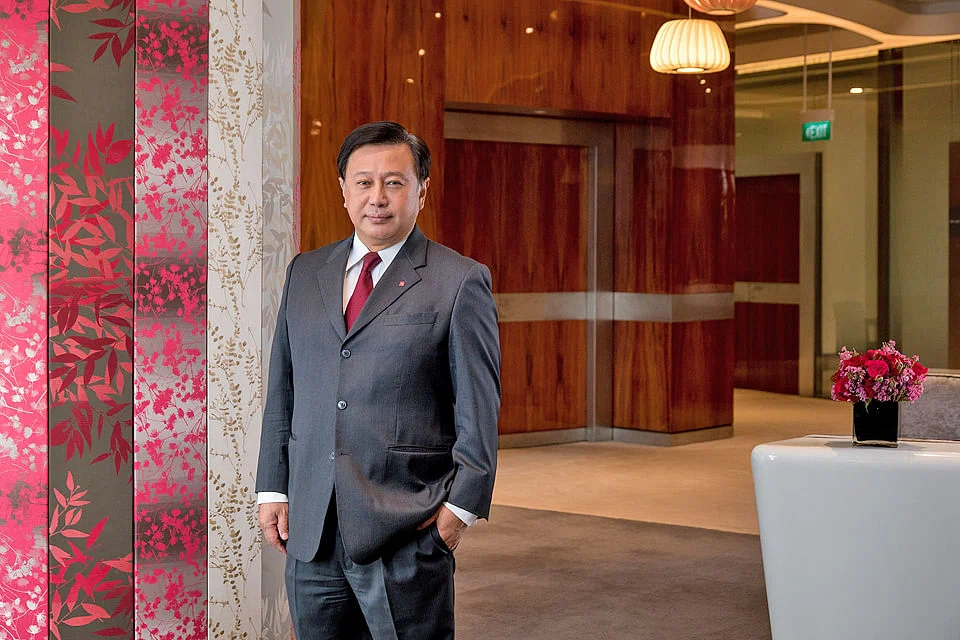
DBS is gunning for a 7 to 8 per cent annual growth in assets under management (AUM) over the next couple of years, bringing its current AUM base of about S$234 billion to S$300 billion by 2023, its newly minted group head of consumer banking and wealth management business Lim S Sim told The Business Times.
This growth target will push ahead of industry growth rates, and comes as DBS has in part bulked up by completing its buyout of the Asian private banking business of Societe Generale in Singapore and Hong Kong in 2014, with the wealth business now making up 20 per cent of total group income.
"We will look at every opportunity. If the price makes sense and it's positive accretion, we will consider it very favourably," said Mr Lim, when asked if this target will include M&A and whether asset acquisition prices being put on the table now are realistic.
Mr Lim joined DBS in 2010, and had previously been at Nikko Citigroup. Prior to the current role, he was the Singapore country head at DBS.
One market that stands out for DBS is Indonesia, where there are plans for the bank to expand its footprint in the wealth space.
"Indonesia is closest to a hinterland that we have, and we have plans for Indonesia to grow," said Mr Lim. "There is definitely a lot of organic growth right now... and we look at everything in its own right and merit."
This comes as private banks such as DBS are jostling for a piece of the US$2.7 trillion in wealth transfer in Asia over the next 10 to 15 years.
Where the bank aims to have an edge for its wealth management business is to move nimbly to execute restructuring deals for Asian businesses. Patriarchs are due to be handing over the reins to the next generation, or are now more willing than before to entertain trade sales or fresh private equity owners as their children have different pursuits from their family business.
Global banks have declared similar ambitions of tapping on wealth opportunities in this region by bringing the institutional business to the table. But as someone who has worked for foreign banks, Mr Lim noted that banks with a clear local presence should compete by being more agile in tackling client needs from this region.
"I'm not hung up when people say they are global. If a global bank says it's global, it's only good to somebody who really is global. An American bank says (to you), 'we are global'. But you only have an account in Singapore and Hong Kong. So you say: 'That's very nice, but I don't need an account in Tokyo or New York'," explained Mr Lim.
"Sometimes, decisions are made in New York (or London), and when they say 'cut this' when they want to shrink the balance sheet, the local managers don't have a choice. I've been through that, so I know. Here, we're the head office. If we believe you have a viable business even though the business environment is bad, we'll stick by you."
To be sure, when asked if DBS has been quicker than its peers in executing transactions, Mr Lim concedes that this has yet to always be the case. But he also questioned as well the number of banks that can execute the same in this region, with similar nimbleness. "Sometimes we do a good job, sometimes we can do a better job," he said. "The good thing is that if we get into a gridlock, one phonecall between Su Shan and myself or Tse Koon, and we can fix it very fast," he added, referring to group head of institutional banking Tan Su Shan, and Singapore country head Shee Tse Koon.
Singapore is also increasingly being promoted as a centre for family offices to set up shop, which allows DBS to offer inbound clients here a gateway into the rest of Asia, noted Mr Lim. Even as there is rising competition in this regard, Mr Lim sees greater gain from access to critical mass. "On Leng Kee Road, all the cars are there. Because you can walk from one (showroom) to another, it's a win-win for everyone."
DBS is said to rank roughly among the top five wealth managers in Asia excluding China. Assets managed for clients with at least S$1.5 million rose 6 per cent from a year ago to S$152 billion in 2018, which ranked DBS among the top five wealth managers in Asia ex-China, according to the 2018 list by Asian Private Banker and checks by BT.
Its AUMs out of North Asia today make up close to half of its today asset base, speaking to the bank's deepened presence in Hong Kong and Taiwan.
With DBS serving all segments of wealth management, Mr Lim has also been thinking about how to serve wealth solutions akin to Spotify, in that the recommended playlist is refined as the user sends more information about their likes and dislikes with each "play" and "skip".
In working with time-starved customers, relationship managers should, with technology, be able to call "at the right time, with the right solutions, with the right proposal, with the right insight, to the right person".
"We've still got some way to go," said Mr Lim, when asked where DBS is at in terms of using machine learning to mine and clean the data to reach this stage. But the shift is inevitable, as he noted that in tapping organic growth in markets such as Indonesia, just planting more boots on the ground would be incomplete.
"Headcount is like fighting tomorrow's war using yesterday's method," added Mr Lim. "We still need more people on the ground but we need to equip them to be more productive."
There is also a broader concern back at home that Singapore residents were not planning well enough for their future financial needs.
Mr Lim noted that Singapore has the world's longest life expectancy at 84.8 years, which means banks here should work to engage the middle bracket of the population on financial planning. This means bringing lower-cost solutions, as DBS tried to do this month with its launch of two portfolios comprising Singapore and UK-listed exchange-traded funds (ETFs). The portfolios are automatically rebalanced quarterly, and carry a flat annual management fee of 0.75 per cent.
The environment also means DBS is readying itself for more open data portability of customers so that Singapore residents can, in time, switch financial providers more easily, while holding to an aggregated view of their financial liabilities, retirement assets, and household expenses.
As Singapore's largest retail bank, DBS will embrace this open-banking trend, according to Mr Lim, even if greater transparency would make it easier for customers to switch to competing offers.
"It might be a little bit more painful at the beginning," he felt. "But what's good for Singapore will eventually be good for DBS."