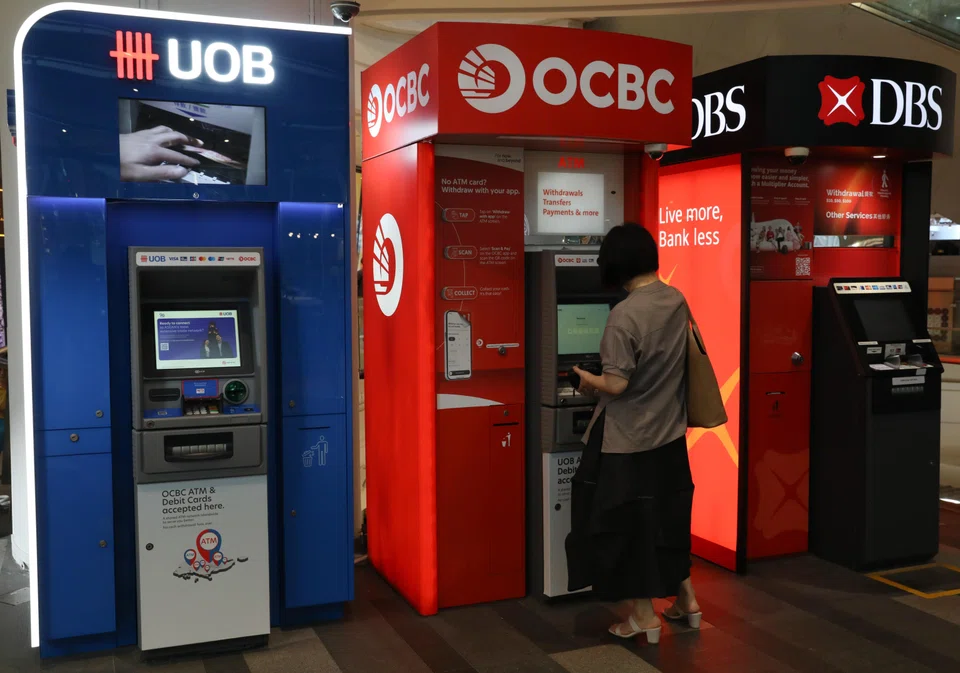
DBS, OCBC and UOB expected to post flat or weaker Q3 earnings as margins narrow
Focus will be on whether stronger wealth and trading income can cushion lending slowdown

[SINGAPORE] Singapore’s three local banks are set to deliver flat or weaker third-quarter earnings, as lower benchmark rates further squeeze net interest margins (NIMs).
Analysts said the focus this week will be on whether stronger wealth and trading income can cushion the slowdown in lending, amid lingering uncertainty from US President Donald Trump’s tariffs.
Maybank Research analyst Thilan Wickramasinghe expects sequential earnings to remain “flat to negative” as sharper margin contraction outweighs gains from wealth management and trading.
Wickramasinghe forecast Q3 net profit to come in at a range of S$2.77 billion to S$2.8 billion for DBS ; S$1.66 billion to S$1.73 billion for OCBC ; and S$1.48 billion to S$1.51 billion for UOB .
In comparison, DBS posted a net profit of S$3.03 billion in the same period a year ago while OCBC registered S$1.97 billion; and UOB S$1.61 billion.
While non-interest income could rise as investors move funds into higher-yield investments, “management focus is expected to remain on preserving net interest income (NII) momentum” in Q3, Wickramasinghe noted.
In the second quarter, average NIMs fell by nine basis points (bps) quarter on quarter, but NII declined by just 3 per cent, he observed.
DBS and UOB are due to release their Q3 results on Thursday (Nov 6), while OCBC will follow on Friday.
In September, the US Federal Reserve cut its benchmark interest rate by 25 bps to a range of 4 to 4.25 per cent – the Federal Open Market Committee’s first move since December 2024. This was followed by another 25 bp reduction in October, bringing the range to 3.75 to 4 per cent.
Every 100 bps cut in US Federal Reserve rates could trim S$400 million to S$500 million in NII, based on current sensitivity levels across the three banks, said DBS Group Research analyst Lim Rui Wen in an Oct 23 note.
Closer to home, Singapore’s economy expanded 2.9 per cent year on year in the third quarter, indicated advance estimates from the Ministry of Trade and Industry released in October. This marked a moderation from 4.5 per cent in the previous quarter but still surpassed market expectations.
“We think DBS and UOB have higher potential for upside surprises from stronger wealth and trading,” Wickramasinghe wrote. “For OCBC, we look for more clarity amid (the) leadership transition. No dividend surprises expected.”
In Q3, domestic liquidity has kept short-term rates low, with the Singapore Overnight Rate Average (Sora) falling about 60 bps. One-year Treasury-bill yields also dropped to 1.35 per cent in October from 2.95 per cent in January, pointing to further margin compression, Wickramasinghe wrote.
In September, the three-month Sora was down 21 bps month on month to 1.51 per cent per annum, the lowest since August 2022. Year on year, it was down 202 bps.
Lower benchmark yields reduce what banks can earn on loans and short-term investments faster than deposit costs can adjust, even as all three banks have progressively reduced interest rates on their flagship deposit accounts.
DBS’ Lim likewise flagged persistent NIM pressure as Singapore dollar rates have been “held down by excess liquidity”.
She expects margin compression across the banks to quicken, as the rates earned on loans and investments fall faster than the rates paid on deposits – a lag that reduces the spread between the two and narrows overall profitability.
The research house attributed this to the delayed impact of deposit repricing and lower average three-month Sora rates.
RHB Research sees a similar trend and noted that if deposit growth continues to outpace loans, that could weigh on interest income.
It added that the 60 bps fall in the compounded three-month Sora may pressure margins, although in the case of DBS, hedges, deposit repricing and a rebound in the Hong Kong Interbank Offered Rate (Hibor) should provide some cushion.
The three-month Hibor stood at 3.525 per cent per annum as at end-September, up more than 180 bps from end-June.
For DBS, “despite pressure on NIM and loan growth, nine-month NII could still chalk up positive growth on overall asset growth from continued deposit inflows”, RHB Research wrote.
It added in a separate note: “Generally, we expect Singapore banks to book weaker H2 earnings versus H1 due to a combination of seasonality and the US tariff policies.”
In Q2, management at OCBC and UOB guided for full-year 2025 NIMs of 1.9 to 1.95 per cent and 1.85 to 1.9 per cent, respectively.
DBS chief executive officer Tan Su Shan, meanwhile, urged investors not to “focus on NIMs”, adding that deposit volume growth will continue to support NII – expected to exceed 2024’s figure – through 2025.
As at the Oct 31 market close, shares of DBS had gained 6.7 per cent over the past three months, while OCBC rose 1.7 per cent and UOB slipped 1.5 per cent, including dividend payouts.
TRENDING NOW
MAS allocates S$1.45 billion to five asset managers in third EQDP batch: Chee Hong Tat
‘My grandfather’s legacy’: Sherman Kwek lays out three-year plan for CDL to drive returns
‘How many will survive?’: Bubble fears arise as China’s humanoid robotics face reality check
CDL to hire dedicated CEO for fund management as it steps up push into private funds