DBS targets S$1 trillion in AUM by 2030 as it steps up AI, hiring push
The bank plans to hire 600 more front-line advisers and platform engineers by end-2028
 Add BT as a preferred source
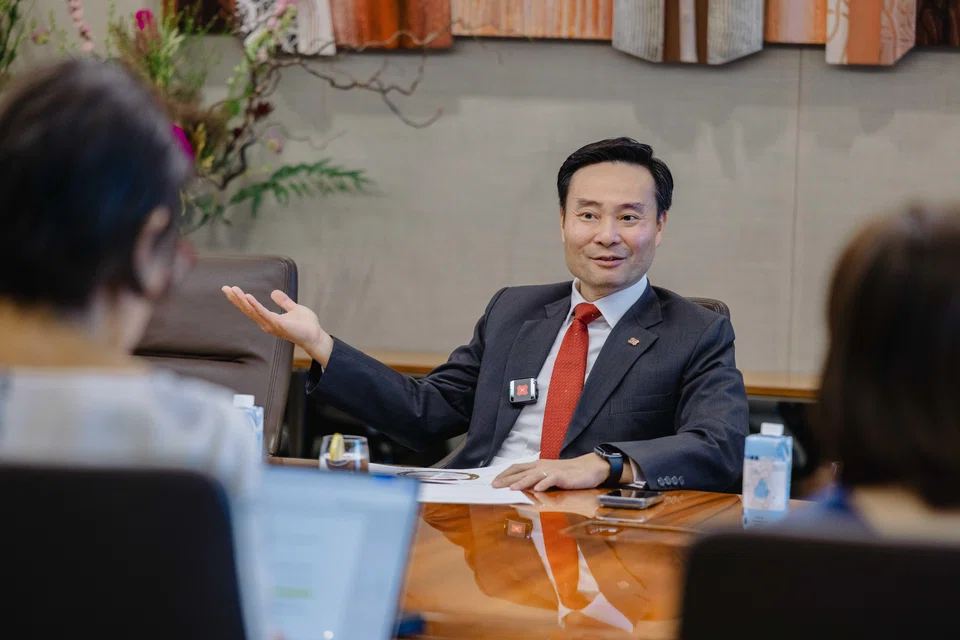
[SINGAPORE] DBS is looking to accumulate more than S$1 trillion in assets under management (AUM) across its retail and wealth segments by 2030, as it doubles down on artificial intelligence, partnerships and regional expansion to capture Asia’s growing wealth.
To support its ambitions, South-east Asia’s largest bank plans to hire 600 more front-line advisers and platform engineers by end-2028, said Shee Tse Koon, DBS group executive and group head of consumer banking and wealth management.
Shee previously targeted S$500 billion in wealth AUM by end-2026, which excludes the retail segment. But by Q1, AUM already hit S$492 billion, putting the bank on track to cross the target by the mid-year.
In Q1, some 58 per cent of wealth AUM was actively deployed in investment products.
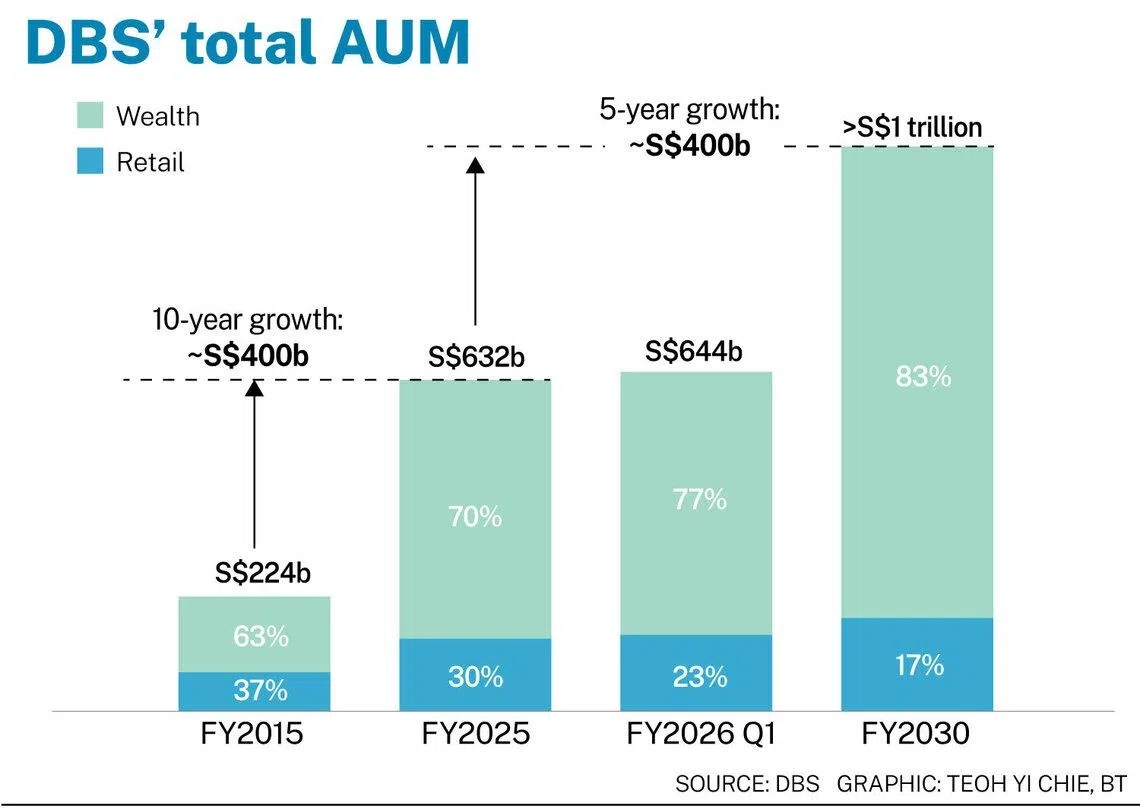
With the wealth business already one of DBS’ largest revenue contributors, Shee said the bank aims to “win in every segment” by serving clients across what it calls a “true wealth continuum”, from the mass market to the ultra-high-net-worth.
“The way we look at the entire wealth business is not just about AUM growth, but also how we can help our customers actively deploy this AUM, diversify this AUM, and provide strategic advice to plan for the future,” Shee said at a media roundtable on Tuesday (Jul 14).
AI investments reaping benefits
Shee noted that the bank’s AI investments – both generative and agentic – have already started to reap benefits.
As at May 2026, DBS has added 20 per cent more new high-net-worth and ultra-high-net-worth clients, after it reduced name screening time by 75 per cent and cut source-of-wealth profiling time by 20 per cent since last year.
Enhanced portfolio tools for advisers, wider do-it-yourself investments shelf, chatbots for mass market clients and a wealth management solution suite across the wealth continuum have also resulted in 30 per cent more customers across the board having diversified portfolios.
SEE ALSO



AI has also helped to automate manual tasks and improve corporate actions, allowing front-line advisers to have 10 per cent more face time with clients. Shee expects to double this improvement by 2027.
In particular, the digiWealth platform – targeted at mass market and emerging affluent customers – has led to a five times increase on-year in enquiries related to financial planning for wealth planning managers, as well as a 42 per cent rise in adoption of regular savings plans, as at February 2026.
“While we are very big on digital, we recognise that the wealth arena is one that will always still need human beings for certain cases,” he said. “No two products are homogeneous, and no two customers are homogeneous, so there will be certain things that they will need human advice.”
On hiring, Shee noted that the bank’s consistent hiring of relationship managers over the years has fuelled its growth, but talent is “thin” not just in terms of front liners but also in technology, engineers and platform staff.
But even as DBS continues to hire, it is also training staff across functions to scale domain expertise and AI know-how.
“This is something we’ve done before in the past when we drove the digitalisation journey,” he said. “We trained a lot of our people to be digital, then to be data-ready, now we’re training them in AI.”
New geographies
DBS is also seeking to access new geographies and customer pools.
One way to do so is to have more ecosystem partnerships, similar to the one it signed with Samsung Securities.
Earlier in July, DBS signed a memorandum of understanding with Samsung Securities that would allow the former to gain access to the South Korean market. Clients of Samsung Securities will also be able to tap into DBS’ wealth management solutions.
Shee said there are “quite a number” of other similar partnerships that the bank is in discussions with, although he declined to name them.
These partnerships would help DBS accelerate access to markets where it does not have a natural franchise by leveraging partners with established customer bases, he noted.
At the same time, the bank wants to deepen its presence in its existing markets.
The bank has previously said that it would add 18 wealth centres in its core markets of Singapore, Hong Kong, China, Taiwan, Indonesia and India – areas “where wealth is being generated in Asia” said Shee.
Hiring will span these core markets as well as other key jurisdictions, such as Dubai and London.
Its hubs in Singapore and Hong Kong – where the bank has booking centres – will also help attract international wealth flows, especially as wealth is shifting into the region, he said.
Currently, DBS has clients from 120 different nationalities, with more from Asia.
Shee noted that the wealth business is already “one of the most cost efficient” in the industry, with a cost-income ratio of less than 50 per cent, and a return on equity (ROE) of 72 per cent. In Q1, the bank’s overall cost-income ratio was 39 per cent, and ROE was 17 per cent.
“This really is a proof point that it is not just about the AUM growth, but a very broad-based growth,” he said.
Decoding Asia newsletter: your guide to navigating Asia in a new global order. Sign up here to get Decoding Asia newsletter. Delivered to your inbox. Free.
Copyright SPH Media. All rights reserved.