As default rates rise, better metrics are needed to help private credit investors
Traditional headline metrics for fixed income may not take into account risk-mitigating factors put in place by managers – or the lack thereof


AVOIDING losses is key when investing in private credit, but navigation can be tricky given a general lack of data as well as a lack of standardised metrics.
Initiatives are underway to address this, but the higher-for-longer interest-rate environment means investors should pay more attention to default risks and think about diversification.
“Transparency is key for private credit. Investors need to understand the underlying exposures within a private credit vehicle and the associated risks linked to those assets,” said Brett Craig, director of private credit at asset manager Aura Group.
“The market often lacks sufficient transparency regarding these aspects, hindering investors’ decision-making.”
Another issue is a lack of standardised metrics, he added. “Unlike public markets, where standardised benchmarks and indices are common, private credit funds often use disparate methodologies, making comparisons difficult.”
Aura’s private credit arm, which runs an open-ended private credit fund, is working with a credit analytics company that has built risk models for banks. It hopes to provide its investors with a standardised risk measure that meets the standards of regulators.
More of such models may be needed as the private credit industry matures and absorbs money from high-net-worth individuals and family offices.
“Positive tailwinds for private credit have brought many investors, both experienced and new, into the market. However, the influx of capital and democratisation of access (have) led to a proliferation of strategies,” said Chee Jiun Wen, head of private markets and alternatives at Bank of Singapore (BOS). “Distinguishing between managers is no easy task.”
One of the key factors that differentiate a manager is a disciplined approach to underwriting the creditworthiness of a company across market cycles, he added.

Skill in underwriting was a frequently cited factor among managers and investors with whom The Business Times spoke, but is difficult to assess.
They also said evaluating a private credit fund is complex because of the multidimensional nature of private credit. Traditional headline metrics for fixed income may not take into account risk-mitigating factors put in place by managers – or the lack thereof.
Michele Ferrario, co-founder and chief executive of investment platform StashAway, said that for open-ended private credit funds, it is also possible to look beyond a manager’s past performance.
Open-ended funds typically allow investors to buy or redeem units at fixed intervals. This gives investors a liquidity option, and it means investors buy into an existing pool of assets instead of a blind pool.
“We can take into account the fund’s current portfolio. Our selection process involves analysing metrics such as historical default rate, loan quality, the team’s experience in navigating through different credit cycles, performance and track record,” Ferrario said.

Michelle Shi, head of alternative solutions in Asia-Pacific at UBS’ chief investment office, said metrics the bank evaluates include default rates, loan-to-value ratios, portfolio net leverage, interest coverage and fund-level net leverage.
Such metrics are at risk of being ignored or downplayed by the more retail end of the market. Alex Catterick, senior managing director and head of alternative investment solutions at Manulife Investment Management, said such investors “tend to be focused on the absolute return” of private credit solutions.
Yet, sustainable performance in credit requires a focus on risk rather than absolute return.
“We tend to guide investors to have a long-term view towards these types of structures. While the yield and performance are both key metrics, we think investors – and their advisers – need to look under the hood,” Catterick added.
This could include understanding how a manager evaluates loans; ensuring portfolio diversity across sector, company size and tenor; and checking on collateral.

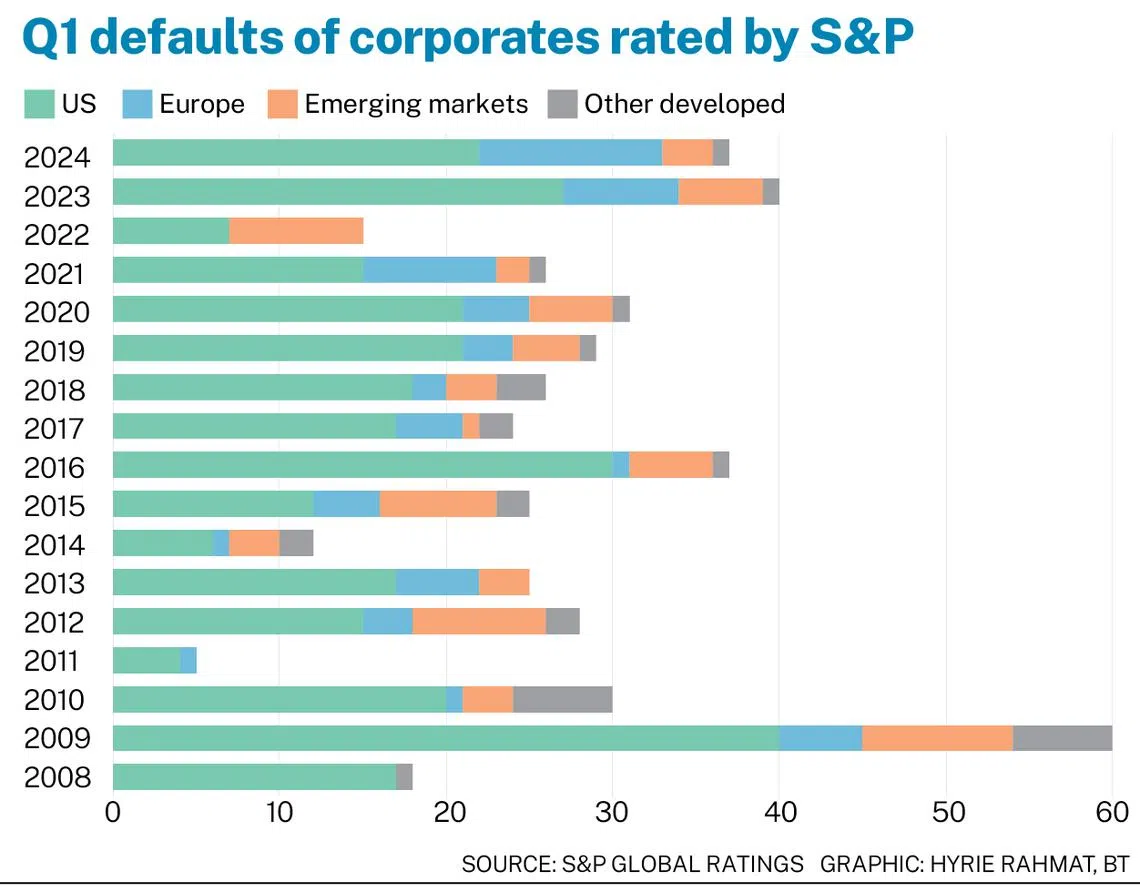
Higher interest rates are already testing credit quality, said S&P Global Ratings. Its data showed defaults in the first two months of 2024 were at their highest level since 2009.
European defaults more than doubled in the first two months of 2024 versus the same period in 2023, and first-quarter defaults are at elevated levels when compared with past years’ data.
As investors look to grow their private credit exposure while diversifying their portfolios, UBS’ Shi said there is “increasing demand for investment ideas outside the United States – mainly in Europe and Asia”.
Chee of BOS, meanwhile, said some investors have expressed interest in diversifying their exposure away from corporate lending and towards asset-based finance as well as speciality lending opportunities.
“We are also seeing some interest in long/short credit opportunities. Within traditional corporate lending in private markets, we do also note some investors seeking out specialised strategies including sector-focused strategies in enterprise software, healthcare and royalties,” he added.
For service providers, the growth of private credit presents an opportunity to offer new models and tools.
Alex Popp, global head of sales and account management for private markets at asset servicing platform Charles River, said the company is able to help managers crunch data or run stress test scenarios.
“We can highlight areas where maybe the valuation has gone up or gone down by a certain amount,” he said.
Some clients have given the company, which is a unit of State Street, permission to aggregate data.
“We do have the ability to, at an anonymised level, start to look at trends within the data in our system,” Popp added. “We haven’t productised it today… (but) we are growing that data source and we are looking at how we can do that in the future.”