

Del Monte’s surging debt is a US$2.5 billion red flag for investors

Uma Devi
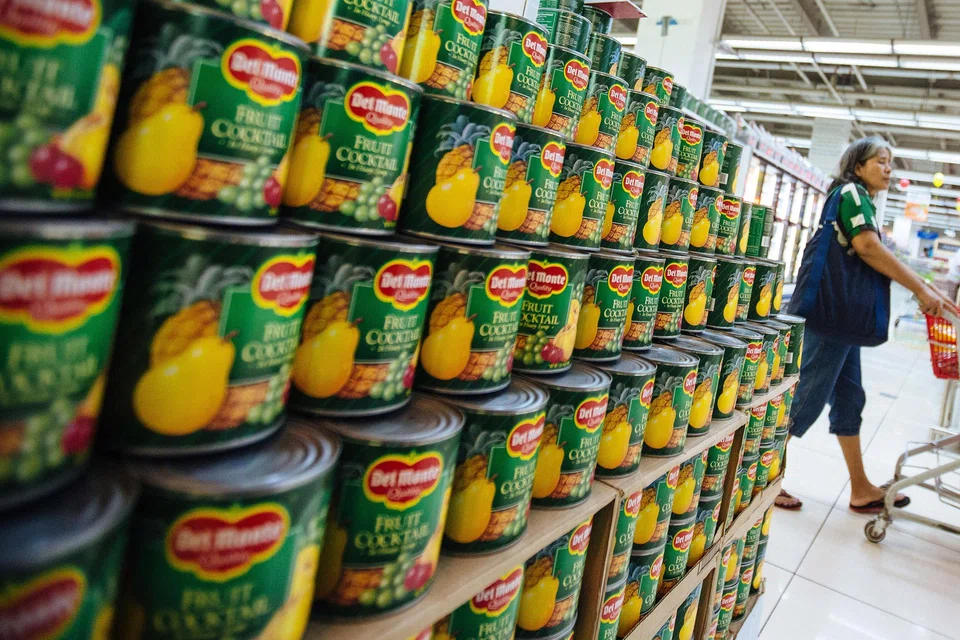
FOR a household name, canned-food brand Del Monte Pacific is performing surprisingly poorly on the stock market.
The company, best known for its canned fruits and vegetables, was among the worst performers on the Singapore Exchange last year, generating a total return of negative 61.1 per cent.
For the first half of its FY2024 ending October, the company posted a net loss of US$21.6 million. It had reported earnings of US$19 million in the corresponding year-ago period, including one-off items. The loss came despite a 2.4 per cent increase in sales to about US$1.2 billion.
Gross profit fell 27.7 per cent to US$243.8 million on higher costs.
The poor performance is understandable: commodity prices are cyclical in nature, and a number of factors – from poor weather to crises such as the Russia-Ukraine war – could cause a spike in raw commodity prices that in turn eats into profits.
The more pressing issue is Del Monte’s debt levels.
The company had liabilities – specifically loans and borrowings – of US$2.5 billion as at end-October, up from US$2 billion at end-October 2022. Del Monte attributed the increase to higher short-term loans it took on for working-capital requirements.
The company’s total debt-to-equity ratio stood at 6.8 times, while its net debt to adjusted earnings before interest, taxes, depreciation and amortisation was 9.6 times.
In H1 FY2024, Del Monte’s interest expense alone amounted to US$93.3 million.
Company executives have said that a 100-basis-point interest rate cut will reduce its interest expense by anywhere from US$10 million to US$15 million.
Higher than peers
Del Monte’s debt levels are considerably higher than its peers’, all of which have debt-to-equity ratios below one according to Bloomberg data as at Jan 2.
Pickles Holdings, a Japan-based company that makes and sells pickled vegetables, had total debt of 3.2 billion yen (S$29.5 million), and a total debt-to-equity ratio of 0.18 as at end-November.
Sato Foods Industries, another Japanese food processing company, had total debt of 0.7 billion yen as at end-September and a total debt-to-equity ratio of 0.2.
St Cousair, a manufacturer and seller of jams, wines and other food products in Japan, had 1.8 billion yen of debt as at end-September and a total debt-to-equity ratio of 0.4.
Korea-based Daehan Flour Mills posted a total debt figure of 269.6 billion won (S$273.5 million) as at end-September, and a total debt-to-equity ratio of 0.3.
Seafood supplier Oceanus Group, posted a total debt of S$68.1 million for the quarter ended September, while its total debt-to-equity ratio stood at 0.6.
Hopes pinned on listings
To be fair, Del Monte did have plans to taper its debt levels.
It had intended to list two of its units: 87 per cent-owned Del Monte Philippines (DMPL) and 93.6 per cent-owned US subsidiary Del Monte Foods.
DMPL’s initial public offering was reportedly set to raise up to 44 billion pesos (S$1 billion) in 2021. The company announced in August that year, however, that it would defer the listing, amid a surge in Covid-19 cases.
Fast forward to today, and Del Monte executives said that they are still evaluating market conditions and will make announcements when the company is ready.
Carving out a unit and listing it on a stock exchange is often a way for a company to cut its debt, as proceeds from the listing can be put towards working capital or debt repayment.
To add to its problems, Del Monte is grappling with high inventory costs.
In the second quarter, the company said that the cost of its inventory was inflated due to higher metal, raw produce and logistics costs, as well as continued commodity price volatility.
The company noted that a correction in inventory levels will need to be done over the next nine to 12 months, and will include lowering its FY2024 levels across all major segments.
Del Monte has also said that it will see a cut in production in FY2025 to reduce or normalise inventory, which will result in an “unfavourable impact from fixed costs that will be spread over lower volume”.
While its interest costs should fall in the coming quarters, Del Monte has to look at production efficiencies as well as quicker and more certain ways to cut back debt.
Investors, meanwhile, should be prepared for prolonged periods of uncertainty and a possibility of reduced dividend payouts until the company’s debt is brought down to a more manageable level.
TRENDING NOW

Singapore bars Alice Huang, woman tied to affair with Nvidia’s Jensen Huang, for misleading police

Nvidia prepares to oust Jensen Huang after news of second affair, with executive: reports

Higher rates, weaker spending: Is the Philippines entering stagflation?

Demand, tech capabilities position Apac and AI as Skyscanner’s next growth frontiers: CEO Bryan Batista

