Diversification is a full meal at Sats
Company is making meals for supermarkets and restaurants, sees opportunities in e-commerce.

Claudia Chong
Singapore
A BLOW to the travel sector during the Covid-19 pandemic has validated and accelerated Sats's plans to diversify its revenue streams out of both aviation as well as its domestic market of Singapore.
Even as its bottom-line gets pummelled by the loss of business due to travel restrictions, the ground handling and in-flight catering firm is seizing opportunities in food production, e-commerce and the movement of perishable and medical goods.
On the aviation front, Sats is also aiming to increase its share of revenue from overseas markets - some of which have already seen a steady pick-up in domestic travel as restrictions are relaxed. The company is looking for potential acquisitions at depressed valuations, and hoping to increase its stakes in its overseas associates as regulations on foreign ownership ease up.
Sats has had a rocky 2020 so far. It sank into a net loss of S$6.3 million for the fourth quarter of FY20 ended March 31. The loss deepened to S$43.7 million in Q1 FY21.
New avenues
Things might have been worse if Sats had not already been on a diversification path. In Q1, revenue plunged 55 per cent year on year to S$209.4 million. Aviation revenue fell 72.9 per cent to S$110.6 million. But non-aviation revenue was up 73.3 per cent to S$96.9 million.
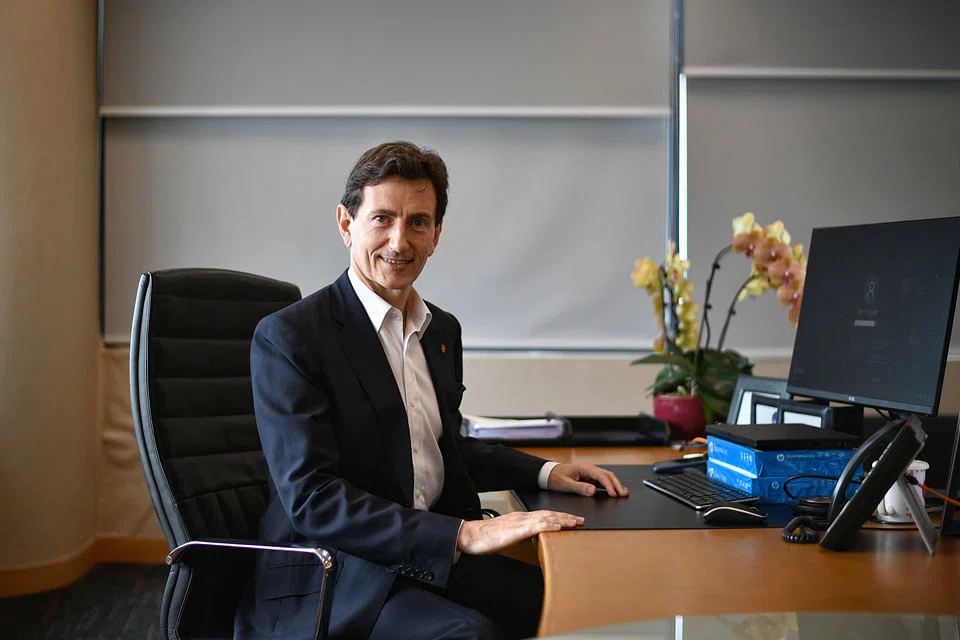
"During Covid-19, we were already in the process of addressing what we see as a big opportunity due to the fundamental drive of urbanisation in big Asian cities," Sats's president and chief executive Alex Hungate told The Business Times in an interview.
For instance, Sats's kitchens don't just produce airplane meals. They also provide ready-to-cook ingredients such as soups, sauces and chicken cuts, and prepared food products such as chicken nuggets, burgers and sausages to fast-casual restaurants, cafes and food service businesses. It supplies ready-to-cook products and bakery items to supermarkets and convenience stores too.
"When populations urbanise, they move away from the direct food sources that they have in the countryside. They eat out more, they order in food and they want ready-to-eat meals," Mr Hungate said.
Sats's central kitchen in Kunshan, China, was built for the non-aviation segment and can produce 50,000 meals a day. Its customers include Yum China, which operates the KFC and Pizza Hut brands; and Hema, Alibaba's brick-and-mortar supermarket chain.
A second similar central kitchen is under construction in Tianjin. It will be more than twice the size of the Kunshan kitchen and is slated to be ready by the end of this year.
The company also plans to build a third central kitchen in India, a country that Mr Hungate said has the same urbanisation potential as China.
Another business Sats has been actively building is e-commerce and logistics. It already has an e-commerce hub at Changi Airport in Singapore, which incorporates a cargo terminal and sorting facilities. It is building other hubs alongside its airport operations in other parts of Asia, such as Saudi Arabia.
Next to its cargo handling facilities in Singapore, Sats has built a perishables handling centre for temperature-sensitive pharmaceuticals and vaccines - which could be particularly useful in the coming months if a vaccine for Covid-19 is found.
The company has replicated the model in Bangalore, a big pharmaceutical production centre, and is currently doing the same in Hong Kong and Beijing to build a network of handling facilities.
In FY20, the Singapore market contributed to 61 per cent of the group's S$2.6 billion combined revenue that includes the share of revenue from associates and joint ventures. Greater China contributed 12 per cent while Japan contributed 10 per cent.
In the medium to long term, the majority of revenue will start to come from outside of Singapore, said Mr Hungate. In addition to investments in larger markets such as India and China, the group is eyeing majority stakes in some of its overseas associates and joint ventures.
Changing regulations
"A lot of our investments in other markets are in aviation and have been constrained by a restriction on the level of foreign ownership," said Mr Hungate. "(But) in places like India, just in the last few years, the Modi government has changed the regulations to allow foreign companies to own ground handlers up to 100 per cent. And in Indonesia, with the permission of the regulator on a case-by-case basis, it is possible now for foreign companies to own up to 66 per cent of ground handlers."
With valuations in the aviation industry getting depressed, Sats is looking at ways to grow its market share through acquisitions.
One distinct possibility is that as airlines restructure, they are likely to see flight catering and cargo handling as non-core. Some would look for companies that can buy those assets from them and run those operations as a strategic partner.
"When airlines look for partners to do that for them, they are still very concerned about quality. And therefore, because Sats has a strong reputation in the industry, they are quite likely to call Sats as one of the handful of people that they would consider having that kind of a partnership with," said Mr Hungate.
The company has raised more than S$500 million since the start of the Covid-19 crisis. Cash and equivalents stood at S$723.5 million as at end-June, with cash ratio at 1.09. Operating cashflow was negative at S$61.1 million in Q1 compared with a positive operating cashflow of S$80 million a year ago.
Sats is keeping a close eye on expenditure amid the pandemic. It has implemented staff and pay cuts as part of its cost-saving initiatives.
For the first quarter, staff count fell from 16,700 to 13,500 year on year. This was due to factors that included natural attrition, voluntary early retirement, non-renewal of employment contracts that have expired and automation that led to job redesign.
Some 10,000 existing employees have been redeployed to new roles and activities such as public services and upskilling through the Sats Academy. The company will continue to reduce its headcount, but the final total figure will depend on its expansion into new markets and the shape of the recovery of aviation volumes.
The International Air Transport Association is projecting a slow recovery for air travel, with revenue passenger kilometres not expecting to return to 2019 levels until 2024.
Still, Mr Hungate is confident of the company's ability to weather the storm. "We believe that in times of crisis, that's when there's the opportunity to make these changes because customers are thinking differently," he said. "The shifts in supply chains, the move towards e-commerce, the increase in chaining of restaurants - all of those trends are accelerating. Now is actually the best time to be bold."