Attractive dividend yields to prop up DBS, OCBC, UOB shares as earnings soften in Q4

Tan Nai Lun
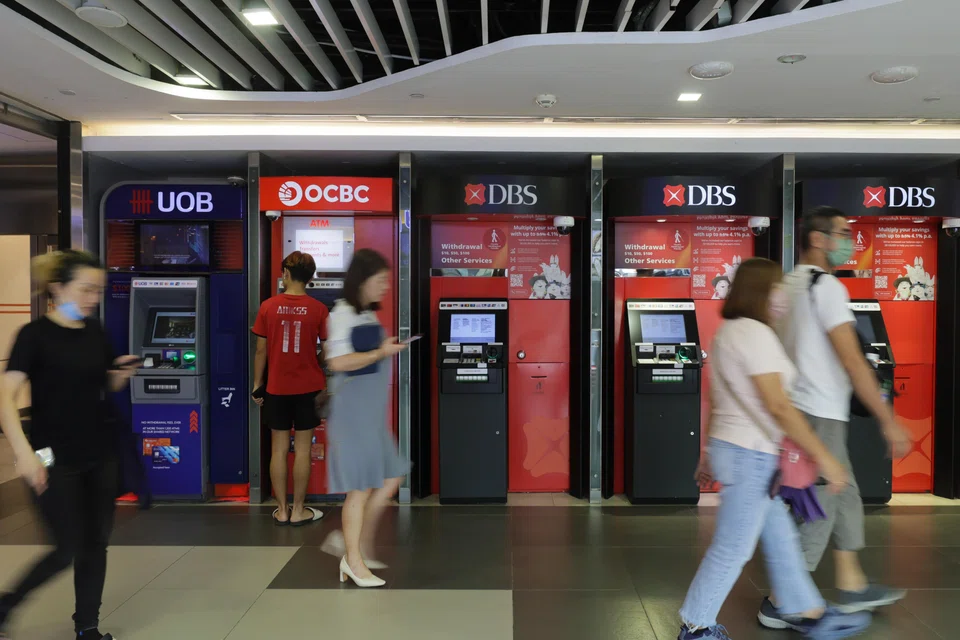
EARNINGS for the trio of local banks – DBS , OCBC and UOB – for the three months ended December 2023 are expected to be softer quarter on quarter, amid weaker net interest margins (NIMs) and seasonally weaker fee income.
But analysts said the lenders are likely to continue posting attractive dividend yields for Q4, which should provide support for their share prices.
CGS-CIMB analysts Andrea Choong and Lim Siew Khee said the banks’ Q4 earnings will likely be weighed down by seasonally softer business volumes given the end-of-year festive period.
Easing NIMs and modest fees are expected to be a shared feature across the banks, though still-benign credit costs may counterbalance some of the income weakness, they said.
DBS’ NIMs are likely to contract amid higher funding costs, due to the shift from current and savings accounts into fixed deposits in the second half of 2023, the CGS-CIMB analysts added.
As for UOB, they noted that the bank has been shoring up liquidity by offering competitive fixed-deposit rates, amid the imminent US Federal Reserve fund rate cuts.
“This would likely come at the expense of NIMs as the excess liquidity is placed in lower-yielding government securities,” they said.
However, RHB’s Singapore research team said UOB’s fees are expected to remain a bright spark due to the holiday season, while operating expenditure from its Citi acquisition tails off.
But the team noted that as long as the bottom line is elevated, this should be supportive of dividend yields, which should in turn provide downside support to share prices.
Meanwhile, the team noted that OCBC’s NIMs have weakened as expected, due to muted loan growth, deposit competition and a lower exit NIM.
The bank’s non-interest income is also “unlikely to excite”, given seasonal softness in wealth management activities – unless insurance and non-customer flow trading income surprises positively, the team said.
Overall, CGS-CIMB analysts expect the banks should still be able to deliver dividend yields of around 7 per cent for the quarter, which should retain investor interest in banks.
Furthermore, high capital levels may also encourage special dividends, said Thilan Wickramasinghe, head of Singapore research and head of regional financials at Maybank Investment Banking Group.
While the sector’s average Common Equity Tier 1 (CET-1) ratio of 14 per cent is already significantly higher than regulatory minimums, there is potential for further upward revisions in CET-1 ratios once the new Basel capital rules take effect in 2024.
This puts the sector in a strong position to pay out higher dividends and reduce excess capital, he said.
The CET-1 ratio is a measurement of a bank’s core equity capital compared with its total risk-weighted assets, and signifies a bank’s financial strength.
Wickramasinghe expects DBS and UOB to have the highest potential to surprise on special dividends, given their high CET-1 ratios and limited merger and acquisition probability in the near term.
For DBS, Citi analyst Tan Yong Hong noted some scenarios for the bank’s dividends. The lender may repeat its historical special dividend of S$0.50 per share for the fourth quarter, or opt to spread its special dividend per share (DPS) across 2024, given share-price underperformance.
But the Monetary Authority of Singapore’s review of DBS, following its recent outages, could also lower the probability of meaningful excess capital distribution, he added.
Meanwhile, Tan expects OCBC will likely maintain its 52 per cent payout ratio, given earnings uncertainties and its solid track record of maintaining absolute DPS. This comes even as its CET-1 ratio of 14.8 per cent for Q3 could excite some investors due to a higher payout ratio.
Jefferies analysts Sam Wong, Chen Shujin and Calvin Leung noted that OCBC’s strategy to deliver organic and inorganic growth, and its medium-term CET-1 target of 14 per cent, could also potentially result in a special capital return.
Watch for further guidance
Analysts expect the banks’ guidance on outlook and interest rates to be a key area to watch in this quarter’s earnings.
Citi’s Tan expects no earnings surprises for Q4, but noted that investors should watch for changes in guidance.
The banks will likely reset earnings expectations lower, given the recent Fed dovish shift, he added.
IG market strategist Yeap Jun Rong noted that DBS CEO Piyush Gupta had previously guided that higher-for-longer interest rates will be a net benefit to earnings in the coming year.
“But with rate expectations currently pricing for six rate cuts from the Fed through 2024, focus will be on whether his view still holds,” Yeap said.
Meanwhile, the Jefferies team expects banks across the board will have to adjust down their 2024 NIM outlook to account for the latest forward curve.