Dolce & Gabbana bets on independent future after China stumble
[ROME] Dolce & Gabbana plans to remain independent to preserve its creative freedom, even as the Italian fashion house claws back sales lost to the pandemic and a bungled ad campaign in China.
The privately held label is a favourite of investment bankers looking to drum up interest in a potential deal, but the Milan-based company has no intention of changing its stand-alone status, said its chief executive officer Alfonso Dolce.
"We decided to stay independent to stay authentic and creative," he said in an interview. It's crucial for the firm to plan its own strategy, from shop openings to runway shows to the way we relate to long-time workers and clients," he said.
Sales are expected to climb back to pre-pandemic levels this fiscal year, buoyed by North and South America, after dropping 15 per cent to about 1 billion euros (S$1.57 billion) in the 12 months through March, he said.
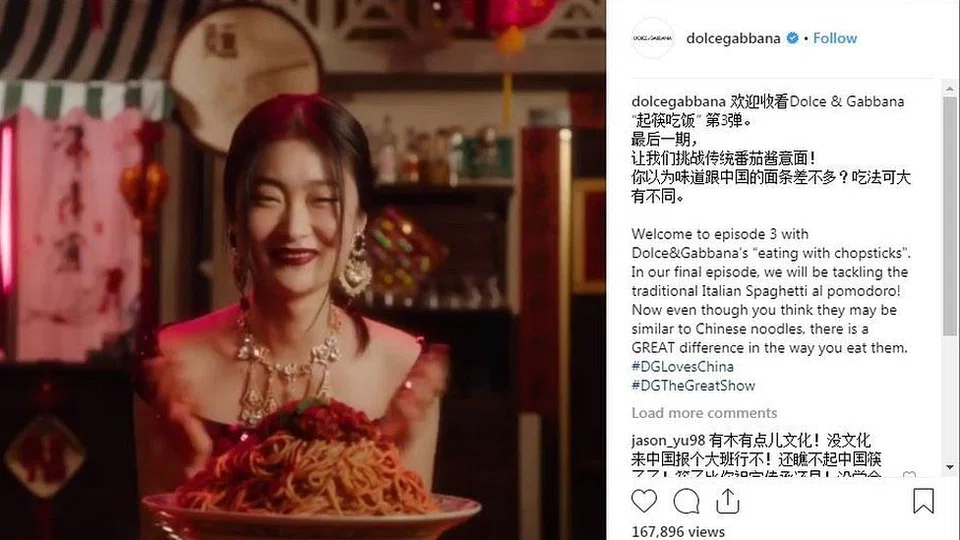
The company has yet to fully recover from the self-inflicted public relations debacle in China, the world's fastest-growing market for luxury goods. The trouble began before a planned runway show in Shanghai three years ago, when Dolce & Gabbana posted videos featuring a Chinese model awkwardly attempting to eat a cannoli and other Italian foods with chopsticks.
Widely deemed offensive, the ads incited a consumer backlash. Being independent did not save the company from the China stumble, and probably made matters worse, said Luca Solca, a luxury goods analyst at Sanford C. Bernstein. "It's become painfully obvious that fashion and luxury brands need strong senior local teams in China to call the shots on what could be controversial or plain wrong," he said.
"Making these decisions top down from Europe is not an option, let alone having the creative director post on social media without any filter."
Sales in China have rebounded 20 per cent from last year, but remain lower than before the misstep. In the social-media firestorm that followed the incident, the brand managed to hang on to existing customers in China, but struggled to win new ones, Dolce said.
"Speaking in absolute terms, we haven't fully overcome the incident," said the CEO, brother to designer Domenico Dolce. "But we have recovered in terms of institutional relations, even if we still suffer some animosity among some groups on the country's social networks."
To rebuild its image, the firm has been working with two international crisis management companies, and twice participated in China's International Import Expo in Shanghai to show its commitment to the country. The Italian firm has about 1,200 workers in China and plans to open a new boutique in Shanghai's Citic Square soon, said Dolce.
"We have been more discreet - less loud - in our communication campaigns," he said. "We'll keep focusing more on our visibility at the institutional level."
Founded in 1985 by Stefano Gabbana and Domenico Dolce, the fashion house known for its classic Mediterranean style prides itself on making all its products in Italy. Like luxury rivals, it is been winning back business lost during the Covid-19 lockdowns, and the CEO said he expects total sales in the fiscal year ending in March to grow as much as 25 per cent to 1.25 billion euros, excluding extraordinary factors.
While online purchases increased to 13 per cent from 8 per cent of total revenue last year, Dolce & Gabbana intends to keep investing in physical shops, particularly in Australia, South Africa and Korea. The company is also approaching key travel hubs, with new stores opening in airports in Europe in coming months. It is looking for growth from jewelry, luxury watches, beauty care, and, for the first time, home decor.
Dolce & Gabbana is not the only storied Italian fashion brand that has eschewed the embrace of a larger rival. Giorgio Armani, Prada and Salvatore Ferragamo are among others still going solo. Still, the firm's ability to remain a stand-alone enterprise may depend on setting things right in China, said Solca.
"If this stigma can be overcome - and it's an if - then the company could stay independent," he said. "Otherwise, I doubt it."
BLOOMBERG
Decoding Asia newsletter: your guide to navigating Asia in a new global order. Sign up here to get Decoding Asia newsletter. Delivered to your inbox. Free.
Share with us your feedback on BT's products and services