

Embattled S-Reits headed for slow recovery next year
OCBC sees continued price volatility; RHB expects hospitality Reits to recover only in H2
Singapore
THE hospitality, office and retail sector real estate investment trusts (Reits) are expected to recover next year, analysts said, given positive developments on the vaccine front.
But the fine print says this recovery will not be smooth.
Volatility in the share prices of retail and hospitality Reits is anticipated, said OCBC in a Nov 27 report.
A manufacturing bottleneck for vaccines and the logistical challenges of administering them to enough people to achieve population immunity are likely challenges that could prolong the recovery for Singapore Reits (S-Reits), OCBC added.
RHB Group Research expects the recovery of hospitality Reits to come only in the second half of next year.
OCBC, on its part, said a return to pre-Covid levels of revenue per available room/unit may happen only in 2022 or 2023.
But given the "forward-looking nature of investors", it said a "re-rating of hospitality Reits can continue".
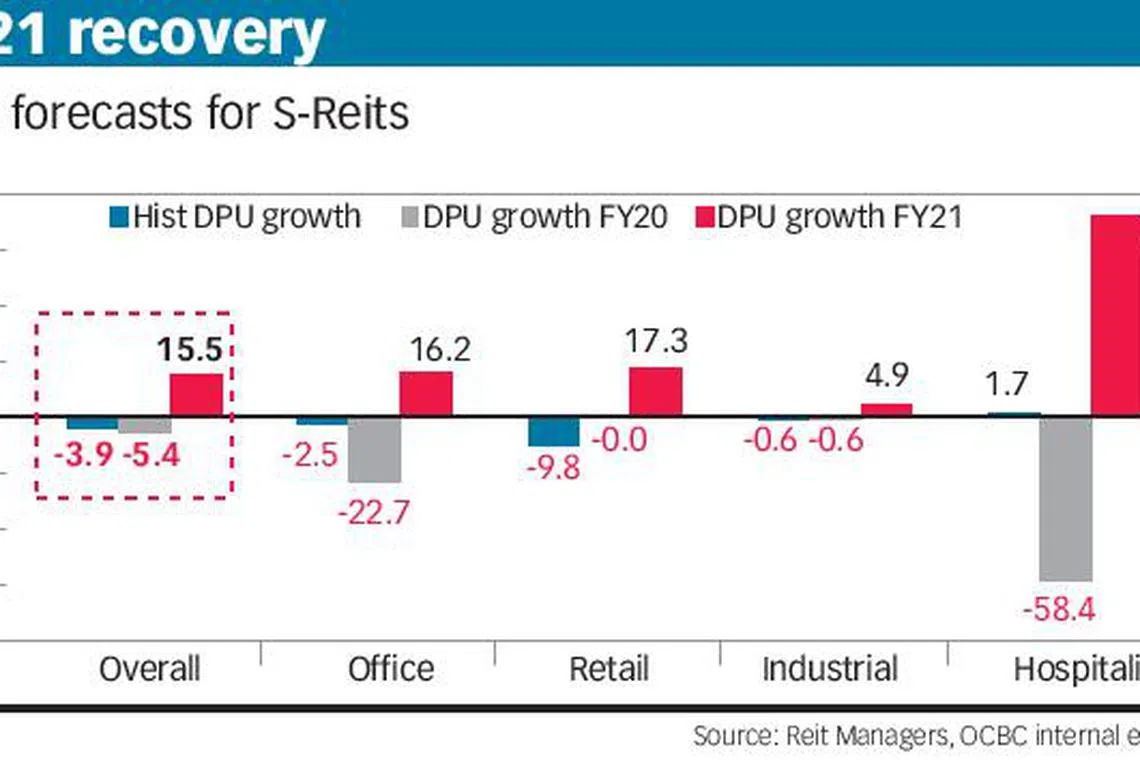
OCBC is bullish on Ascott Residence Trust, CDL Hospitality Trusts and Far East Hospitality Trust - in that order. It expects distributions per unit (DPUs) for hospitality Reits to rise 71.8 per cent in FY21. (They have fallen 58.4 per cent so far this year.)
On the office property front, financial institutions are downsizing their footprints in the central business district (CBD).
Keppel Reit has said some of its financial tenants may give up 10 to 30 per cent of their space when their leases expire in one to two years.
This trend is partially offset by Chinese tech companies expanding their presence here. OCBC's channel checks showed progress in the filling of space to be vacated by UBS at One Raffles Quay (ORQ). Keppel Reit and Suntec Reit each own a third of ORQ.
Nevertheless, the dip in CBD office rents has not abated. CBRE data for Q3 showed quarter-on-quarter declines of 4 per cent and 3.6 per cent respectively for core Grade A and B CBD office rents - to S$10.70 psf per month and S$8.15 psf per month.
Savills Research & Consultancy expects CBD Grade A office rents to fall 6 per cent in this year and 10 per cent in the next.
The DPU of office Reits has fallen 22.7 per cent in the current fiscal year, but OCBC expects it to improve by 16.2 per cent in the next fiscal year.
The retail, office and hospitality Reits have the most room to rebound, following this year's slump. DBS Group Research analyst Derek Tan noted that most retail, office and hospitality Reits are still 15 to 20 per cent below their pre-Covid levels.
But some other Reits have done very well this year.
Keppel DC Reit, for instance, has returned 33.4 per cent in the year to date, given its exposure to the data consumption secular growth trend.
ParkwayLife Reit is another outperformer, having returned 18.9 per cent this year after its inclusion in major indices such as the EPRA NAReit Index.
Frasers Logistics & Commercial Trust, up 16.2 per cent for the year, has benefited from the growing e-commerce trend.
Excluding the performance of Eagle Hospitality Trust, which has been suspended since March 24, the worst performers this year are Lippo Malls Indonesia Retail Trust (down 60.7 per cent in total returns), First Reit (down 56.2 per cent), ARA US Hospitality Trust (down 41.3 per cent), and Starhill Global Reit (down 31.7 per cent).
First Reit is now restructuring master-lease agreements for 11 Indonesian hospital assets. Lippo Malls Indonesia Retail Trust is attempting a large acquisition of a new mall.
DBS' Mr Tan believes that overall, S-Reits have come through the Covid-19 test well. He expects disruption to earnings to be largely confined to 2020. Landlords were obliged to support their tenants with partial rental reliefs this year.
Testament to S-Reits' emerging recovery in the third quarter is the fact that most Reits have begun paying out the income available for distribution that was held back in the earlier part of the year.
Vijay Natarajan, an analyst at RHB, said most retail Reits are still holding back some of the income they had earlier withheld - perhaps because they anticipate that they are not out of the woods yet, and may need to give out more rental rebates.
The FTSE ST Reit Index has not done too shabbily. As at Dec 9, it was down 9.9 per cent for the year. The benchmark Straits Times Index, on the other hand, was down 11.8 per cent.
But Carmen Lee, head of research at OCBC Investment Research, said that, compared to other sectors "such as the high-flying tech sector or some of the regional market indices, the performance is dismal".
Next year, Reit investors can look forward to potential new Reit offerings: the student accommodation Reit listing of Singapore Press Holdings, which publishes The Business Times, and City Developments' listing of commercial assets in UK. Both had been expected by the market this year. A European logistics Reit is also said to be in advanced talks to list in Singapore.
Analysts believe recent government measures signalling the positive support for the sector will also help attract more initial public offerings (IPOs).
READ MORE: For retail Reits, domestic spending can mitigate absence of tourist dollars
TRENDING NOW

Cracks emerge in AI borrowing boom as CoreWeave, Oracle and SoftBank debt worries grow

Could stablecoins be the future of money?

‘How many will survive?’: Bubble fears arise as China’s humanoid robotics face reality check

Philippine power giant First Gen rebuffs foreign offers, plans up to US$2.6 billion in expansion

