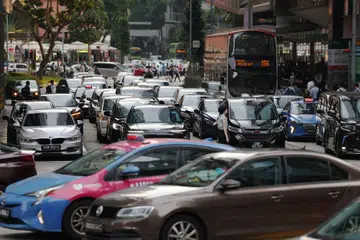
Americans consider fewer nights out as rising petrol prices bite: Reuters/Ipsos poll
 Add BT as a preferred source
DeeperDive is a beta AI feature. Refer to full articles for the facts.
[WASHINGTON] US consumers plan to cut spending on restaurant meals and movies if petrol prices keep rising as Russia's invasion of Ukraine rattles the global economy, according to a Reuters/Ipsos poll completed on Thursday.
Some 54 per cent of US adults expect to spend less on meals out if petrol prices rise to between US$6 and US$7 per gallon, the poll found. Forty-nine percent said they would trim spending on movies and other entertainment. Some 60 per cent said they would not drive as far for leisure activities.
Automobile club AAA said the average price at the pump on Thursday was about US$4.32 per gallon, up from US$3.48 a month ago.
It said that petrol prices could rise to a range of US$6 to US$7 per gallon if crude oil prices hit US$200 per barrel.
Washington and its allies have responded to Russia's attack on Ukraine, now in its third week, with unprecedented sanctions against Moscow, including a US ban on Russian energy imports.
The sanctions have sent Russia's economy into a tailspin.
Navigate Asia in
a new global order
Get the insights delivered to your inbox.
US consumers are also bearing costs as the conflict added to already high petrol prices and helped send them to record highs, crimping household budgets.
Forty-seven per cent of respondents in the poll said they would spend less on home improvements like furniture and appliances if petrol prices kept rising.
Lower income consumers already appear to be pulling back sharply on some spending, Bank of America economist Anna Zhou said in a report, citing slower growth in credit card purchases of clothing in the four weeks through March 5.
The bank said lower-income consumers appeared to be relying more on credit cards than debit cards when buying petrol, a possible sign of stressed finances.
Some 82 per cent of poll respondents buy fuel for a vehicle driven by someone in their family, with almost a third spending US$51 to US$100 each week filling their tanks and another third spending more than US$100 weekly.
The carnage of the Russian invasion - with Russian forces increasingly shelling urban areas - has fueled an outrage that has led many Americans to say sanctions are worthwhile despite higher fuel prices.
Still, even fast-rising petrol prices may not change the outlook for the economy as a whole.
"In normal times higher crude oil prices always translate into weaker real consumer spending," Nomura economist Robert Dent said.
But these times may be different: US households are flush with US$2.6 trillion in excess cash built up from circumscribed living during the pandemic and massive government aid packages, and for many, the massive recent drop in Covid-19 cases is a licence to spend, even if prices are rising fast, Dent said.
"The underlying fundamentals for growth and aggregate demand remain very, very strong," he said.
Higher petrol prices will not force most Americans to make uncomfortable cutbacks on basics, the poll showed.
Some 64 per cent of respondents, for instance, said higher petrol prices wouldn't change what they spend on medicines; 58 per cent expected no change to spending on utilities.
About half said they'd keep spending on groceries unchanged, with 28 per cent anticipated spending less and 18 per cent expecting to spend more.
The Reuters/Ipsos poll was conducted online, in English, on Wednesday and Thursday throughout the United States, gathering responses from 1,005 adults.
It has a credibility interval, a measure of precision, of about 4 percentage points. REUTERS
Decoding Asia newsletter: your guide to navigating Asia in a new global order. Sign up here to get Decoding Asia newsletter. Delivered to your inbox. Free.
Share with us your feedback on BT's products and services