

Australia’s Sun Cable sweetens solar proposition to Singapore, offers up to 40-year offtake

Anita Gabriel
AUSTRALIA’s Sun Cable is willing to sweeten its proposition to Singapore customers with offtake agreements of up to 40 years given volatile energy prices, under its proposed mega project to supply 1.75 gigawatts (GW) of solar power to the city-state via what will be the world’s longest renewable energy subsea cable.
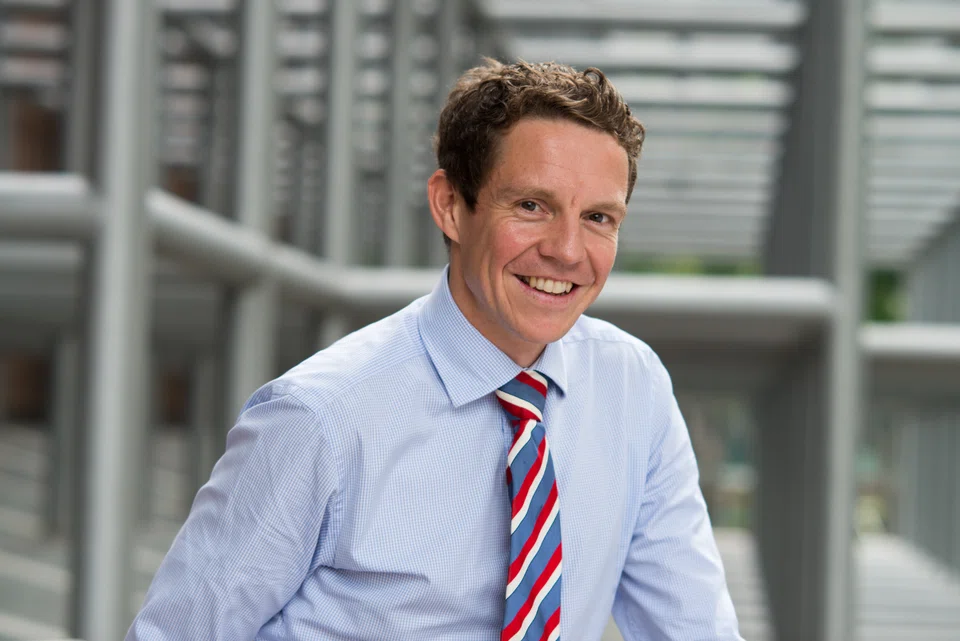
“What’s happened in the last 12 months is that it is very difficult for business to deal with that kind of volatility in prices. And so, we can offer, if they (buyers) want, a 40-year power purchase agreement (PPA) at a fixed price point just to ensure zero volatility in prices... (that) becomes an important selling point,” Sun Cable’s co-founder and chief strategy officer Dr Fraser Thompson told The Business Times in an interview.
“We anticipate PPAs will be in the range of 15-20 years, with a maximum of 40 years. We have had over 50 per cent oversubscribed. So there is real demand – that’s the first proof in the pudding. On the off-taker discussions, the things that they are increasingly focusing on is not just the price, but the volatility,” he added.
Thompson cited two key factors driving the trend of longer-term PPAs, chiefly the sharp fluctuations in energy prices and that Singapore, in its road map for carbon prices, has flagged that prices could potentially increase to as high as S$80 a tonne (in 2030).
“The Singapore government has done a good job trying to send a price signal for future prices. That helps off-takers sort of anchor and understand that this is what the world could look like, and makes it easy for them to commit to a renewable electricity contract. And so those are probably the two pieces which make it particularly good timing for a lot of off-takers to want to go towards a longer-term PPA,” he continued.
Thompson said Sun Cable was still working out the “exact dates” with Singapore for the power link between the two countries under the second request-for-proposal (RFP) for potential importers to submit proposals. The RFP to appoint licensed electricity importers was issued by the Energy Market Authority in July this year and ends in December 2023; it is part of the city-state’s plans to meet its import target of 4 GW of low-carbon electricity by 2035.
“We don’t have locked in dates yet... we are sort of nailing the exact date,” he said, adding however that the company has been in discussions with Singapore for the last two years and hopes that the project will be completed around 2029 or “slightly earlier”. This would also fall in line with Singapore’s stated goal to import 30 per cent of energy from low-carbon sources by 2035.
“We are pulling all the pieces (regulatory, commercial and operational) together for a financial close in 2024,” he added.
Sun Cable, backed by billionaires Mike Cannon-Brookes and Andrew Forrest, plans to build a A$30 billion (S$27 billion) giant solar farm in Northern Australia to power Darwin and Singapore. The flagship project officially called Australia-Asia PowerLink will span over 12,000 hectares of land and involves a 20 GW peak solar generation site in Elliot, a small town in the Northern Territory.
The multibillion-dollar project’s major – and also, the grandest – portion will include a 4,200 kilometre high-voltage submarine cable that will route through Indonesian waters to deliver renewable energy to Singapore. The project could meet up to 15 per cent of Singapore’s power needs when completed.
The changing narrative following the moves by Peninsular Malaysia and Indonesia this year to ban renewable-energy exports, which may have thrown up a challenge for import-reliant Singapore for its clean energy needs, could work in favour for the Australian company.
“There is a practical constraint that these countries face with their own domestic needs. And if you zoom out... in Asean, we’ve only got Laos, which has scalable electricity through hydro. But then, that’s going to transit through several countries. And we can’t have a whole Asean power grid dependent on one renewable energy source,” he said. Against that backdrop, the Sun Cable project’s cost competitiveness given the long distance is a crucial factor.
In this context, Thompson said that while the high voltage direct current (HVDC) transmission system that will link Darwin and Singapore is a “big capex” item, there have been significant improvements in transmission rates (lower transmission loss) and voltage. “If we did this project five years ago, it wouldn’t have been economic – we would have lost too much electricity in transit. It’s a much more efficient system (now) in terms of delivering electricity than before,” he added.
Currently, HVDC manufacturing activity is mostly focused in Europe, he said, adding that Asia needed to start building those supply chains to meet the demand for a broader and scalable Asian grid. On its part, Sun Cable plans to “get the ball rolling” and has already shortlisted three locations across Asia to set up a factory to manufacture the cables.
He said: “We’re in advanced discussions with a number of cable manufacturers and will be announcing them in due course. We haven’t signed off the contracts as yet. But we’ve got a very good idea of where that supply will come from.”






