

China solar industry’s losses narrowing on overcapacity push, association says
The deficit still comes up to 6.42 billion yuan in the July-to-September period
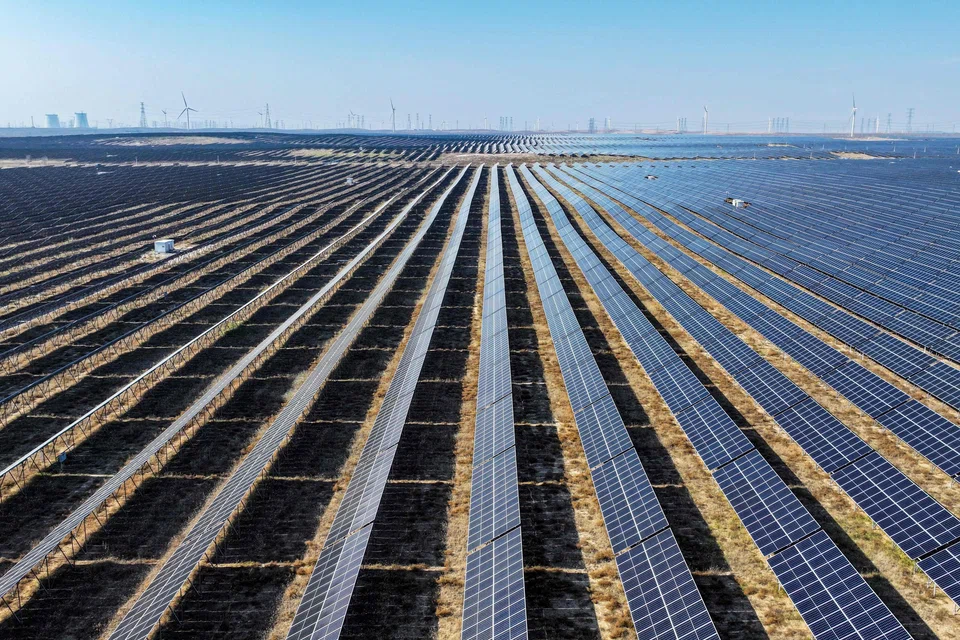
[BEIJING] Losses in China’s slumping solar sector narrowed in the third quarter, data presented by an industry group official revealed, as the government’s war on industrial overcapacity targeted manufacturers.
The solar industry’s capacity reached levels capable of satisfying global demand roughly twice over, figures from earlier this year showed, making it a focus of Beijing’s broader efforts to rein in industrial production this year.
Industry-wide losses narrowed by 46.7 per cent quarter on quarter but still reached 6.42 billion yuan (S$1.2 billion) in the July-to-September period, it was revealed in a presentation by Wang Bohua, the honorary chairman of the China Photovoltaic Industry Association.
New manufacturing capacity down, future demand uncertain
Speaking at an industry event in the north-western city of Xian on Wednesday (Dec 18), Wang said the construction of new manufacturing capacity was lower than in 2024 – though he did not provide figures.
In the first 10 months of 2025, output of solar cells and finished modules rose by 9.8 and 13.5 per cent, respectively, the presentation showed, but the industry scaled back polysilicon and silicon wafer output by 29.6 and 6.7 per cent, respectively.
Wang highlighted an array of regulations passed in 2025, such as limits on the energy consumption of polysilicon plants, that he said were forcing less efficient capacity to shutter.
New government guidance aimed at expanding the use of renewables outside the power sector would, meanwhile, support demand, he said.
An industry ministry official speaking at the same event reiterated government calls to strengthen control over manufacturing capacity and close down outdated production lines in 2026.
China’s demand could fall sharply in 2025, Chinese financial services firm Sinolink Securities analyst Yao Yao said at the event, citing its most pessimistic scenario.
New installations are expected to reach a new record high of 285 gigawatts (GW) in 2025, and then range between 185 GW and 275 GW in 2026, he said.
A push for market-based pricing poses challenges for solar developers, and could weigh on installations.
However, the chairman of leading manufacturer Longi Green Energy, Zhong Baoshen, remained optimistic.
“Within the next five years, China’s demand will definitely break through 300 GW,” Zhong said.
If domestic demand misses expectations, it could intensify the imperative for companies to go overseas in search of new markets.
Wang’s presentation showed that exports of finished modules, which make up the bulk of solar exports, rose 6 per cent in the January-to-October period, although the overall value of solar exports fell 13.2 per cent on lower prices. REUTERS
Decoding Asia newsletter: your guide to navigating Asia in a new global order. Sign up here to get Decoding Asia newsletter. Delivered to your inbox. Free.
Share with us your feedback on BT's products and services
TRENDING NOW

High Court rules against Julius Baer’s Singapore trust arm in US$50 million family trust dispute

MSCI proposes standalone status for Indonesia; Jakarta stocks plunge 8%

Once staunchly pro-China, Malaysian Chinese businesses are now distancing themselves from Beijing

No chicken feed: How Malayan Flour Mills built an empire from flour to fowl

