

Coffee trader seeks to shield more Vietnam growers from weather
The country is the world’s largest producer of robusta beans, used in instant coffee and espresso blends
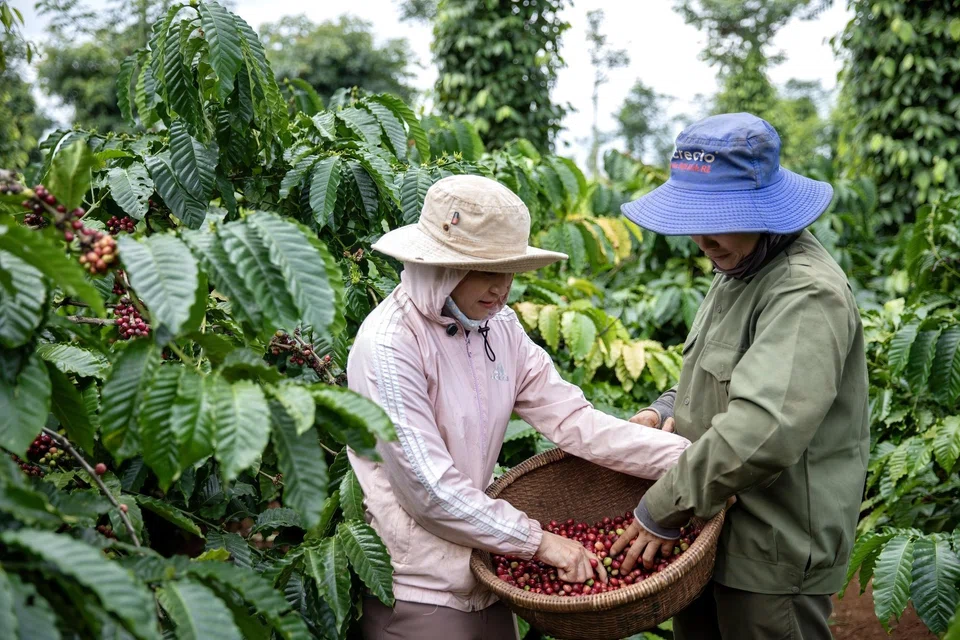
[HONG KONG/HANOI] Major coffee trader ECOM Agroindustrial is pushing for a five-times increase in the number of growers covered by its speciality weather insurance in Vietnam, where the industry depends on thousands of smallholder farmers increasingly exposed to climate risk.
The world’s second-biggest coffee trader is seeking to expand the coverage to 2,500 farmers this year, up from 500, said Laurent Bossolasco, Vietnam-based sustainability manager at ECOM.
The company piloted the parametric insurance programme five years ago, under which payouts are triggered if it rains too much or too little and farmers do not have to provide proof of crop losses.
Vietnam is the world’s largest producer of robusta beans, used in instant coffee and espresso blends, and most of the country’s growers farm relatively modest plots and have limited ability to absorb weather-related disruptions. As climate pressures mount and economic incentives shift, some have diversified into or replaced coffee with crops such as black pepper and durian.
This year, farmers are facing the prospect of a strong El Nino, which is expected to bring heat and dryness to much of South-east Asia, posing a fresh threat to coffee supplies and other crops. The latest seasonal outlooks for Vietnam point to a roughly 50 per cent chance of below-normal rainfall in the key coffee-growing region of the Central Highlands from July to September.
Growers with coverage stand to at least partially recoup losses from adverse weather, helping them avoid starting the next season heavily in debt, a potential “game changer for farmers”, Bossolasco said. “When we look at supply and demand, we have more demand than supply. We need to make sure that we keep as much coffee around.”
Parametric insurance has grown in popularity in recent years as extreme weather disrupts the global economy. Not every risk is well suited for this type of product, but renewable energy firms will use it to manage swings in wind and sunshine, while other companies tap them to protect property and goods from tropical cyclones and floods that disrupt supply chains.
The first payouts under ECOM’s programme were triggered in 2024 after a season impacted by poor rainfall. The following year, growers were hit by torrential rains, and all of the farmers who purchased wet-season coverage received payouts, according to insurance brokerage WTW, which has helped to design the policies that the coffee trader is offering Vietnam’s growers.
Vietnam’s distinct wet and dry seasons and their significant impact on the yield and quality of the country’s coffee crop present a particularly strong use case for parametric products, said Christopher Au, senior director of climate practice and alternative risk transfer solutions at WTW.
SEE ALSO



“They are very distinct risks and they are very closely correlated with weather,” he said. “The parametric application here is quite strong.”
Tran Duc Vinh, a 52-year-old grower from Vietnam’s mountainous Gia Lai province, was among the coffee farmers who received insurance payments following last year’s heavy rains. He purchased a policy covering excessive rainfall for about 200,000 dong (US$7.60) to protect his half-hectare (1.2-acre) farm and received roughly the same amount in a payout, he said.
“The weather has become much more extreme, making farming unsustainable, so I bought parametric insurance to give myself a bit more confidence,” Vinh said. He’s considering buying protection against heavy rains again this year, but forecasts of El Nino mean he’s “not sure it’s worth it”.
Indonesian programme
Working closely with farmers, ECOM has experimented with different insurance designs. For example, growers can pay about US$16 to US$18 per hectare for coverage against extreme precipitation, with payouts of up to US$120 depending on how much rainfall exceeds a predetermined threshold at a given location.
ECOM is also involved in a similar insurance programme in Indonesia, which is seeking to sign up 5,000 arabica coffee farmers this year and 10,000 the next. Just like Vietnam, most growers are smallholders, although the country’s output is modest when compared with major South American producers.
In Vietnam and Indonesia, a government-supported fund finances payouts, with matching reinsurance capacity provided by Hannover Re.
The involvement of a major commercial player will likely help attract private sector money and scale the programmes beyond pilot initiatives, said Kay Tuschen of weather and climate insurance provider CelsiusPro. Its subsidiary, Global Parametrics, manages the UK- and Germany-supported Natural Disaster Fund.
If those programmes are successful, they could serve as a blueprint for ECOM’s operations elsewhere, which include cocoa and cotton, said Bossolasco.
“The sector is facing growing pressures from climate change, rising input costs, volatile markets, labour shortages,” said Bossolasco. Having invested years in working with farmers to improve their climate resilience, including through access to materials and expertise, the question was: “What else we can do if there is a big weather event, in terms of protection?” BLOOMBERG
Decoding Asia newsletter: your guide to navigating Asia in a new global order. Sign up here to get Decoding Asia newsletter. Delivered to your inbox. Free.
Share with us your feedback on BT's products and services
TRENDING NOW

Once staunchly pro-China, Malaysian Chinese businesses are now distancing themselves from Beijing

Looking beyond looming CEO succession, should UOB potentially pursue a transformative merger?

Could stablecoins be the future of money?

Grab CEO’s wife Chloe Tong on life with Anthony Tan and finding her purpose

