

Confusion reigns as Singapore's electricity spot prices spike
Market players are confounded by what could have caused it; consumers may have to brace themselves for relatively higher rates in new contracts

Singapore
SOMETHING peculiar is going down in Singapore's power market. Electricity spot prices have shot through the roof in the last two days, confounding market players. If the trend keeps up, business margins of hard-hit electricity retailers could wither, and consumers could get "bill shocks".
Singapore-based energy broker James Whistler, the global energy head of Simpson Spence Young, told The Business Times: "Spot prices have been extreme."
The surge in electricity prices coincided with a planned "gas curtailment" of 16-20 per cent on Tuesday, which market players were notified about over the weekend, a key executive of a power firm told BT.
But even so, the extent of the price swings in the electricity sector here, which is 95 per cent fuelled by natural gas, has raised eyebrows, not least because of Singapore's robust gas supply infrastructure.
Mr Whistler said: "What we're seeing in the last 48 hours is sustained high prices. That shouldn't happen, really. These events shouldn't really cause this sort of price outcome due to standby-by generation capacity, but for some reason, this capacity doesn't appear to have been scheduled on. This could turn into a bit of a prickly debate."
Many industry players are confused.
A seasoned one among them said: "We don't know what is happening in the market, as generation supply is adequate and the power system has been operating under non-emergency conditions. The root cause of the issue could be related to upstream gas supply, but the generators have ample on-site back-up fuel stocks."
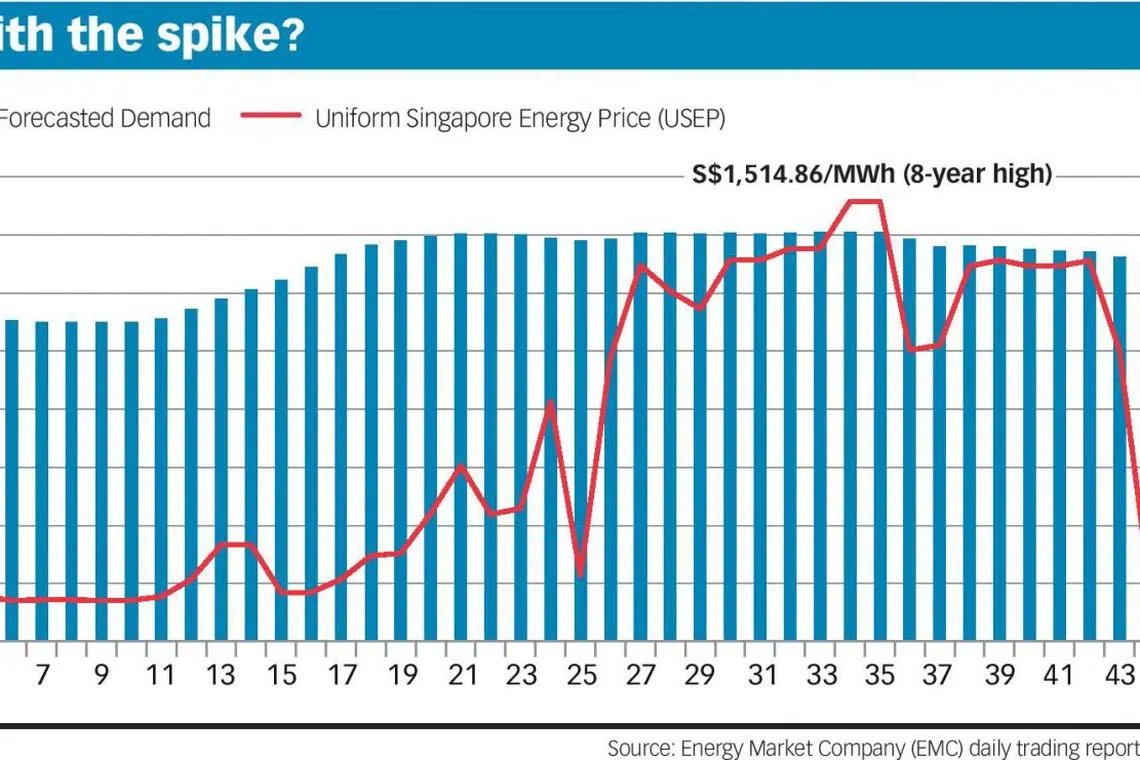
On Tuesday, the Uniform Singapore Energy Price (USEP), which varies half-hourly depending on prevailing conditions in Singapore's wholesale market, spiked abnormally, hitting a multi-year high of S$1,514.86 per MWh (megawatt-hour).
The last time the city state's energy market price shot past S$1,500/MWh was in August 2013, when it hit S$2,788/MWh as a result of tight supply conditions.
The latest two-day surge drove daily USEP average prices four to five times higher, from S$125/MWh in the first 25 days of July, said Henry Gan, senior vice-president of markets and operations of the Energy Market Company (EMC).
He also pointed out that the half-hourly supply cushion had dropped to as low as 14 per cent on Monday and 15.5 per cent the next day.
(The supply cushion is a gauge of supply adequacy in the energy market, and indicates capacity, which was offered but not scheduled and can be called up if necessary. Anything below 20 per cent signifies a supply crunch.)
Volatile prices are common in Singapore's competitive, real-time electricity market, given the shifting demand-supply forces.
However, this week's events could hurt some electricity retailers, chiefly the independent retailers (IRs) who do not generate their own electricity.
The top executive of one of the 12 electricity retailers for the residential segment under Singapore's Open Electricity Market (OEM) said: "As an IR, we buy from the spot market and use electricity futures for hedging purposes. For a retailer that has hedged for the current quarter, the futures will settle in October.
"Prior to October, however, we will settle the wholesale market purchases with EMC daily. The high prices will result in some short-term pain, which our commercial team has to manage."
Unsurprisingly, the unusual volatility has led to a surge in the trading of electricity futures on the Singapore Exchange (SGX), a means for retailers to proactively manage price volatility and risks. SGX's commodities head William Chin said the renewed futures hedging activity saw trading in the quarterly electricity futures (EF) contracts jump to 264 lots, or a total of 190 GWh (gigawatt hours) on Monday and Tuesday alone.
"This was almost the entire volume of the previous week," he said.
Could this spell trouble for the smaller players in Singapore's super-competitive, liberalised electricity sector, which has had at least five players (including Red Dot Power) throw in the towel since the sector's phased liberalisation was completed in 2019?
The chief of a leading retailer replied: "Not really. Hedging tools are available. The opportunity to manage risk via SGX Futures is certainly there for all players.
"So, it depends on the hedging levels of the IRs. Some are likely to be over-hedged and could be making money. What's happening is a physical supply issue ... an opportunistic move by the generation companies arising from the curtailment."
When contacted for comments on the matter, a spokesperson from YTL PowerSeraya, a leading power player, said: "The Singapore electricity wholesale market prices take into account a range of factors, such as system constraint, electricity demand and availability of capacity, to generate the required amount of energy to meet electricity demand. The higher electricity spot prices in recent days were caused by various factors, which include but are not limited to any scheduled upstream gas maintenance."
Electricity consumers, including households, may feel the heat as retailers take into account risk events such as the one playing out now to determine pricing. "It could create new pricing benchmarks for fixed customers upon renewal," said one industry player.
The website of the Energy Market Authority (EMA) says that 49 per cent and 47 per cent of household and business accounts respectively had switched out of SP Services - the incumbent supplier pre-liberalisation - as at end-April. The remaining are still with SP.
SP's market share has shrunk since the opening of the sector as consumers, wowed by the potential savings of 20-30 per cent in their power bills, jumped ship to one of the retailers over its regulated tariff package - the default option for Singapore households that stay with SP.
However, SP does offer a wholesale electricity price (WEP) product that is priced competitively. BT reported two years ago that "a few thousands" had gone with this non-standard price plan that has no contract expiry date. These consumers could feel the pinch from the recent spike as the big downside in SP's wholesale product is the element of uncertainty as the rates paid by consumers are determined by occasionally volatile USEP.
A majority of consumers however are protected from the sharp uptick for now, given their preference for stable fixed-price plans for either six, 12 or 24 months. "We will continue to honour the prices offered to our customers over their contract period," said Dallon Kay, president and chief executive of Diamond Energy.
But for new customers, relatively less attractive prices down the road cannot be ruled out.
Mr Kay added: "We are keeping the option open to evaluate and adjust our pricing if high prices persist in the spot market. A price adjustment, if implemented, would apply for customers that sign up to new contracts."
The EMA said in a statement late on Wednesday: "Singapore imports natural gas from Indonesia and Malaysia via sub-sea pipelines, and Liquefied Natural Gas (LNG) from around the world, via the Singapore Liquefied Natural Gas (SLNG) Terminal for industrial use, including power generation.
Natural gas supply piped from West Natuna, Indonesia to Singapore has been partially curtailed since July 26 due to an incident at an upstream production facility.
"The EMA has worked with the industry, including the power-generation companies, to use available LNG supply to mitigate any impact. Parties are working to end the curtailment as soon as possible.
"We would like to provide assurance that there is sufficient generation capacity and gas supply in the system."
TRENDING NOW

Government to bring forward raising of retirement age, give employers more financial support to create flexi-load jobs

If Europe goes to war, the fallout will be felt in East Asia

Former minister Maliki Osman, Revolut chairman join Asia Gulf Holdings advisory board

Small nuclear reactors could boost the Asean Power Grid: GE Vernova executive

