

Finland works with communities to bury nuclear reactor waste
The Onkalo repository, estimated to cost 3.5b euros, has progressed with local and national support
Olkiluoto Island, Finland
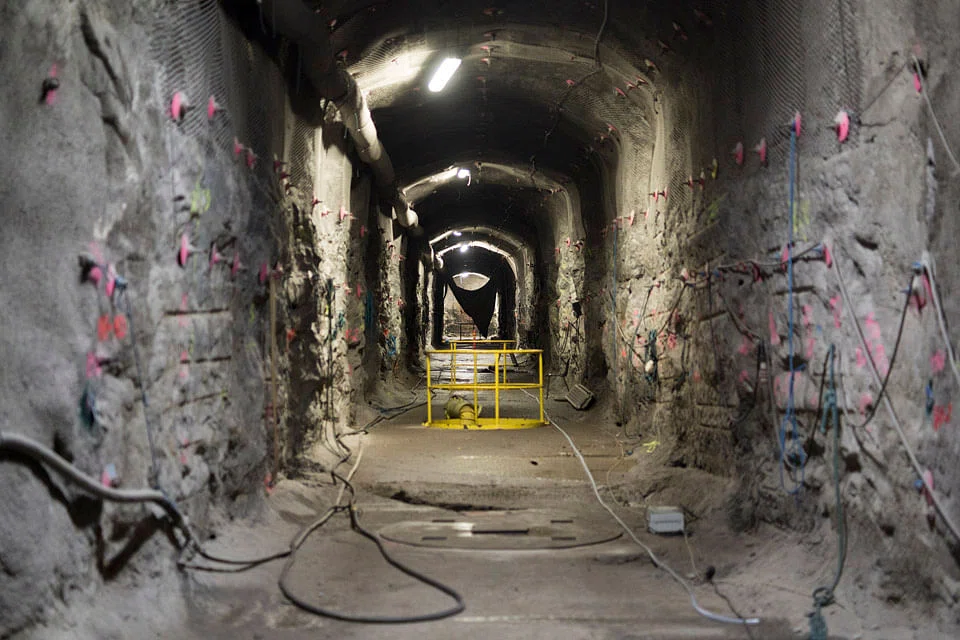
BENEATH a forested patch of land on the Gulf of Bothnia, at the bottom of a steep tunnel that winds for 4.8 kilometres through granite bedrock, Finland is getting ready to entomb its nuclear waste.
If all goes well, some time early in the next decade, the first of what will be nearly 3,000 sealed copper canisters, each up to 5.2 metres long and containing about two tonnes of spent reactor fuel from Finland's nuclear power industry, will be lowered into a vertical borehole in a side tunnel about 426m underground. As more canisters are buried, the holes and tunnels - up to 32 km of them - will be packed with clay and eventually abandoned.
The fuel, which contains plutonium and other products of nuclear fission, will remain radioactive for tens of thousands of years - time enough for a new Ice Age and other epochal events. But between the two-inch-thick copper, the clay and the surrounding ancient granite, officials say, there should be no risk of contamination to future generations.
"We are pretty confident we have done our business right," said Timo Aikas, a former executive with Posiva, the company that runs the project. "It seems the Olkiluoto bedrock is good for safe disposal." The repository, called Onkalo and estimated to cost 3.5 billion euros (S$5.4 billion) over the century or so that it will take to fill it, will be the world's first permanent disposal site for commercial reactor fuel.
With the support of the local municipality and the national government, the project has progressed relatively smoothly for years. That is a marked contrast to similar efforts in other countries, most notably those in the US to create a deep repository in Nevada. The Yucca Mountain project in the Mojave Desert, which would handle spent fuel that is currently stored at 75 reactor sites around the country, faced political opposition from Nevada lawmakers for years and was defunded by the Obama administration in 2012.
Now, with the backing of the nuclear power industry - and with the retirement of Yucca Mountain's chief nemesis, Senator Harry Reid of Nevada - the Trump administration wants to take the project out of mothballs. But its fate remains uncertain.
Experts in nuclear waste management say the success of the Finnish project is due in part to how it was presented to the people who would be most affected by it. Each community under consideration as a repository location was consulted and promised veto power should it be selected.
In the US, Congress in 1987 pre-emptively directed that only the Yucca Mountain be studied as a potential site, effectively overruling opponents in Nevada who were worried that the project might affect water supplies or otherwise contaminate the region.
"When you look at the Finnish repository, it's natural to admire the technical accomplishment," said Rodney C Ewing, a professor at Stanford and former chairman of the Nuclear Waste Technical Review Board, an independent federal agency that reviews Energy Department programmes, including Yucca Mountain. "But of equal importance has been the social accomplishment." Mr Aikas, who was involved in the Finnish site selection process beginning in the 1980s, said he and his colleagues learnt early lessons about the need to consult local residents.
"We ran into difficulties because we tried to behave as industry did back then - we'd decide and announce," he said. Invariably, he said, by presenting decisions as unreviewable, they ran into local opposition.
"Very soon we learnt that we had to be very open," Mr Aikas added. "This openness and transparency creates trust." When five sites were selected for further study in 1987, offices were opened in each community to provide information.
The approach proved so successful that when it came time for the national government to make a final decision on a repository in 2000, officials in Eurajoki, the municipality that includes Olkiluoto Island, agreed to host it on one condition: that Posiva not present the government an option to choose any other site.
Eurajoki officials had concerns early in the process, Mr Aikas said, but eventually came to see that the repository would provide property tax revenue and jobs. The municipality also had experience with nuclear power: two of the country's four operating nuclear power reactors are on Olkiluoto, less than three km from the repository, and a third plant is under construction nearby. "You have a community that is familiar with nuclear issues," said Prof Ewing at Stanford.
Nevada, by contrast, has no nuclear power plants. What it does have is a history of government testing of atomic weapons, both in the air and underground, for four decades until the early 1990s. "You have to expect that a community with that experience will be a little sceptical," Prof Ewing said.
Finland's success also has its roots in an early decision by the national government. In 1983, it established the principle that the companies creating the waste - TVO, which owns the reactors at Olkiluoto, and Fortum Power and Heat, which owns the other two - are responsible for disposing of it. The government had only approval and regulatory roles.
"It has always been important to resolve this spent-fuel issue and keep it in the hands of the power company," Mr Aikas said. Posiva, the company developing the repository, is a joint venture of the two utilities.
In the US, more than 80,000 tonnes of spent fuel are stored on the surface, in pools or dry steel-and-concrete casks, at operating nuclear reactors and at other sites near now-closed plants. The original deadline to have a repository operating by 1998 is long past. NYTIMES






