
TOPLINE

Kim Heng pursues growth in renewable and fossil fuel-linked projects

Chairman and CEO Thomas Tan says the oil and gas industry is now rebounding, while renewable sector growth is still nascent

Tessa Oh
Tessa Oh

Published Mon, Jul 31, 2023 · 05:00 AM
    • Kim Heng is well positioned to fill a gap in South Korea, as the country ramps up investments in offshore wind projects, says chairman and CEO Thomas Tan.
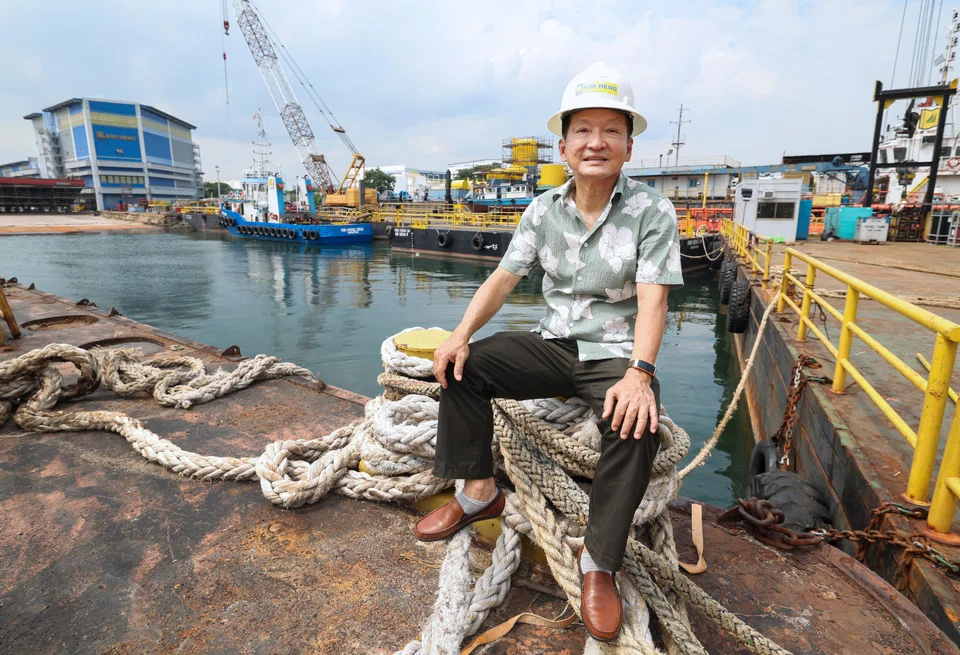
    • Kim Heng is well positioned to fill a gap in South Korea, as the country ramps up investments in offshore wind projects, says chairman and CEO Thomas Tan. PHOTO: YEN MENG JIIN, BT

    KIM Heng is positive on renewables, and has been pursuing new projects in this segment, but it is not giving up on its traditional oil and gas business just yet.

    The offshore marine services contractor is on track for its renewables business to account for half its bottom line by the end of 2024 – or even sooner. This is despite revenue from its renewable energy segment falling 4 per cent to S$9.5 million for the six months ended Dec 31, 2022, due to fewer contracts secured in the offshore windfarm projects in Taiwan.

    Beyond that, however, it is “hard to put a timeline” on how much more the segment could grow in the near-term, its executive chairman and chief executive Thomas Tan told The Business Times.

    This is primarily because the renewables energy industry is still nascent. Many countries do not currently have the infrastructure to support it, he said. “Many countries are not ready yet. It takes a lot of time and investment. Some need huge capital, and who is there to fund it?”

    He pointed out that fossil fuels, on the other hand, are easily available and the industry’s infrastructure is mature. Globally, oil and gas businesses have been recovering, and that oil prices are rising and staying supported.

    While Tan believes the global transition to renewables is inevitable, he does not think it will not happen right away – it could be another decade or two until it overtakes the energy market.

    “The legacy business is still there. We’ll continue to service it to the point where I see there’s no longer any value we can add, or the business is no longer coming into the market; then we will eventually give it up,” he said.

    Kim Heng made an earnest plunge into renewable energy in 2019, by expanding its business operations to include offshore wind-farming solutions and horizontal directional drilling. Revenue from its oil and gas business has been falling substantially, and Tan is looking for new opportunities to tap for the next wave of growth.

    “One of the opportunities we identified was that OSVs (offshore service vessels) will still be needed for offshore and other marine projects, such as those in renewables. So our vision is to pivot and diversify while others are busy doing a lot of restructuring,” said Tan.

    Since then, Kim Heng has revamped and reskilled its workforce, and secured several critical contracts in this segment.

    In 2021, it was awarded a turnkey contract for the lifting and installation of wind turbines in Vietnam. The following year, it clinched a contract to provide design, engineering and drilling equipment for the installation of pipe conduits for an offshore wind-farm project in Taiwan.

    Also in 2022, Kim Heng entered into a non-binding Memorandum of Understanding (MOU) with US-based Crowley Wind Services for offshore wind farm cable-laying and installation projects along the east cost of the United States.

    Turning the tide

    For the half-year ended Dec 31, 2022, Kim Heng swung into the black with S$3.6 million net profit. It had reported a net loss of S$1.7 million in the period in the year before. Revenue for the six months rose 44 per cent to S$49.4 million, from S$34.3 million in the previous corresponding period.

    The stock has turned around too, rising 2.1 per cent this year to close at S$0.099 on Friday (Jul 28). The counter fell to as low as S$0.02 in 2020 as the pandemic took its toll.

    Kim Heng now has a market capitalisation of S$69.6 million, and trades at 9.5 times its historical earnings. It has a historical dividend yield of 2.9 per cent.

    Tan said the positive results came from the company’s decision in 2017 to acquire offshore vessels at deep discounts and put them to work. “We also repurposed and modified the vessels, which generated substantial revenue once we put them to work,” he added.

    Pent-up demand over the pandemic for marine offshore services also contributed to the good result.

    Kim Heng’s marine construction segment contributed S$10.8 million in revenue for the six months, from the S$1.7 million recorded previously, due to an increase in modification and fabrication works related to vessels.

    Its oilfield services segment’s revenue went up by 59 per cent to S$12.4 million, mainly due to higher material sales and the securing and completion of several projects following the easing of Covid-19 safe-management measures.

    Revenue generated from the chartering of vessels grew 12 per cent to S$16.6 million due to improvements in the utilisation and daily charter rates for the anchor-handling tug supply and anchor-handling tug vessels.

    While Tan believes the offshore marine industry is in a good place, he remains cautious due to the “undercurrent of uncertainty” amid global macroeconomic headwinds. In the near term, he plans to focus on expanding the business in areas where it is strong.

    In June, Kim Heng signed a non-binding MOU with offshore global solution provider Kom to work together on offshore windfarm projects and other offshore projects in South Korea – marking the company’s first foray into one of the world’s largest marine markets.

    Asked about Kim Heng’s prospects in South Korea, Tan said as the country ramps up investments in offshore wind projects, there will be a short supply of expertise, vessels and equipment in the next two years. Kim Heng is “well positioned” to fill this gap, he said.



