

Livestock industry needs to do more on methane: investor group
 Add BT as a preferred source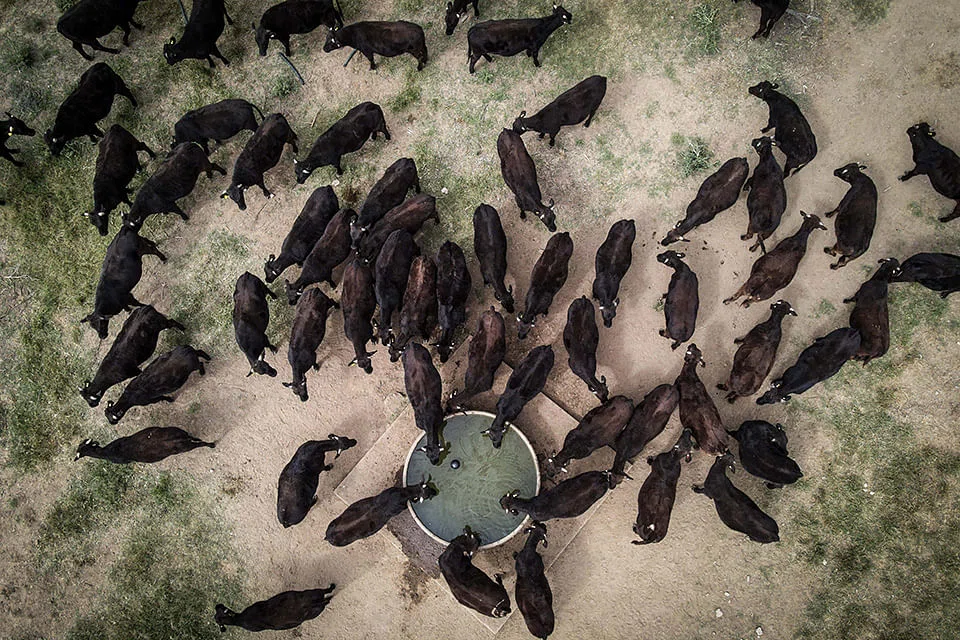
DeeperDive is a beta AI feature. Refer to full articles for the facts.
London
A GLOBAL push to cut methane emissions and end deforestation is at risk of being held back by weak corporate efforts in the livestock industry, an investor group said on Wednesday (Dec 1).
More than 100 countries pledged to cut methane emissions by 30 per cent as well as to halt and reverse deforestation by 2030 at the 2021 United Nations Climate Change Conference (COP26), much of which will need to come from the livestock industry.
The United Nations (UN) food agency said livestock accounts for 44 per cent of man-made methane.
Yet less than a fifth of the world's biggest livestock producers currently measure even some of their emissions, showed a report from the FAIRR Initiative (FI), whose members manage more than US$45 trillion in assets.
"As the largest driver of both methane from human activity and deforestation, the ambitions set at COP26 handed a big slice of responsibility to the food and agriculture sector," said FI chair Jeremy Coller.
Navigate Asia in
a new global order
Get the insights delivered to your inbox.
"Yet failures from methane to manure management underline the growing sense in the market that cows are the new coal."
In its fourth annual report, the group assessed 60 publicly listed animal protein producers worth a combined US$363 billion on 10 environmental, social and governance-related issues including emissions and antibiotic usage.
Among those to score highly in the assessment were Norwegian aquaculture firms Mowi ASA and Grieg Seafood, while the highest-ranking meat and dairy companies were Maple Leaf, Marfrig, and Fonterra, all of which were defined as "low risk".
Fellow large producers including the world's biggest meatpacker JBS SA and Tyson Foods, meanwhile, were regarded as "medium risk", the report said.
JBS dropped points for reasons including its reporting on animal welfare and employee working conditions, while Tyson was marked down for reasons including that some of its sourcing is from regions at risk of deforestation, FAIRR said.
JBS and Tyson were not immediately available to comment when contacted by Reuters.
The group makes the findings public so other investors can use them when they analyse company performance and in their engagement with company boards.
The report also found that 42 of 45 meat and dairy firms which source soya for animal feed from areas at high risk of deforestation, such as Brazil's Cerrado region, do not have a policy to mitigate deforestation.
The cattle industry has also done a poor job in monitoring its broader supply chain, the report said, and is currently missing up to 90 per cent of the deforestation caused by indirect suppliers.
Nearly a third of the cattle bought by JBS in the Brazilian Amazon state of Para came from ranches with "irregularities" such as illegal deforestation, prosecutors found in a 2020 audit.
"The science is clear that to avoid runaway climate change, high-emitting sectors such as agriculture must transform themselves in the next decade," said Eugenie Mathieu, senior analyst at Aviva investors.
"Yet FAIRR's latest research shows how far the food sector has to go." REUTERS
Decoding Asia newsletter: your guide to navigating Asia in a new global order. Sign up here to get Decoding Asia newsletter. Delivered to your inbox. Free.
Share with us your feedback on BT's products and services
TRENDING NOW
Air India asks Tata, Singapore Airlines for funds after US$2.4 billion loss

Beijing’s calculated silence on the Iran war

China pips the US if Asean is forced to choose, but analysts warn against reading it like a sports result

Richard Eu on how core values, customers keep Singapore’s TCM chain Eu Yan Sang relevant

