

New York turning food waste into compost, gas
The city has started collecting organic waste from households, drop-off sites in multimillion-dollar campaign
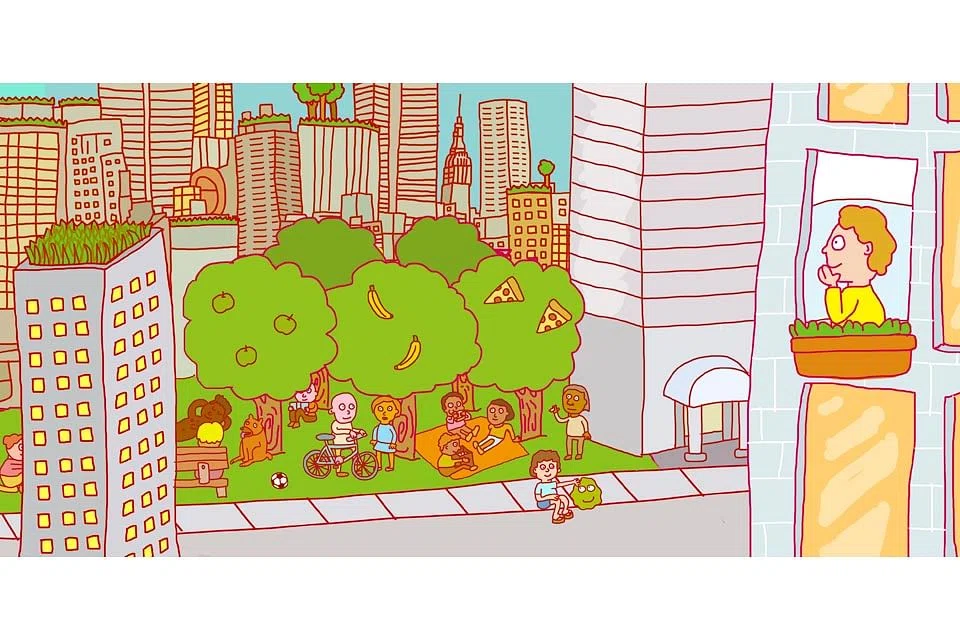
New York
NEW YORKERS already have blue and green bins for recycling glass, metal, paper and plastic. But now brown bins for organic waste are starting to appear all over the city. These plastic totems are part of the city's multimillion-dollar campaign to cut down on greenhouse gas emissions and reliance on landfills, and to turn food scraps and yard waste into compost and, soon, clean energy.
In the 19th century, the city had a simple method for dealing with organic rubbish: It enlisted scavenging swine to nose through the gutters for leftovers. Now, the city is employing the primal chemistry of decay.
About 14 million tonnes of waste are thrown out each year. It costs the city almost US$400 million annually just to ship what it collects from homes, schools and government buildings (by rail, barge or truck) to incinerators or landfills as far away as South Carolina. (In addition, dozens of private companies put trucks on the road to take away refuse from office buildings and businesses.)
The largest single portion of the trash heap is organics, or things that were once living. That apple core, that untouched macaroni salad, that slice of pizza and the greasy paper plate it was served on are heavy with moisture, which makes shipping expensive. As they decompose, they release methane, a greenhouse gas.
Former Mayor Michael R Bloomberg declared food waste the "final recycling frontier" when his administration began its ambitious curbside programme in 2013 as the linchpin of the city's sustainability goals.
That effort has continued under Mayor Bill de Blasio, and the project is on the verge of an expansion that could change how all New Yorkers deal with refuse, and test the city's ability to manage organic materials on a scale never seen in the United States.
Smaller cities like Portland, Oregon; San Francisco; and Seattle all have mandatory programmes. But the population of those three places combined is smaller than Brooklyn or Queens alone.
New York's residential organics collection programme is already the largest in the country: More than one million residents in parts of all five boroughs have curbside service. By the end of next year, officials say, all city residents will have a way to recycle their food scraps and other leaf and yard waste.
On her first day as sanitation commissioner, in 2014, Kathryn Garcia said that she wanted her agency to lead the nation in organics recycling. While businesses are gearing up to use machinery and technologies that will turn food waste into new products, the department has to make sure there are enough facilities (and willing neighbours) to accommodate and sort tens of thousands of tons of putrescible materials.
So how will it work?
"Without the citizenry of New York, I don't think our team could have gotten our programme off the ground," said Ron Gonen, the city's deputy commissioner of recycling and sustainability during the Bloomberg administration.
To persuade skeptical city officials that New Yorkers would participate, he pointed to the tens of thousands of people already hauling leftovers to collection points in vacant lots, community gardens and farmers' markets, set up by pioneering composters and groups like the Lower East Side Ecology Centre.
In 2013, the city began handing out countertop buckets and large outdoor rolling bins made with thick, chew-resistant plastic and raccoon-proof lids to about 3,000 households on Staten Island.
Last year, about 23,000 tonnes of orange peels, apple cores and other organic materials were collected from about 300,000 households, 722 schools, 50 agencies and institutions and 80 drop-off points, according to the city. That means about 2 per cent of the organic waste collected by the city was diverted from landfills.
The programme was adopted in neighbourhoods like Park Slope, Brooklyn, with little resistance. But wooing the managers of tall buildings hasn't been as easy. The trash rooms of large buildings require reorganisation and new routines to accommodate organics collection. Porters must carry extra bins to the curb. So far, 774 apartment buildings have signed up, a small fraction of the city's high-rises.
Stuyvesant Town-Peter Cooper Village, the 110-building complex on the East Side of Manhattan that is home to 27,000 people, has signed on. Its management company leveraged the enthusiasm of committed composters and campaigned residents with text messages and emails emphasising that pest activity would not increase.
Not everyone will have trucks pick up their food scraps or dead leaves at the curbside by the end of next year, especially those in densely populated neighbourhoods of Manhattan and the Bronx, unless their building owners apply for the programme. To reach those sections, the city is expanding the number of drop-off sites, especially in high-traffic areas near subway stations. It is also experimenting with bin-sharing programmes and partnerships with libraries and local businesses willing to adopt containers.
The earth has been recycling organics for billions of years. But according to Jean Bonhotal, the director of the Cornell Waste Management Institute, humans have interrupted that circular system by entombing valuable nutrients in landfills and relying on chemical fertilisers.
"Our soils, really, in the whole world, are pretty trashed," Ms Bonhotal said.
Paradoxically, for nature to retake its course, human intervention is required. After organics are tossed in the back of a city truck, they are driven to a waste transfer station operated by a private company. (Staten Island's scraps are taken directly to a composting site in Fresh Kills.) The compostables, which often arrive in plastic bags, are then separated from contaminants before being transported to a composting site or an anaerobic digestion facility, ideally no more than 100 miles away.
Robert Buffolino, the general manager at American Recycling Management, one of six companies paid by the city to manage the bulk of the compostables, has seen all manner of inorganic material come through: pencils, water bottles, phones, even a computer. Schools especially, he said, need to educate their students about what goes in the bin.
"They still have some work to do with that," he said.
Even utensils and plates marketed as "biodegradable" don't always break down as advertised. Instead of using fingers and rakes to remove unwanted materials, the city now uses expensive machines to pulverise the material and separate plastics with paddles and centrifuges.
Composting facilities may reject a whole truckload if it isn't clean enough, sending it to a landfill. There is also the critical question of whether there are enough facilities to process the waste, clean or not.
"There's definitely enough capacity for what's collected now," Ms Garcia, the sanitation commissioner, said. "The challenge is moving the programme rapidly, but not overwhelming the processing capacity in the region," she added. "The state does not have unlimited capacity yet." The city has only two composting sites that can handle food waste. One is at the jail complex on Rikers Island, and the other is in Fresh Kills, what used to be city's largest dumping ground.
The majority of the city's organics will be sent to private facilities in the region. Hauling companies pay composting sites a so-called tipping fee to take in and process materials. For now, about 10 facilities take in the city's scraps, and the Sanitation Department is meeting with other sites that could assist in the coming year.
Finding enough land far enough from neighbours but close enough to the city is one challenge. And many private composting sites are accustomed to processing farm waste like rotting vegetables, which is somewhat different from handling the Chinese takeout and fettuccine Alfredo that city dwellers toss.
The State Department of Environmental Conservation, which regulates organic recycling facilities, said that by the end of the year, new regulations would allow existing facilities to take in more food scraps.
While the government is counting on private industry to build and operate the processing infrastructure, businesses are reluctant to go into debt without an assured flow of material, said Brian Fleury, a vice-president of WeCare Organics, which manages the city's Staten Island composting site. "They can't guarantee a voluntary programme," Mr Fleury said.
McEnroe Organic Farm in the Hudson Valley, about 160 kilometres north of the city, is the largest recipient of the city's feedstock. More than half of the approximately 12,000 cubic metres of finished compost it makes a year is reused on its own crop beds, and the rest is sold for about US$60 per cubic metre to farmers and home gardening stores on the East Coast.
The challenges ahead are similar to the ones that recyclers of metals, glass and plastic have confronted over the past three decades: Will residents properly sort their food scraps? Can processors sufficiently clean up what is collected? And will compost be treated as a valuable commodity?
It might sound like Doc Brown's harebrained scheme to power his DeLorean time machine in Back to the Future, but using leftovers to create energy is now commonplace in Europe. And cities across the US are following suit, including New York.
Brian Paganini, a vice-president of Quantum Biopower, which recently opened a US$14 million facility in Southington, Connecticut, said anaerobic digestion was "the next revolution in recycling". Quantum is one of several companies looking at the city's feedstock.
One upside is that digesters occupy a much smaller footprint than composting fields. But the initial capital costs are much greater. The remaining solids must also be processed or discarded. And like human stomachs, digesters can get upset. It can take several months to calibrate the mix of microorganisms that will break down organics.
"You can't feed a baby French fries on Day 1," Mr Paganini said.
Instead of relying on private developers to build new facilities for the digesters, cities are adapting existing infrastructure: wastewater treatment facilities.
In a testing programme that began in 2012, the city is adding commercial food waste to some of the tanks at the Newtown Creek Wastewater Treatment Plant in Brooklyn, to generate higher levels of methane gas, a byproduct of wastewater treatment.
Since the pilot began, the plant's biogas production has increased by as much as 17 per cent, according to the city's Department of Environmental Protection.
For now, most of that biogas is simply burned off, or flared, though some helps heat the plant's boilers, said Pam Elardo, a deputy commissioner for the department. (While wasteful, excess methane must be flared for safety reasons and to reduce fugitive methane, a greenhouse gas.) To create usable methane, the utility National Grid plans to build a US$30 million system for the plant, which will essentially squeeze out water vapor and carbon dioxide, as well as filter out chemicals and conditioners flushed into the sewer system.
A small group of National Grid customers could be warming their homes with gas made from the plant by the first cold day near the end of next year, the company said.
For now, only a small portion of the city's food waste is converted into biogas. But there may come a day when sanitation vehicles pick up our leftovers, drive to one of the city's 14 wastewater treatment plants, process the organics for digestion, then drive a few yards to refuel with compressed gas. NYTIMES






