

Not-so-sweet deal for Singapore’s refineries as they shift to US, alternative crudes
Variations in density and sulphur content present compatibility challenges
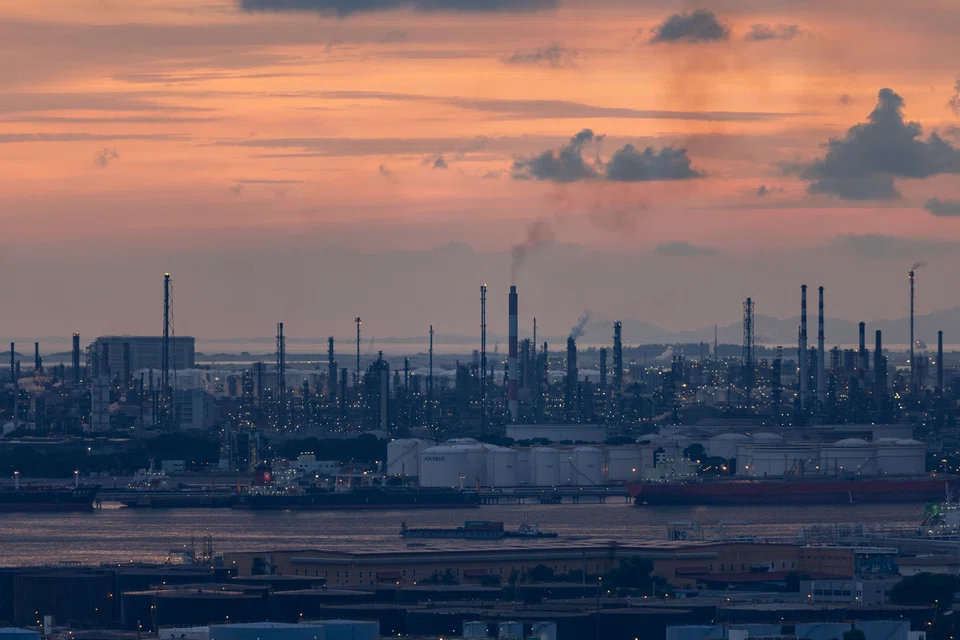
[SINGAPORE] The Republic’s refineries face weaker margins and reduced efficiency as they pivot to alternative crude oil feedstocks from the Americas and West Africa to offset disruptions arising from the Middle East conflict.
While the delivered cost per barrel of light-sweet West Texas Intermediate crude from the US to Singapore currently undercuts the cost of heavier Middle Eastern grades such as Omani crude, “a one-for-one swap isn’t feasible”, said Wang Zhuwei, director of global oil trading research at S&P Global.
This is because Singapore’s refineries are largely tailored to process a medium-sour oil mix.
Crude is categorised by two factors: its density – light, medium or heavy – and its sulphur content, with lower levels deemed sweet and higher levels known as sour.
Despite this, players in the Republic are increasingly turning to more expensive light-sweet West African crude.
“It is a ‘no-choice’ option to keep the refinery running,” said June Goh, senior oil market analyst at Sparta Commodities.
The shift in crude diet is already affecting operations.
Xavier Tang, senior market analyst at Vortexa, pointed out that after ExxonMobil upgraded its refinery in May 2025, it ceased light-sweet crude imports at its very large crude carrier terminal.
However, amid the Middle East conflict, the refinery has purchased light-sweet crude to partially fill the supply gap, he noted, adding that ExxonMobil will likely reduce operating rates at its secondary units with the lighter crude oil mix.
SEE ALSO





Wang of S&P Global noted that Middle Eastern crude accounts for roughly 70 per cent of Singapore’s oil mix, up from around 50 per cent in 2024.
The remaining 30 per cent is split between regional sources – such as Malaysian Tapis, Indonesian and Vietnamese grades, and Australian condensates – and international barrels from West Africa, Russia and occasionally the US and Latin America, he added.
With the current supply-chain disruptions, Sparta’s Goh estimates that refineries here can switch out between 15 and 30 per cent of their feeds to alternative barrels, but “will not be able to run optimally” with the change in diet.
As a result, base oil and bitumen production will be affected, and the yields of diesel and fuel oil will be lower, she noted.
Two of Singapore’s three refineries have declared force majeure on bitumen, a key material used in road construction.
Beyond the substitution threshold, Wang noted that Middle Eastern crude becomes “very hard to replace (in the) short term”.
“(This) is why Singapore refiners are responding with run cuts, product export restrictions, and willingness to pay high premiums for Middle East barrels that do clear Hormuz, rather than a pure crude swap,” he said.
How about Canadian heavy crude?
Canadian heavy crude has emerged as another lifeline and diversification strategy for Singapore’s refineries.
However, Goh flagged that because it has a higher sulphur content than Middle Eastern crude, there is a limit to how much Singapore’s refineries can process.
Barrett Bingley, Asia regional director at the Asia Pacific Foundation of Canada, said that blending Canadian heavy crude into Middle Eastern grades is a “very real option” for ExxonMobil’s refinery in Singapore.
“(In the) immediate term, blends of up to 10 to 15 per cent would be possible, most likely Cold Lake, Pacific Cold Lake and Fort Hills Reduced Carbon Lifecycles Dilbit,” he noted.
Bingley said that Singapore Refining Company on Jurong Island can handle such blends, as well as other Canadian grades such as Borealis Heavy and Hangingstone Dilbit, provided that technical elements – for instance, diluted bitumen residue – are carefully managed.
Meanwhile, Aster’s refinery at Bukom “likely will not be able to take Canadian oil as (it) is”.
If Singapore is looking to diversify its crude supply, the government could incentivise one of its three main refineries to invest in upgrades to process Canadian heavy-sour crude without blending, Bingley added.
Ripple effects
Given the unstable energy flows from the Middle East, analysts noted the spillover effects of the region’s shifting crude mix.
“The lighter diet among refineries will also mean lower diesel production, at a point in time when the region needs this fuel the most,” said Goh.
“This would translate into significantly higher diesel prices for longer – to the detriment of many industries that rely on this fuel.”
Meanwhile, S&P Global’s Wang noted that while freight rates between the Middle East and Asia have come off their peaks, they remain “well above” pre-conflict levels due to war-risk premiums.
“Tightness in global product markets is likely to continue through the second half of 2026, driven by upstream infrastructure damage and ongoing downstream production cuts,” he said.
More broadly, Tang of Vortexa noted that the impact is more severe for industries that consume diesel and jet fuel, as the shortage in middle distillate production is “more pronounced” than for other oil products such as petrol and naphtha.
“The impact has already reverberated throughout Asia, with higher oil product prices seen across various industries,” he said.
Decoding Asia newsletter: your guide to navigating Asia in a new global order. Sign up here to get Decoding Asia newsletter. Delivered to your inbox. Free.
Copyright SPH Media. All rights reserved.
TRENDING NOW

DBS, OCBC, UOB rout lops billions off STI as inflation, rate concerns spook investors

Grab CEO’s wife Chloe Tong on life with Anthony Tan and finding her purpose

OCBC sheds S$8 billion in value as shares close nearly 6% down; analysts cautious on banks

Deal between tycoon friends sparks scrutiny of Philippine power sector

