Panic buying leaves up to 90% of fuel pumps dry in major British cities
 Add BT as a preferred source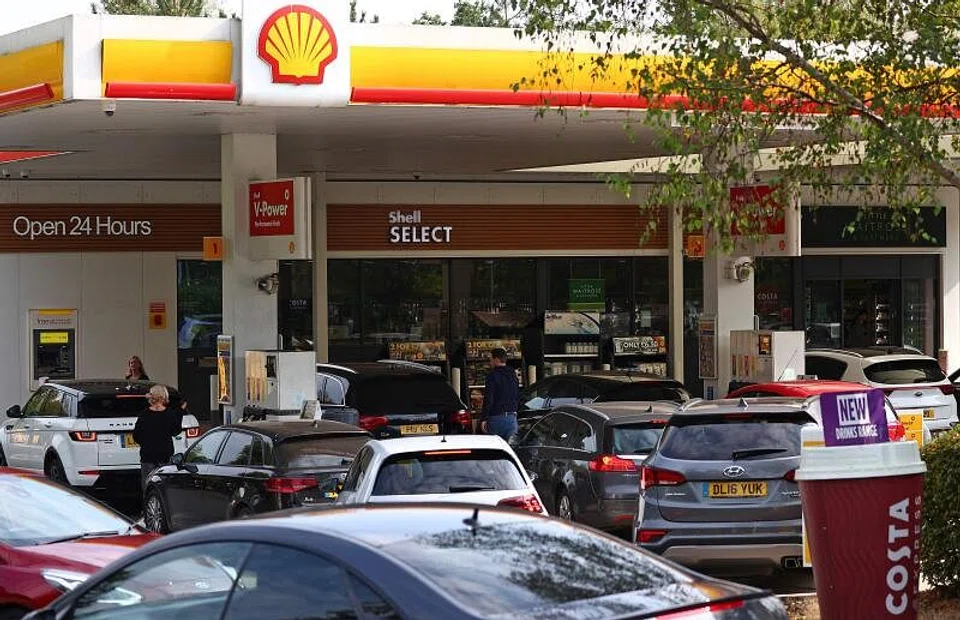
DeeperDive is a beta AI feature. Refer to full articles for the facts.
[LONDON] Up to 90 per cent of British fuel stations ran dry across major English cities on Monday, after panic buying deepened a supply-chain crisis triggered by a shortage of truckers that retailers are warning could batter the world's fifth-largest economy.
A dire post-Brexit shortage of lorry drivers emerging after the Covid-19 pandemic has sown chaos through British supply chains in everything from food to fuel, raising the spectre of disruptions and price rises in the run up to Christmas.
Just days after Prime Minister Boris Johnson's government spent millions of pounds to avert a food shortage due to a spike in prices for natural gas, the biggest cost in fertiliser production, ministers asked people to refrain from panic buying.
But queues of dozens of cars snaked back from petrol stations across the country on Sunday, swallowing up supplies and forcing many gas stations to simply close. Pumps across British cities were either closed or had signs saying fuel was unavailable on Monday, Reuters reporters said.
The Petrol Retailers Association (PRA), which represents independent fuel retailers which now account for 65 per cent of all UK forecourts, said members had reported that 50 per cent to 90 per cent of pumps were dry in some areas.
"We are unfortunately seeing panic buying of fuel in many areas of the country," Gordon Balmer, executive director of the PRA, who worked for BP for 30 years, told Reuters. "We need some calm," he said. "Please don't panic buy: if people drain the network, then it becomes a self-fulfilling prophecy."
Navigate Asia in
a new global order
Get the insights delivered to your inbox.
Environment Secretary George Eustice said there was no shortage of fuel, urged people to stop panic buying and said there were no plans to get the army to drive trucks, though the Ministry of Defence would help with trucker testing.
Hauliers, gas stations and retailers warned that there were no quick fixes, however, as the shortfall of truck drivers - estimated to be around 100,000 - was so acute, and because transporting fuel demands additional training and licensing.
For months, supermarkets, processors and farmers have warned that a shortage of heavy goods vehicle (HGV) drivers was straining supply chains to breaking point - making it harder to get goods onto shelves.
Amid warnings of a dire winter ahead, some politicians in the European Union linked the supply chain stress to the 2016 Brexit referendum and Britain's subsequent decision to seek a distant relationship with the bloc.
Olaf Scholz, the Social Democrat candidate to succeed Angela Merkel as German chancellor, said: "The free movement of labour is part of the European Union, and we tried very hard to convince the British not to leave the Union. They decided differently. I hope they will manage the problems coming from that."
British ministers have insisted that Brexit has nothing to do with the current trucker shortage, though around 25,000 truckers returned to Europe before Brexit. Britain was also unable to test 40,000 drivers during Covid-19 lockdowns.
The government on Sunday announced a plan to issue temporary visas for 5,000 foreign truck drivers.
Edwin Atema, the head of research and enforcement at the Netherlands-based FNV union, told the BBC that EU drivers were unlikely to flock to Britain given the conditions on offer. "The EU workers we speak to will not go to the UK for a short-term visa to help UK out of the s*** they created themselves," she said.
REUTERS
Decoding Asia newsletter: your guide to navigating Asia in a new global order. Sign up here to get Decoding Asia newsletter. Delivered to your inbox. Free.
Share with us your feedback on BT's products and services