

Russia agrees with four nations to divide resources beneath Caspian Sea
 Add BT as a preferred source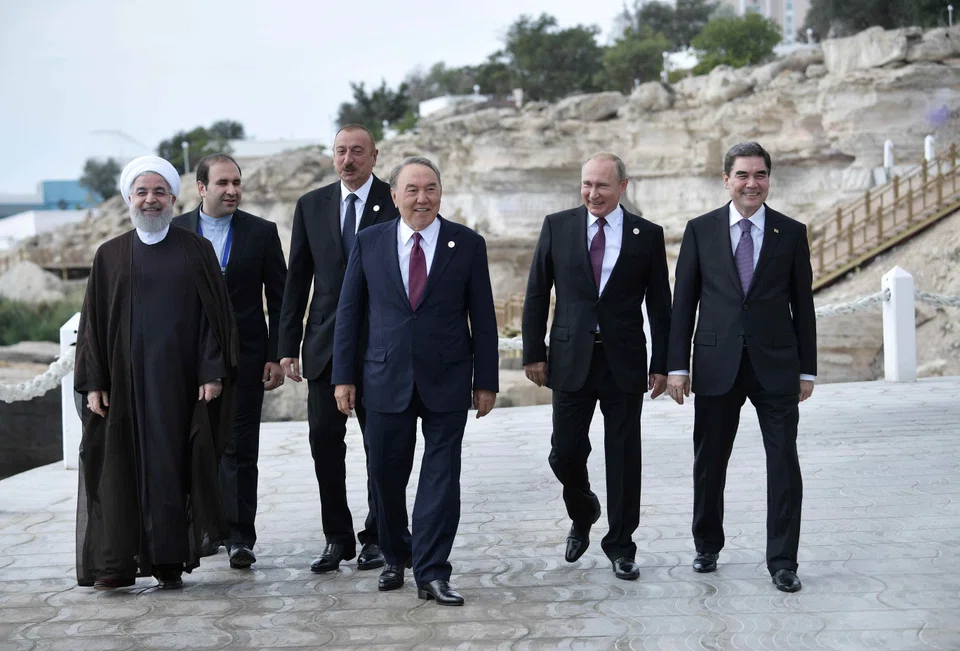
[MOSCOW] The five countries with shorelines on the Caspian Sea agreed Sunday to a formula for dividing up the world's largest inland body of water and its potentially vast oil and gas resources.
The leaders of Russia, Iran, Kazakhstan, Azerbaijan and Turkmenistan signed the Convention on the Legal Status of the Caspian Sea, which the Kremlin said in a statement "reflected a balance of interests" of the seashore nations.
Landlocked and less salty than an ocean, the Caspian Sea was regarded by Iran and the Soviet Union - until the Soviet collapse - as a lake, with a border neatly dividing the two countries' territories.
But when new bordering nations emerged, they sought either their own zones of Caspian territory or a new approach to governing the sea that would classify it as international water with territorial zones and neutral areas.
The pact signed at a summit in Kazakhstan on Sunday takes both approaches in a compromise treating the surface as international water and dividing the seabed into territorial zones.
Iran's president, Hassan Rouhani, told reporters, however, that dividing the seabed's mineral wealth would require additional agreements.
Russia, the sea's main naval power, had opposed splitting the Caspian into national territories that would have confined its own navy to a northwestern corner. The country has launched missiles from its Caspian Sea fleet to strike targets in Syria, flies over the sea to reach Syria, and analysts say, never had the intention of surrendering its military dominance.
The agreement says no country without Caspian shoreline can deploy military vessels in the sea.
Sunday's agreement potentially opens the sea for underwater oil and natural gas pipelines, which Russia had opposed, ostensibly on environmental grounds, though it has built such pipes in the Black and Baltic seas.
Only nations whose seabed territories are crossed by the pipelines would have to agree to lay the new pipelines, the convention says, though all five states could have a say on environmental protections. A proposed trans-Caspian oil pipeline could ease exports from the Kashagan oil field in Kazakhstan, which is managed by Exxon.
NYTimes
Share with us your feedback on BT's products and services
TRENDING NOW

CSE Global independent director quits after clashes with chairman Eugene Lai over board refresh

‘I felt like dying’: Thai Singha beer scion speaks up after disclosure of alleged sexual abuse
Abandoned ‘Titanic’, failing ‘ancient towns’: Why China’s tourism boom leaves white elephants behind

Cat A COE rate exceeds Cat B for third time in 4 months; premiums largely down

